
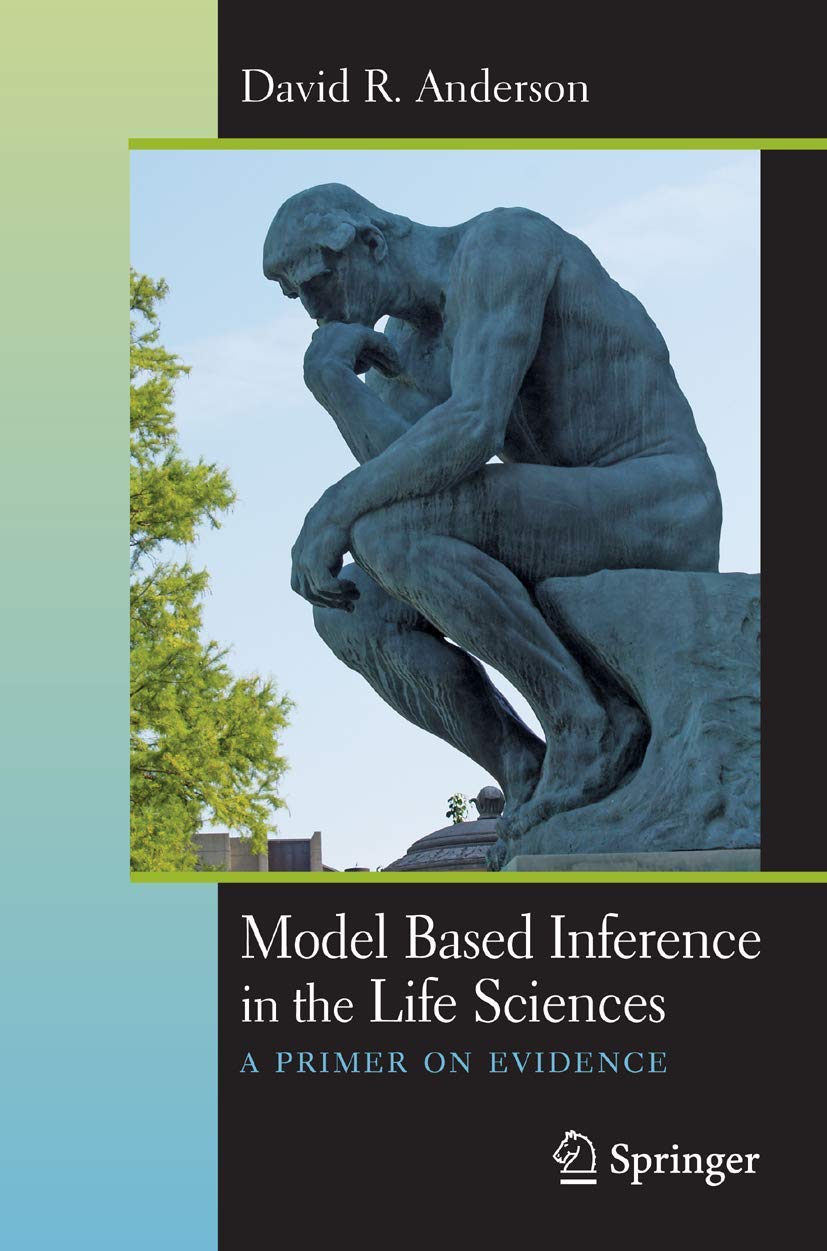
Title
Model Based Inference in the Life Sciences: A Primer on Evidence,New
Sold by Ergodebooks, an authorized reseller.
Returns accepted within 30 days | support@ergodebooks.com
Shipping Information
- Free Standard Shipping — United States only
- Processing Time: 3–5 business days
- Estimated Delivery: 6–10 business days after dispatch
- Double-boxed, fully insured & discreetly packaged
- Tracking number sent via email once dispatched
Returns & Refund
Returns accepted within 30 days of delivery.
Damaged or Defective Item
Free return shipping + replacement or full refund
Wrong Item Received
Free return shipping + replacement or full refund
Change of Mind
Return shipping at customer's expense · 25% restocking fee applies
Payment Option

The abstract concept of information can be quantified and this has led to many important advances in the analysis of data in the empirical sciences. This text focuses on a science philosophy based on multiple working hypotheses and statistical models to represent them. The fundamental science question relates to the empirical evidence for hypotheses in this seta formal strength of evidence. KullbackLeibler information is the information lost when a model is used to approximate full reality. Hirotugu Akaike found a link between KL information (a cornerstone of information theory) and the maximized loglikelihood (a cornerstone of mathematical statistics). This combination has become the basis for a new paradigm in model based inference. The text advocates formal inference from all the hypotheses/models in the a priori setmultimodel inference.This compelling approach allows a simple ranking of the science hypothesis and their models. Simple methods are introduced for computing the likelihood of model i, given the data; the probability of model i, given the data; and evidence ratios. These quantities represent a formal strength of evidence and are easy to compute and understand, given the estimated model parameters and associated quantities (e.g., residual sum of squares, maximized loglikelihood, and covariance matrices). Additional forms of multimodel inference include model averaging, unconditional variances, and ways to rank the relative importance of predictor variables.This textbook is written for people new to the informationtheoretic approaches to statistical inference, whether graduate students, postdocs, or professionals in various universities, agencies or institutes. Readers are expected to have a background in general statistical principles, regression analysis, and some exposure to likelihood methods. This is not an elementary text as it assumes reasonable competence in modeling and parameterestimation.
⚠️ WARNING (California Proposition 65):
This product may contain chemicals known to the State of California to cause cancer, birth defects, or other reproductive harm.
For more information, please visit www.P65Warnings.ca.gov.