
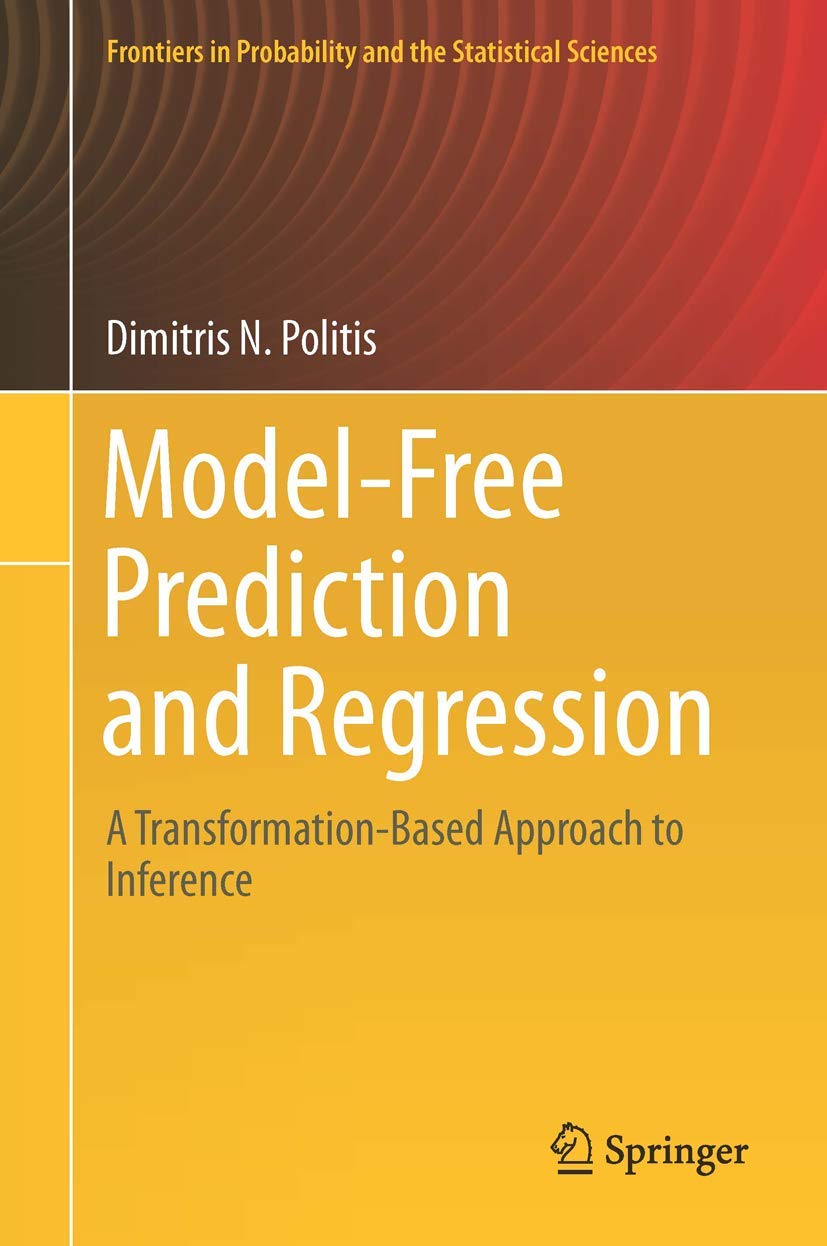
Title
ModelFree Prediction and Regression: A TransformationBased Approach to Inference (Frontiers in Probability and the Statistical,Used
Sold by Ergodebooks, an authorized reseller.
Returns accepted within 30 days | support@ergodebooks.com
Shipping Information
- Free Standard Shipping — United States only
- Processing Time: 3–5 business days
- Estimated Delivery: 6–10 business days after dispatch
- Double-boxed, fully insured & discreetly packaged
- Tracking number sent via email once dispatched
Returns & Refund
Returns accepted within 30 days of delivery.
Damaged or Defective Item
Free return shipping + replacement or full refund
Wrong Item Received
Free return shipping + replacement or full refund
Change of Mind
Return shipping at customer's expense · 25% restocking fee applies
Payment Option

The ModelFree Prediction Principle expounded upon in this monograph is based on the simple notion of transforming a complex dataset to one that is easier to work with, e.g., i.i.d. or Gaussian. As such, it restores the emphasis on observable quantities, i.e., current and future data, as opposed to unobservable model parameters and estimates thereof, and yields optimal predictors in diverse settings such as regression and time series. Furthermore, the ModelFree Bootstrap takes us beyond point prediction in order to construct frequentist prediction intervals without resort to unrealistic assumptions such as normality.Prediction has been traditionally approached via a modelbased paradigm, i.e., (a) fit a model to the data at hand, and (b) use the fitted model to extrapolate/predict future data. Due to both mathematical and computational constraints, 20th century statistical practice focused mostly on parametric models. Fortunately, with the advent of widely accessible powerful computing in the late 1970s, computerintensive methods such as the bootstrap and crossvalidation freed practitioners from the limitations of parametric models, and paved the way towards the big data' era of the 21st century. Nonetheless, there is a further step one may take, i.e., going beyond even nonparametric models; this is where the ModelFree Prediction Principle is useful.Interestingly, being able to predict a response variable Y associated with a regressor variable X taking on any possible value seems to inadvertently also achieve the main goal of modeling, i.e., trying to describe how Y depends on X. Hence, as prediction can be treated as a byproduct of modelfitting, key estimation problems can be addressed as a byproduct of being able to perform prediction. In other words, a practitioner can use ModelFree Prediction ideas in order to additionally obtain point estimates and confidence intervals for relevant parameters leading to an alternative, transformationbased approach to statistical inference.
⚠️ WARNING (California Proposition 65):
This product may contain chemicals known to the State of California to cause cancer, birth defects, or other reproductive harm.
For more information, please visit www.P65Warnings.ca.gov.