
Title
Modeling and Tools for Network Simulation,Used
Sold by Ergodebooks, an authorized reseller.
Returns accepted within 30 days | support@ergodebooks.com
Shipping Information
- Free Standard Shipping — United States only
- Processing Time: 3–5 business days
- Estimated Delivery: 6–10 business days after dispatch
- Double-boxed, fully insured & discreetly packaged
- Tracking number sent via email once dispatched
Returns & Refund
Returns accepted within 30 days of delivery.
Damaged or Defective Item
Free return shipping + replacement or full refund
Wrong Item Received
Free return shipping + replacement or full refund
Change of Mind
Return shipping at customer's expense · 25% restocking fee applies
Payment Option

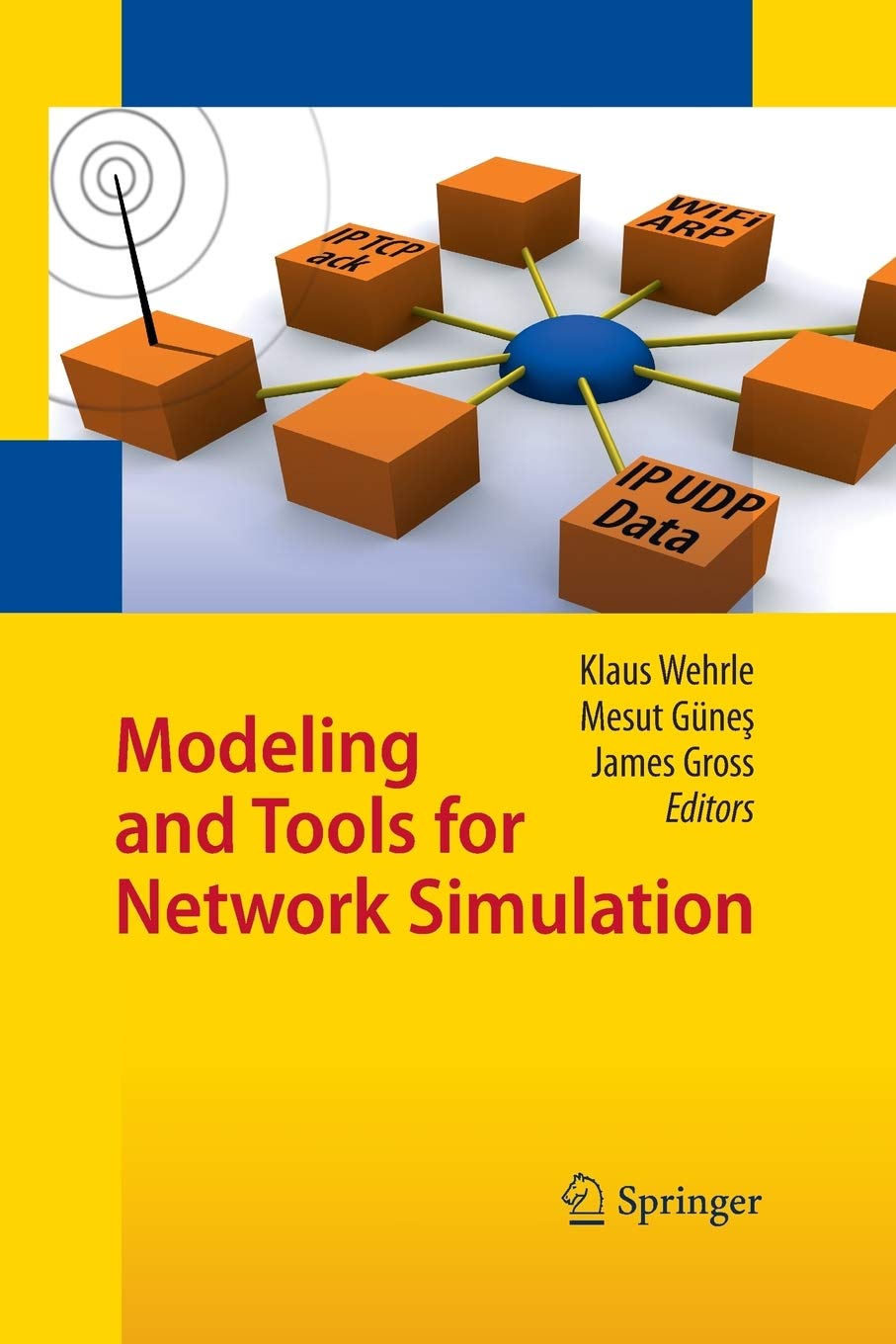
A crucial step during the design and engineering of communication systems is the estimation of their performance and behavior; especially for mathematically complex or highly dynamic systems network simulation is particularly useful. This book focuses on tools, modeling principles and stateofthe art models for discreteevent based network simulations, the standard method applied today in academia and industry for performance evaluation of new network designs and architectures. The focus of the tools part is on two distinct simulations engines: OmNet++ and ns3, while it also deals with issues like parallelization, software integration and hardware simulations. The parts dealing with modeling and models for network simulations are split into a wireless section and a section dealing with higher layers. The wireless section covers all essential modeling principles for dealing with physical layer, link layer and wireless channel behavior. In addition, detailed models for prominent wireless systems like IEEE 802.11 and IEEE 802.16 are presented. In the part on higher layers, classical modeling approaches for the network layer, the transport layer and the application layer are presented in addition to modeling approaches for peertopeer networks and topologies of networks. The modeling parts are accompanied with catalogues of model implementations for a large set of different simulation engines. The book is aimed at master students and PhD students of computer science and electrical engineering as well as at researchers and practitioners from academia and industry that are dealing with network simulation at any layer of the protocol stack.
⚠️ WARNING (California Proposition 65):
This product may contain chemicals known to the State of California to cause cancer, birth defects, or other reproductive harm.
For more information, please visit www.P65Warnings.ca.gov.