If you have any questions, you are always welcome to contact us. We'll get back to you as soon as possible, withing 24 hours on weekdays.
Customer service
All questions about your order, return and delivery must be sent to our customer service team by e-mail at yourstore@yourdomain.com
Sale & Press
If you are interested in selling our products, need more information about our brand or wish to make a collaboration, please contact us at press@yourdomain.com
Help
If you have any questions, you are always welcome to contact us. We'll get back to you as soon as possible, withing 24 hours on weekdays.
Customer service
All questions about your order, return and delivery must be sent to our customer service team by e-mail at yourstore@yourdomain.com
Sale & Press
If you are interested in selling our products, need more information about our brand or wish to make a collaboration, please contact us at press@yourdomain.com
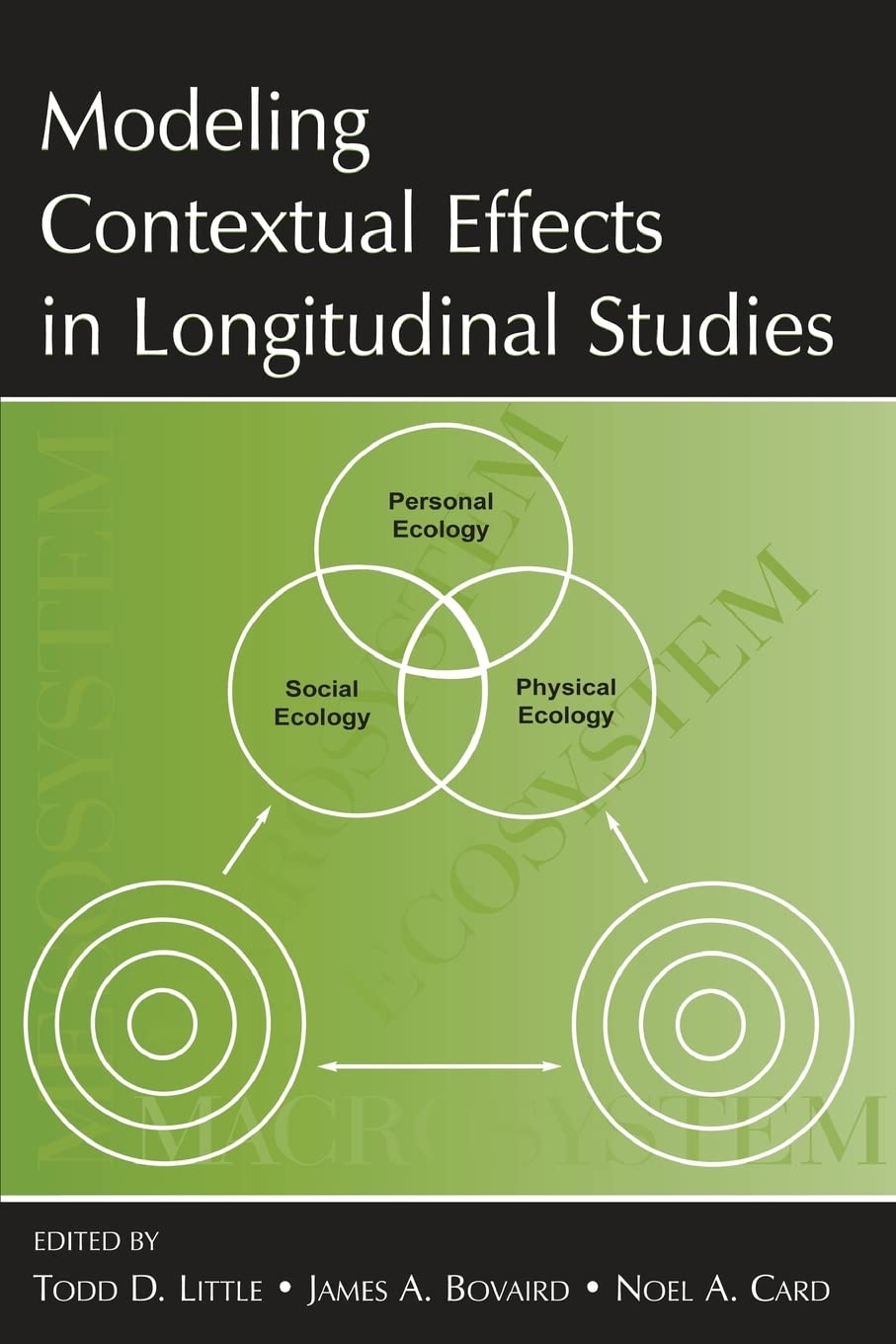
This volume reviews the challenges and alternative approaches to modeling how individuals change across time and provides methodologies and data analytic strategies for behavioral and social science researchers. This accessible guide provides concrete, clear examples of how contextual factors can be included in most research studies. Each chapter can be understood independently, allowing readers to first focus on areas most relevant to their work. The opening chapter demonstrates the various ways contextual factors are representedas covariates, predictors, outcomes, moderators, mediators, or mediated effects. Succeeding chapters review 'best practice' techniques for treating missing data, making model comparisons, and scaling across developmental age ranges. Other chapters focus on specific statistical techniques such as multilevel modeling and multiplegroup and multilevel SEM, and how to incorporate tests of mediation, moderation, and moderated mediation. Critical measurement and theoretical issues are discussed, particularly how age can be represented and the ways in which context can be conceptualized. The final chapter provides a compelling call to include contextual factors in theorizing and research.This book will appeal to researchers and advanced students conducting developmental, social, clinical, or educational research, as well as those in related areas such as psychology and linguistics.
⚠️ WARNING (California Proposition 65):
This product may contain chemicals known to the State of California to cause cancer,
birth defects, or other reproductive harm.
For MAP (Minimum Advertised Price) violations and Intellectual Property (IP) or Trademark concerns, please contact:
support@ergodebooks.com
⚠️ California Proposition 65 Warning: Some products sold on this website may expose you to chemicals known to the State of California to cause cancer, birth defects, or other reproductive harm. For more information, visit www.P65Warnings.ca.gov.