
Title
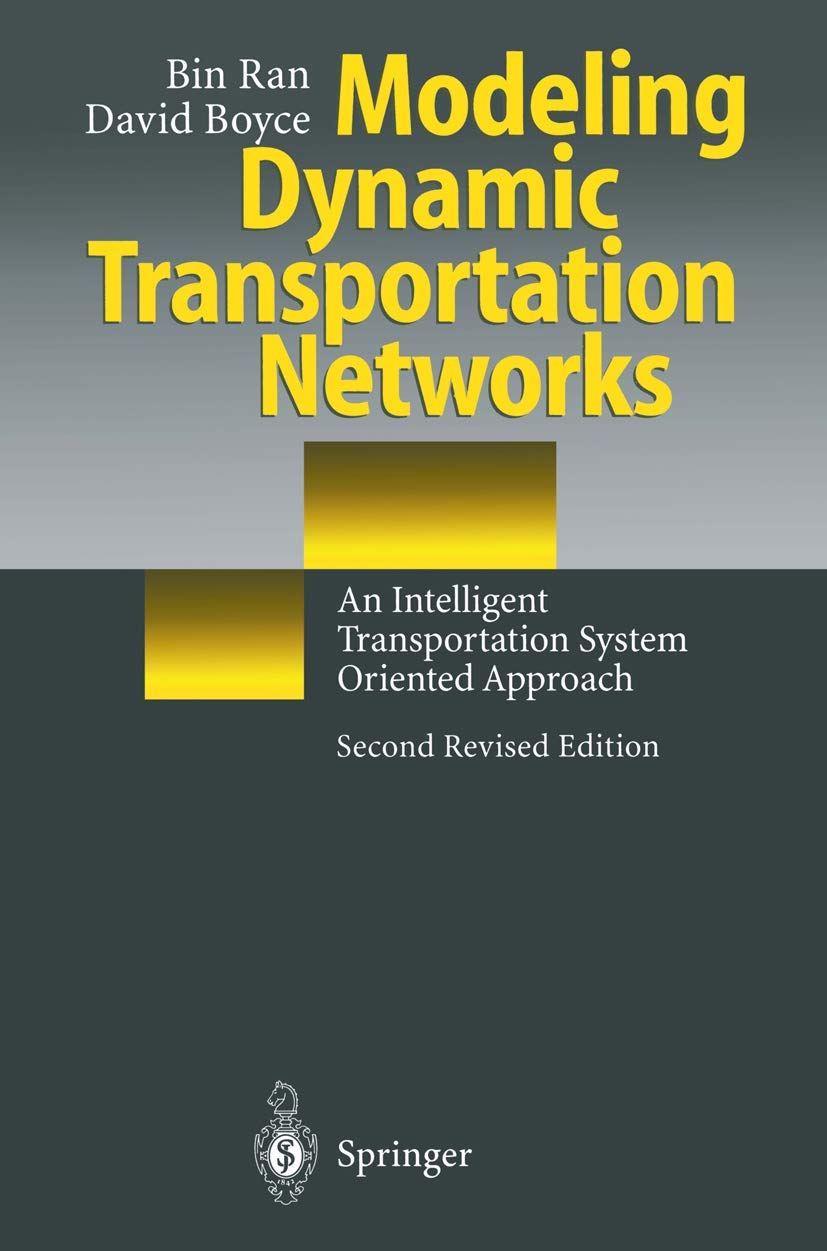
Modeling Dynamic Transportation Networks: An Intelligent Transportation System Oriented Approach,Used
Sold by Ergodebooks, an authorized reseller.
Returns accepted within 30 days | support@ergodebooks.com
Shipping Information
- Free Standard Shipping — United States only
- Processing Time: 3–5 business days
- Estimated Delivery: 6–10 business days after dispatch
- Double-boxed, fully insured & discreetly packaged
- Tracking number sent via email once dispatched
Returns & Refund
Returns accepted within 30 days of delivery.
Damaged or Defective Item
Free return shipping + replacement or full refund
Wrong Item Received
Free return shipping + replacement or full refund
Change of Mind
Return shipping at customer's expense · 25% restocking fee applies
Payment Option

This book seeks to summarize our recent progress in dynamic trans portation network modeling. It concentrates on ideal dynamic network models based on actual travel times and their corresponding solution algorithms. In contrast, our first book DynamIc Urban Transportation Network Models The ory and Implications for Intelligent VehicleHzghway Systems (SpringerVerlag, 1994) focused on instantaneous dynamic network models. Comparing the two books, the major differences can be summarized as follows: 1. This book uses the variational inequality problem as the basic formulation approach and considers the optimal control problem as a subproblem for solution purposes. The former book used optimal control theory as the basic formulation approach, which caused critical problems in some circumstances. 2. This book focuses on ideal dynamic network models based on actual travel times. The former book focused on instantaneous dynamic network models based on currently prevailing travel times. 3. This book formulates a stochastic dynamic route choice model which can utilize any possible route choice distribution function instead of only the logit function. 4. This book reformulates the bilevel problem of combined departure time/ route choice as a onelevel variational inequality. 5. Finally, a set of problems is provided for classroom use. In addition, this book offers comprehensive insights into the complexity and challenge of applying these dynamic network models to Intelligent Trans portation Systems (ITS). Nevertheless, the models in this text are not yet fully evaluated and are subject to revision based on future research.
⚠️ WARNING (California Proposition 65):
This product may contain chemicals known to the State of California to cause cancer, birth defects, or other reproductive harm.
For more information, please visit www.P65Warnings.ca.gov.