If you have any questions, you are always welcome to contact us. We'll get back to you as soon as possible, withing 24 hours on weekdays.
Customer service
All questions about your order, return and delivery must be sent to our customer service team by e-mail at yourstore@yourdomain.com
Sale & Press
If you are interested in selling our products, need more information about our brand or wish to make a collaboration, please contact us at press@yourdomain.com
Help
If you have any questions, you are always welcome to contact us. We'll get back to you as soon as possible, withing 24 hours on weekdays.
Customer service
All questions about your order, return and delivery must be sent to our customer service team by e-mail at yourstore@yourdomain.com
Sale & Press
If you are interested in selling our products, need more information about our brand or wish to make a collaboration, please contact us at press@yourdomain.com
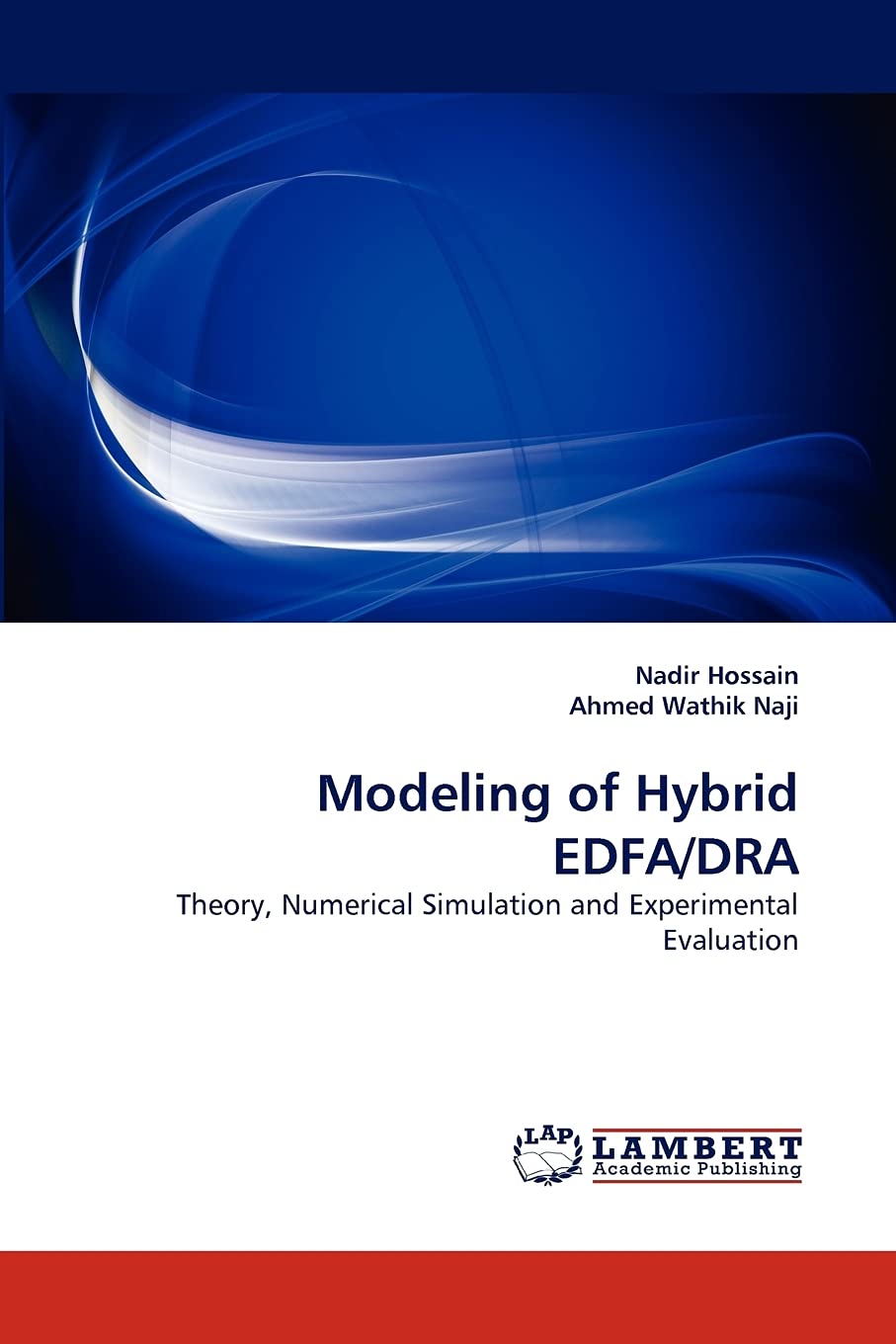
This book focuses on the modeling of hybrid EDFA/ DRA for long haul optical fiber communication system. The mathematical model of hybrid EDFA/DRA is represented by two separate models. The first model deals with the modeling of double pass Erbium doped fiber amplifier (EDFA) and the second model deals with the modeling of distributed Raman amplifier (DRA). These two models are integrated in order to model the hybrid EDFA / DRA. A mathematical model of DP EDFA is developed. A combination of RungeKutta method and relaxation method is used to numerically solve the developed DP EDFA mathematical model. The numerical results are used to describe the design process of an optimized DP EDFA. The DP EDFA mathematical model is validated with the help of previously published experimental results. A mathematical model of DRA is developed. An approach to numerically solve the developed DRA mathematical model is described. Numerical results are used to characterize the DRA. The DRA mathematical model is validated with the help of previously published experimental results.
⚠️ WARNING (California Proposition 65):
This product may contain chemicals known to the State of California to cause cancer,
birth defects, or other reproductive harm.
For MAP (Minimum Advertised Price) violations and Intellectual Property (IP) or Trademark concerns, please contact:
support@ergodebooks.com
⚠️ California Proposition 65 Warning: Some products sold on this website may expose you to chemicals known to the State of California to cause cancer, birth defects, or other reproductive harm. For more information, visit www.P65Warnings.ca.gov.