If you have any questions, you are always welcome to contact us. We'll get back to you as soon as possible, withing 24 hours on weekdays.
Customer service
All questions about your order, return and delivery must be sent to our customer service team by e-mail at yourstore@yourdomain.com
Sale & Press
If you are interested in selling our products, need more information about our brand or wish to make a collaboration, please contact us at press@yourdomain.com
Help
If you have any questions, you are always welcome to contact us. We'll get back to you as soon as possible, withing 24 hours on weekdays.
Customer service
All questions about your order, return and delivery must be sent to our customer service team by e-mail at yourstore@yourdomain.com
Sale & Press
If you are interested in selling our products, need more information about our brand or wish to make a collaboration, please contact us at press@yourdomain.com
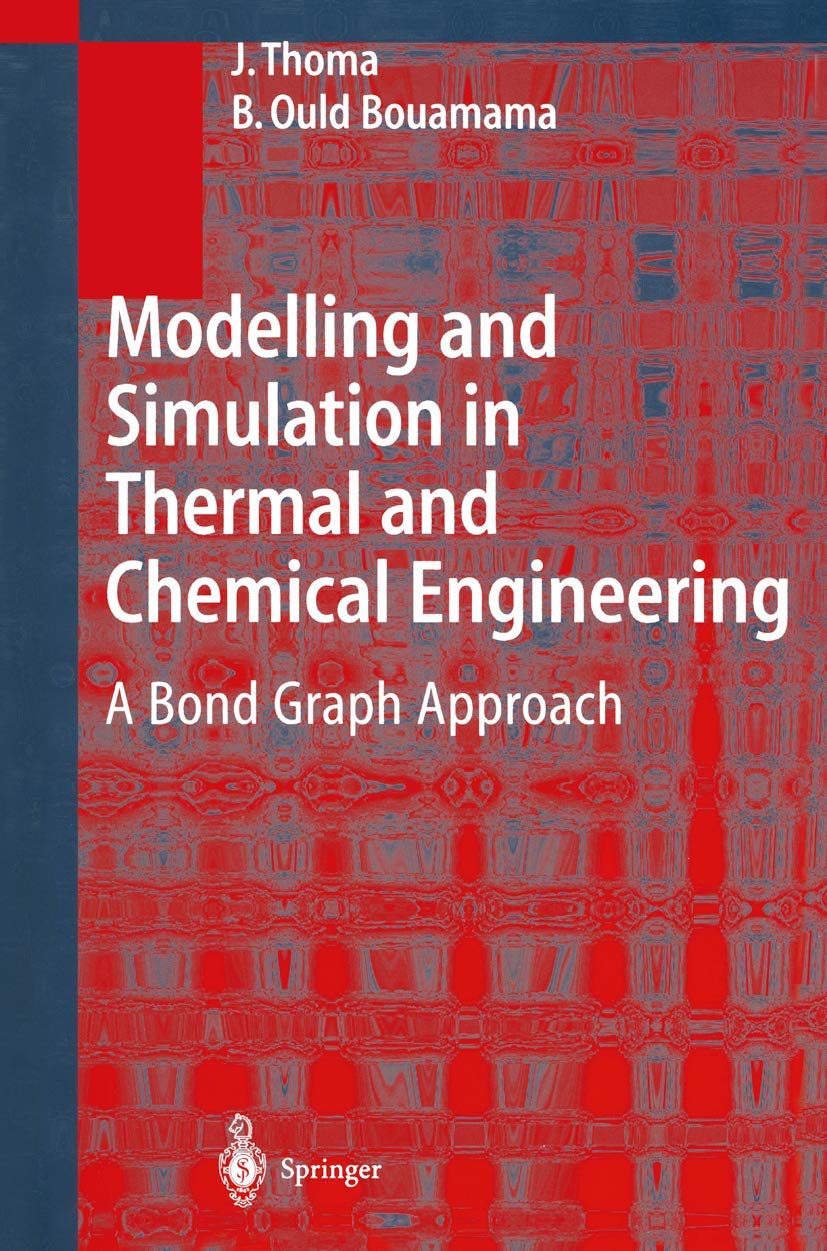
It is a great pleasure for me to introduce this book which has the main ambition to make thermodynamics more directly accessible to engineers and physicists by stressing the analogies with the other physical domains; this science has discouraged more than a few students. The book comes from the meeting of two persons: 1. Jean Thoma, inventor of hydrostatic machines and transmissions, pro fessor at the University of Waterloo (Canada), expert in simulation and pilgrim for the promotion of bond graphs around the world. 2. Belkacem Ould Bouamama, associated professor at the University of Science and Technology in Lille, France, specialist in industrial control and seduced by the richness and structure of the bond graph method. Thermodynamics is a difficult subject; its concepts like entropy, enthalpy, etc. are not intuitive and often very abstract. For this reason, it is current practice to neglect the thermal aspects, although they are necessarily there in all physical phenomena, and to use isothermal models. This is equivalent to think that the system is immersed in an infinite temperature reservoir and maintains its temperature constant even if it receives or dissipates electric and other type of energy. For heat transfer and variable temperature, if it should be included, the classical approach is to study the changes between equilibrium states, and not the process itself, which is more a thermostatic than a thermodynamic approach. This is justified when only the constraints of equilibrium state must be satisfied.
⚠️ WARNING (California Proposition 65):
This product may contain chemicals known to the State of California to cause cancer,
birth defects, or other reproductive harm.
For MAP (Minimum Advertised Price) violations and Intellectual Property (IP) or Trademark concerns, please contact:
support@ergodebooks.com
⚠️ California Proposition 65 Warning: Some products sold on this website may expose you to chemicals known to the State of California to cause cancer, birth defects, or other reproductive harm. For more information, visit www.P65Warnings.ca.gov.