If you have any questions, you are always welcome to contact us. We'll get back to you as soon as possible, withing 24 hours on weekdays.
Customer service
All questions about your order, return and delivery must be sent to our customer service team by e-mail at yourstore@yourdomain.com
Sale & Press
If you are interested in selling our products, need more information about our brand or wish to make a collaboration, please contact us at press@yourdomain.com
Help
If you have any questions, you are always welcome to contact us. We'll get back to you as soon as possible, withing 24 hours on weekdays.
Customer service
All questions about your order, return and delivery must be sent to our customer service team by e-mail at yourstore@yourdomain.com
Sale & Press
If you are interested in selling our products, need more information about our brand or wish to make a collaboration, please contact us at press@yourdomain.com
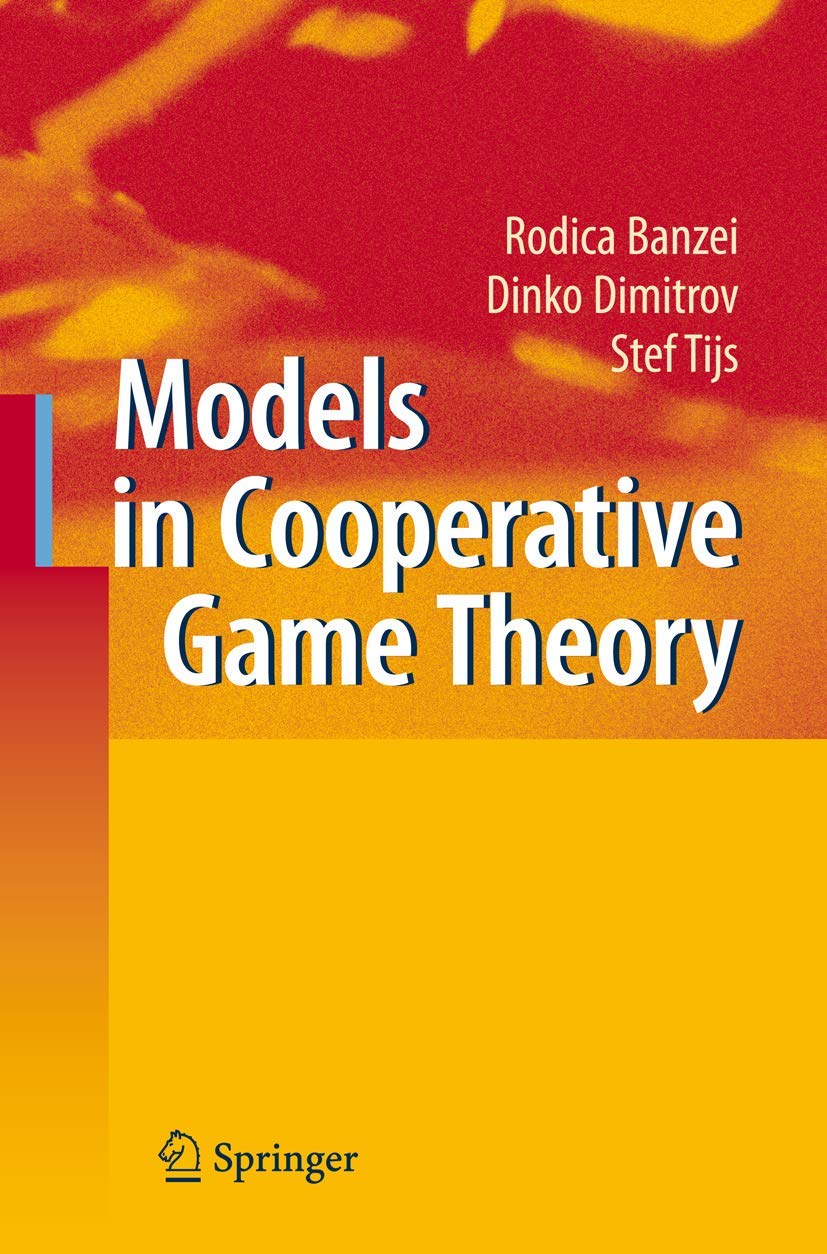
Cooperative game theory is a booming research area with many new developments in the last few years. So, our main purpose when prep ing the second edition was to incorporate as much of these new dev opments as possible without changing the structure of the book. First, this o?ered us the opportunity to enhance and expand the treatment of traditional cooperative games, called here crisp games, and, especially, that of multichoice games, in the idea to make the three parts of the monograph more balanced. Second, we have used the opportunity of a secondeditiontoupdateandenlargethelistofreferencesregardingthe threemodels of cooperative games. Finally, we have bene?ted fromthis opportunity by removing typos and a few less important results from the ?rst edition of the book, and by slightly polishing the English style and the punctuation, for the sake of consistency along the monograph. The main changes are: (1) Chapter 3 contains an additional section, Section 3. 3, on the erage lexicographic value, which is a recent onepoint solution concept de?ned on the class of balanced crisp games. (2) Chapter 4 is new. It o?ers a brief overview on solution c cepts for crisp games from the point of view of egalitarian criteria, and presents in Section 4. 2 a recent setvalued solution concept based on egalitarian considerations, namely the equal splito? set. (3)Chapter5isbasicallyanenlargedversionofChapter4ofthe?rst edition because Section 5. 4 dealing with the relation between convex games and clan games with crisp coalitions is new.
⚠️ WARNING (California Proposition 65):
This product may contain chemicals known to the State of California to cause cancer,
birth defects, or other reproductive harm.
For MAP (Minimum Advertised Price) violations and Intellectual Property (IP) or Trademark concerns, please contact:
support@ergodebooks.com
⚠️ California Proposition 65 Warning: Some products sold on this website may expose you to chemicals known to the State of California to cause cancer, birth defects, or other reproductive harm. For more information, visit www.P65Warnings.ca.gov.