
Title
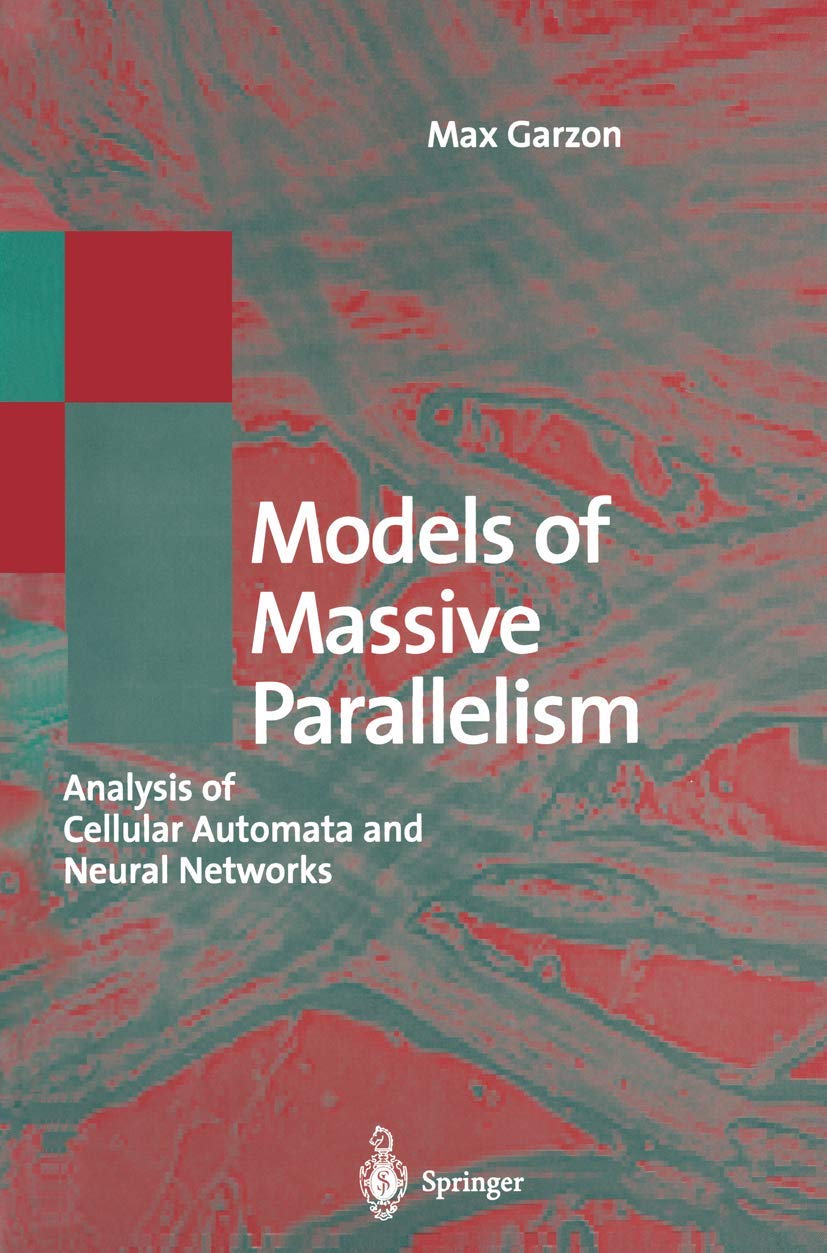
Models of Massive Parallelism: Analysis of Cellular Automata and Neural Networks (Texts in Theoretical Computer Science. An EATC,Used
Sold by Ergodebooks, an authorized reseller.
Returns accepted within 30 days | support@ergodebooks.com
Shipping Information
- Free Standard Shipping — United States only
- Processing Time: 3–5 business days
- Estimated Delivery: 6–10 business days after dispatch
- Double-boxed, fully insured & discreetly packaged
- Tracking number sent via email once dispatched
Returns & Refund
Returns accepted within 30 days of delivery.
Damaged or Defective Item
Free return shipping + replacement or full refund
Wrong Item Received
Free return shipping + replacement or full refund
Change of Mind
Return shipping at customer's expense · 25% restocking fee applies
Payment Option

Locality is a fundamental restriction in nature. On the other hand, adaptive complex systems, life in particular, exhibit a sense of permanence and time lessness amidst relentless constant changes in surrounding environments that make the global properties of the physical world the most important problems in understanding their nature and structure. Thus, much of the differential and integral Calculus deals with the problem of passing from local information (as expressed, for example, by a differential equation, or the contour of a region) to global features of a system's behavior (an equation of growth, or an area). Fundamental laws in the exact sciences seek to express the observable global behavior of physical objects through equations about local interaction of their components, on the assumption that the continuum is the most accurate model of physical reality. Paradoxically, much of modern physics calls for a fundamen tal discrete component in our understanding of the physical world. Useful computational models must be eventually constructed in hardware, and as such can only be based on local interaction of simple processing elements.
⚠️ WARNING (California Proposition 65):
This product may contain chemicals known to the State of California to cause cancer, birth defects, or other reproductive harm.
For more information, please visit www.P65Warnings.ca.gov.