
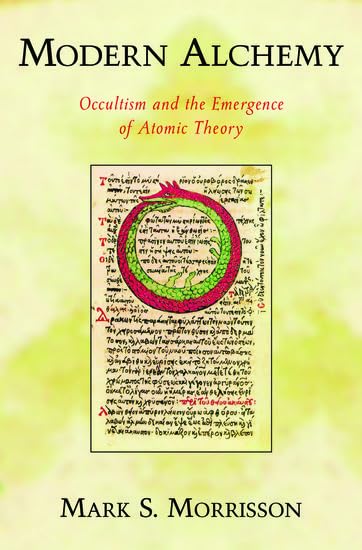
Title
Modern Alchemy: Occultism and the Emergence of Atomic Theory,Used
Processing time: 1-3 days
US Orders Ships in: 3-5 days
International Orders Ships in: 8-12 days
Return Policy: 15-days return on defective items
Payment Option

Alchemists are generally held to be the quirky forefathers of science, blending occultism with metaphysical pursuits. Although many were intelligent and wellintentioned thinkers, the oftcited goals of alchemy paint these antiquated experiments as wizardry, not scientific investigation. Whether seeking to produce a miraculous panacea or struggling to transmute lead into gold, the alchemists radical goals held little relevance to consequent scientific pursuits. Thus, the temptation is to view the transition from alchemy to modern science as one that discarded fantastic ideas about philosophers stones and magic potions in exchange for modest yet steady results. It has been less noted, however, that the birth of atomic science actually coincided with an efflorescence of occultism and esoteric religion that attached deep significance to questions about the nature of matter and energy.Mark Morrisson challenges the widespread dismissal of alchemy as a largely insignificant historical footnote to science by prying into the revival of alchemy and its influence on the emerging subatomic sciences of the late 19th and early 20th centuries.Morrisson demonstrates its surprising influence on the emerging subatomic sciences of the late 19th and early 20th centuries. Specifically, Morrisson examines the resurfacing of occult circles during this time period and how their interest in alchemical tropes had a substantial and traceable impact upon the science of the day. Modern Alchemy chronicles several encounters between occult conceptions of alchemy and the new science, describing how academic chemists, inspired by the alchemy revival, attempted to transmute the elements; to make gold.Examining scientists publications, correspondence, talks, and laboratory notebooks as well as the writings of occultists, alchemical tomes, and sciencefiction stories, he argues that during the birth of modern nuclear physics, the trajectories of science and occultismso often considered antitheticalbriefly merged.
⚠️ WARNING (California Proposition 65):
This product may contain chemicals known to the State of California to cause cancer, birth defects, or other reproductive harm.
For more information, please visit www.P65Warnings.ca.gov.
- Q: What is the main theme of 'Modern Alchemy: Occultism and the Emergence of Atomic Theory'? A: The book explores the relationship between alchemy and the development of modern atomic theory, highlighting how occultism influenced scientific thought during the late 19th and early 20th centuries.
- Q: Who is the author of this book? A: The author of 'Modern Alchemy' is Mark Morrisson, who examines the intersections between alchemical traditions and contemporary scientific inquiry.
- Q: What is the publication date of this book? A: The book was published on April 19, 2007.
- Q: How many pages does 'Modern Alchemy' have? A: The book contains 272 pages.
- Q: What type of binding does this book have? A: This edition of 'Modern Alchemy' is a hardcover binding.
- Q: Is 'Modern Alchemy' suitable for readers interested in science or occultism? A: Yes, the book appeals to both audiences as it delves into the historical significance of alchemy in the context of scientific development.
- Q: Does the book include any references to scientific publications? A: Yes, the author examines various scientific publications, correspondence, and laboratory notebooks to illustrate the influence of alchemy on modern science.
- Q: What edition of the book is available? A: This is the first edition of 'Modern Alchemy'.
- Q: Can this book be considered a scholarly resource? A: Yes, 'Modern Alchemy' is a scholarly work that provides in-depth analysis and references to both historical and contemporary sources in science and occultism.
- Q: What key concepts does the book address? A: The book addresses concepts such as the revival of alchemy, its impact on subatomic sciences, and the merging of science with occult ideas during the early 20th century.