
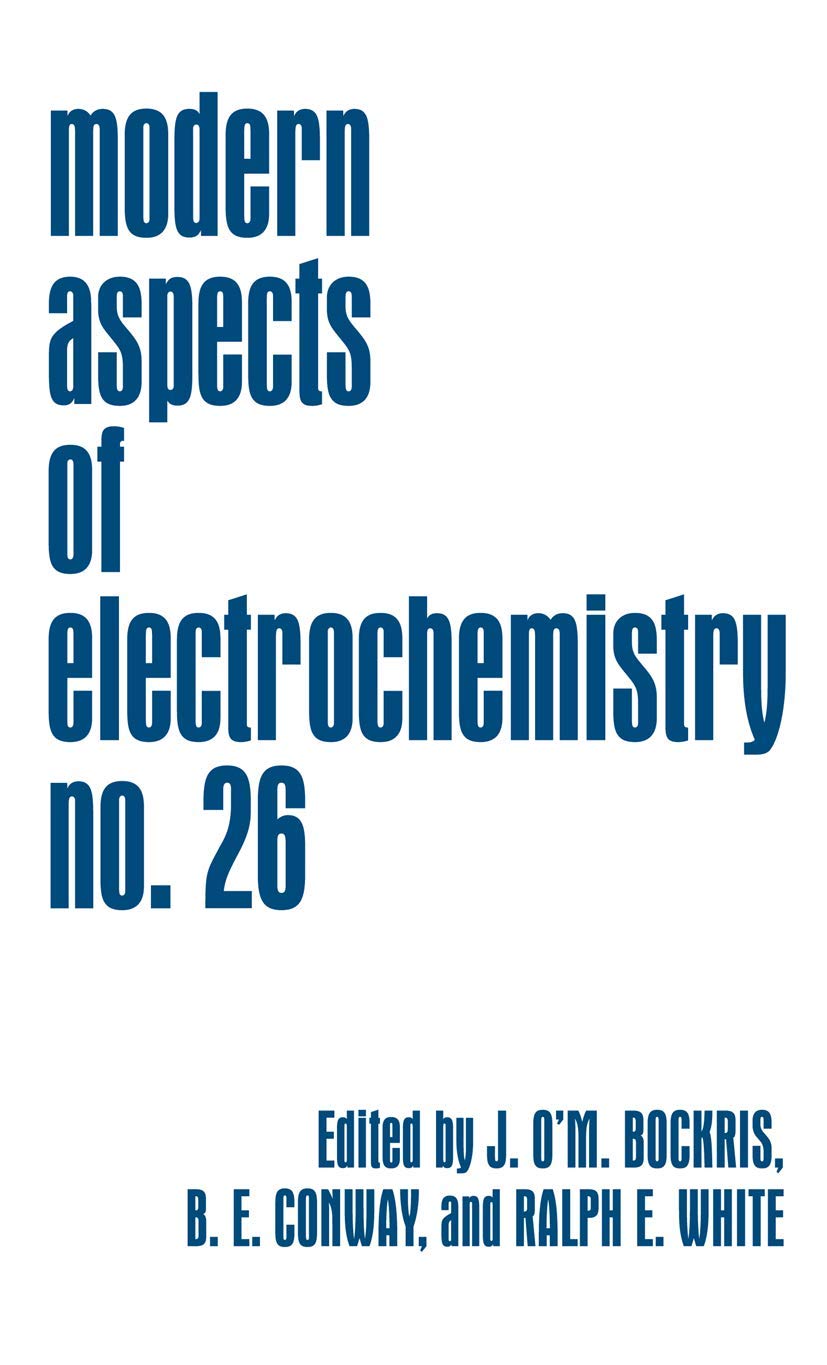
Title
Modern Aspects of Electrochemistry, Volume 26,Used
Sold by Ergodebooks, an authorized reseller.
Returns accepted within 30 days | support@ergodebooks.com
Shipping Information
- Free Standard Shipping — United States only
- Processing Time: 3–5 business days
- Estimated Delivery: 6–10 business days after dispatch
- Double-boxed, fully insured & discreetly packaged
- Tracking number sent via email once dispatched
Returns & Refund
Returns accepted within 30 days of delivery.
Damaged or Defective Item
Free return shipping + replacement or full refund
Wrong Item Received
Free return shipping + replacement or full refund
Change of Mind
Return shipping at customer's expense · 25% restocking fee applies
Payment Option

The present volume presents six chapters, two of them fairly brief, covering both fundamental and applied electrochemistry. The latter aspect has, of course, historical significance in the subject as well as a major technological profile in recent decades, while intimate connections between these complementary facets of the subject have always been a driving force for its earlier and continu ing development. In the Modern Aspects of Electrochemistry series we have periodically included contributions from the several schools of Russi~n electrochemistry. This approach is continued in the present volume by inclusion of the chapter by Benderskii, Brodskii, Daikhin, and Velichko from the Frumkin Institute, Moscow, on phase transitions among molecules adsorbed in the doublelayer interphase at electrodes. This topic has attracted attention for some years through the works of the Russian school and of Gierst and BuessHerman. Such behavior is also related to the important phenomenon of selfassembly of molecules in films at interfaces. In Chapter 1, these authors give an account of the factors associated with twodimensional phase transitions and associated orientation effects with polar adsorbates at electrode interfaces. The theoretical interpretation of these effects are also treated in some detail. Chapter 2, by Rusling, deals with electrochemistry and electro catalysis in microemulsions, thus connecting aspects of electrode kinetics, adsorption at electrode interfaces, and colloid chemistry.
⚠️ WARNING (California Proposition 65):
This product may contain chemicals known to the State of California to cause cancer, birth defects, or other reproductive harm.
For more information, please visit www.P65Warnings.ca.gov.