
Title
Modern Astrodynamics,Used
Sold by Ergodebooks, an authorized reseller.
Returns accepted within 30 days | support@ergodebooks.com
Shipping Information
- Free Standard Shipping — United States only
- Processing Time: 3–5 business days
- Estimated Delivery: 6–10 business days after dispatch
- Double-boxed, fully insured & discreetly packaged
- Tracking number sent via email once dispatched
Returns & Refund
Returns accepted within 30 days of delivery.
Damaged or Defective Item
Free return shipping + replacement or full refund
Wrong Item Received
Free return shipping + replacement or full refund
Change of Mind
Return shipping at customer's expense · 25% restocking fee applies
Payment Option

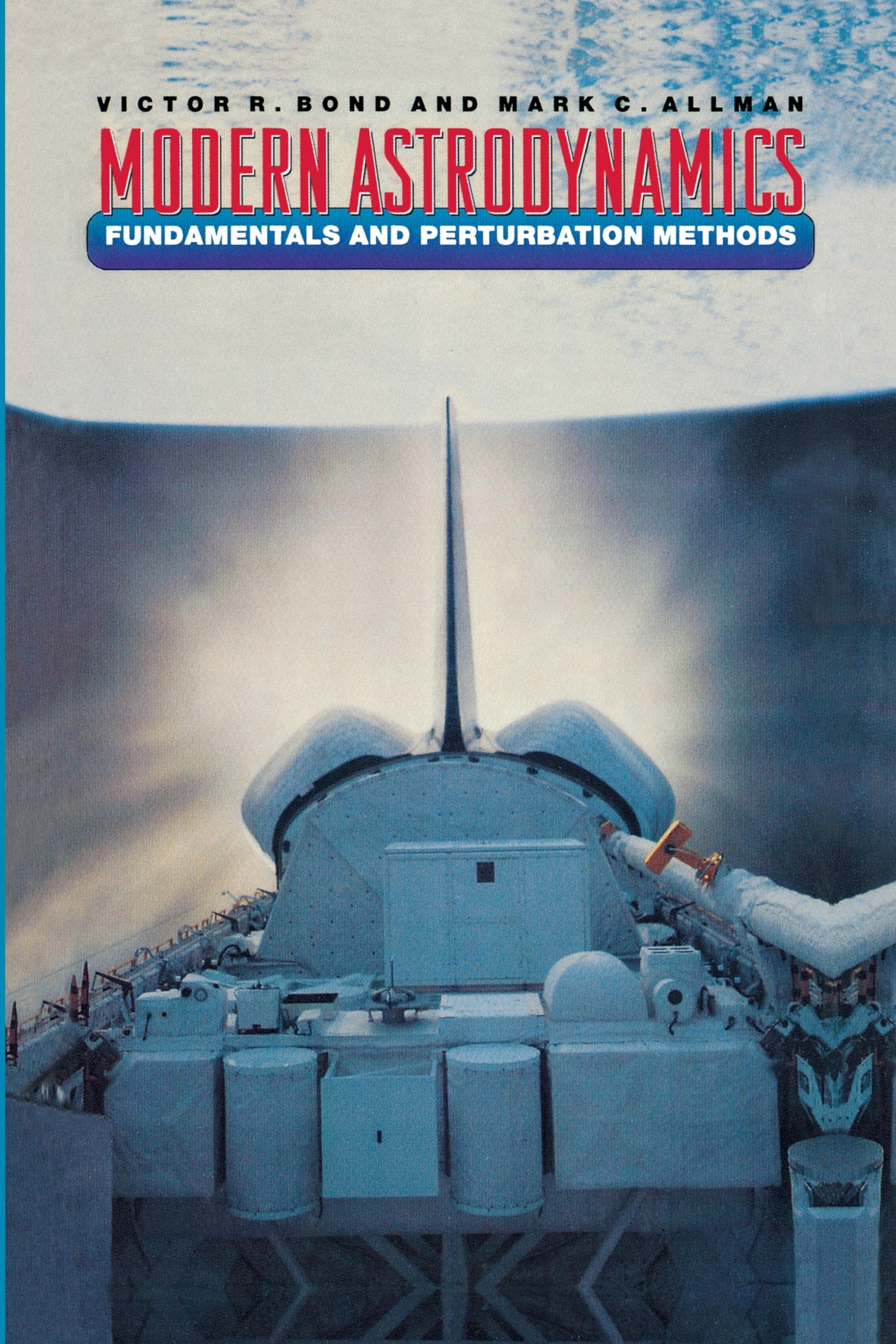
Newton'S Laws Of Motion And His Universal Law Of Gravitation Described Mathematically The Motion Of Two Bodies Undergoing Mutual Gravitational Attraction. However, It Is Impossible To Solve Analytically The Equation Of Motion For Three Gravitationally Interacting Bodies. This Book Discusses Some Techniques Used To Obtain Numerical Solutions Of The Equations Of Motion For Planets And Satellites, Which Are Of Fundamental Importance To Solarsystem Dynamicists And To Those Involved In Planning The Orbits Of Artificial Satellites.The First Part Introduces The Classical Twobody Problem And Solves It By Rigorously Developing The Six Integrals Of The Motion, Starting From Newton'S Three Laws Of Motion And His Law Of Gravitation And Then Using Vector Algebra To Develop The Integrals. The Various Forms Of The Solution Flow Naturally From The Integrals. In The Second Part, Several Modern Perturbation Techniques Are Developed And Applied To Cases Of Practical Importance. For Example, The Perturbed Twobody Problem For An Oblate Planet Or For A Nonsymmetric Rotating Planet Is Considered, As Is The Effect Of Drag On A Satellite. The Twobody Problem Is Regularized, And The Nonlinear Differential Equation Is Thereby Transformed To A Linear One By Further Embedding Several Of The Integrals. Finally, A Brief Sketch Of Numerical Methods Is Given, As The Perturbation Equations Must Be Solved By Numerical Rather Than By Analytical Methods.
⚠️ WARNING (California Proposition 65):
This product may contain chemicals known to the State of California to cause cancer, birth defects, or other reproductive harm.
For more information, please visit www.P65Warnings.ca.gov.
- Q: What is the binding type of this book? A: The binding type is hardcover. This ensures durability and a professional appearance, making it suitable for both personal and academic use.
- Q: How many pages does the book have? A: The book contains two hundred sixty-four pages. This length provides a comprehensive exploration of modern astrodynamics.
- Q: What are the dimensions of this book? A: The dimensions are six point five inches by nine point seven six inches by zero point nine eight inches. This size makes it portable and easy to handle.
- Q: What topics does this book cover? A: The book covers Newton's laws, the two-body problem, and numerical solutions for three-body gravitational interactions. It is aimed at solar-system dynamicists and satellite planners.
- Q: Who is the author of this book? A: The author is Victor R. Bond. He is known for his expertise in aerospace dynamics and has contributed significantly to the field.
- Q: Is this book suitable for beginners? A: Yes, this book is suitable for beginners with a basic understanding of physics. It gradually introduces complex concepts in astrodynamics.
- Q: How can I use this book for my studies? A: You can use this book as a textbook for understanding astrodynamics principles and numerical methods. It serves as a valuable reference for academic research.
- Q: What level of education is this book appropriate for? A: This book is appropriate for undergraduate and graduate students in aerospace engineering. It provides insights essential for advanced studies.
- Q: How should I store this book to keep it in good condition? A: Store the book upright in a dry place away from direct sunlight. This helps preserve the binding and pages over time.
- Q: Can I clean the book if it gets dirty? A: Yes, you can gently wipe the cover with a soft, dry cloth. Avoid using water or cleaning solutions, as they may damage the pages.
- Q: What if the book arrives damaged? A: If the book arrives damaged, you should contact customer support for a return or exchange. Most sellers have policies to address such issues.
- Q: Does the book include illustrations or diagrams? A: Yes, the book includes fifty halftones and diagrams. These visuals are essential for understanding complex concepts in astrodynamics.
- Q: Is there a warranty for this book? A: No, books typically do not come with a warranty. However, you can check the return policy of the seller for any issues.
- Q: How does this book compare to others in the same field? A: This book is rigorous and detailed, making it suitable for those serious about astrodynamics. It is often regarded as a reliable reference compared to introductory texts.
- Q: What should I do if I have questions while reading? A: If you have questions, consider joining online forums or study groups related to astrodynamics. Engaging with peers can provide valuable insights.