
Title
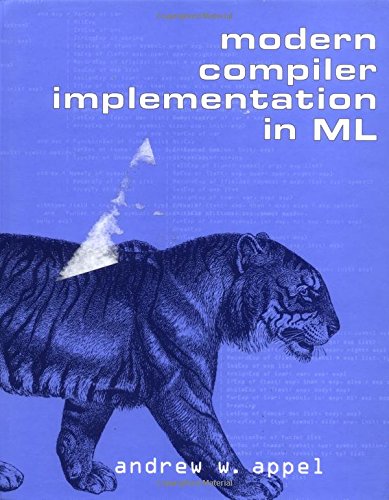
Modern Compiler Implementation in ML,Used
Sold by Ergodebooks, an authorized reseller.
Returns accepted within 30 days | support@ergodebooks.com
Shipping Information
- Free Standard Shipping — United States only
- Processing Time: 3–5 business days
- Estimated Delivery: 6–10 business days after dispatch
- Double-boxed, fully insured & discreetly packaged
- Tracking number sent via email once dispatched
Returns & Refund
Returns accepted within 30 days of delivery.
Damaged or Defective Item
Free return shipping + replacement or full refund
Wrong Item Received
Free return shipping + replacement or full refund
Change of Mind
Return shipping at customer's expense · 25% restocking fee applies
Payment Option

This new, expanded textbook describes all phases of a modern compiler: lexical analysis, parsing, abstract syntax, semantic actions, intermediate representations, instruction selection via tree matching, dataflow analysis, graphcoloring register allocation, and runtime systems. It includes good coverage of current techniques in code generation and register allocation, as well as functional and objectoriented languages, that are missing from most books. In addition, more advanced chapters are now included so that it can be used as the basis for twosemester or graduate course. The most accepted and successful techniques are described in a concise way, rather than as an exhaustive catalog of every possible variant. Detailed descriptions of the interfaces between modules of a compiler are illustrated with actual C header files. The first part of the book, Fundamentals of Compilation, is suitable for a onesemester first course in compiler design. The second part, Advanced Topics, which includes the advanced chapters, covers the compilation of objectoriented and functional languages, garbage collection, loop optimizations, SSA form, loop scheduling, and optimization for cachememory hierarchies.
⚠️ WARNING (California Proposition 65):
This product may contain chemicals known to the State of California to cause cancer, birth defects, or other reproductive harm.
For more information, please visit www.P65Warnings.ca.gov.
- Q: How many pages does the book contain? A: The book contains five hundred forty-eight pages. It provides a comprehensive understanding of modern compiler implementation.
- Q: What is the binding type of this book? A: The book is hardcover. This binding offers durability and a professional appearance for academic use.
- Q: What are the dimensions of the book? A: The book measures approximately seven point seven six inches in length, one point two six inches in width, and nine point seven six inches in height. These dimensions make it a standard-sized textbook.
- Q: Who is the author of this book? A: The author is Andrew W. Appel. He is known for his expertise in programming languages and compiler design.
- Q: What topics does the book cover? A: The book covers all phases of a modern compiler including lexical analysis, parsing, and code generation. It also includes advanced topics such as garbage collection and optimizations.
- Q: Is this book suitable for beginners? A: Yes, the first part of the book is suitable for beginners. It covers fundamental concepts of compilation to help new learners grasp the basics.
- Q: Can this book be used for graduate courses? A: Yes, it is designed for both undergraduate and graduate courses. The advanced chapters make it suitable for higher-level study.
- Q: What kind of techniques does this book discuss? A: The book discusses current techniques in code generation and register allocation. It emphasizes accepted methods rather than exhaustive catalogs.
- Q: How should I care for this book? A: To keep the book in good condition, store it in a dry place and avoid exposure to direct sunlight. Regularly dust the cover to maintain its appearance.
- Q: Is this book safe to use in educational settings? A: Yes, the book is safe for educational settings. It is widely used in academic institutions for teaching compiler design.
- Q: What if the book arrives damaged? A: If the book arrives damaged, contact the seller for a return or replacement. Most sellers have a return policy for damaged items.
- Q: Does the book include practical examples? A: Yes, the book includes detailed descriptions and practical examples using actual C header files. This helps illustrate the concepts discussed.
- Q: Are there any special features in this book? A: Yes, the book is noted as a 'Used Book in Good Condition.' This indicates that it has been previously owned but remains in a usable state.
- Q: Is this book focused on any specific programming languages? A: Yes, it covers both functional and object-oriented programming languages. This diversity enriches the learning experience for various programming paradigms.
- Q: What should I do if I have questions about the content? A: If you have questions about the content, consider reaching out to academic forums or study groups. Engaging with peers can enhance your understanding.
- Q: Is this book part of a series? A: No, this book is not part of a series. It stands alone as a comprehensive resource on compiler implementation.