If you have any questions, you are always welcome to contact us. We'll get back to you as soon as possible, withing 24 hours on weekdays.
Customer service
All questions about your order, return and delivery must be sent to our customer service team by e-mail at yourstore@yourdomain.com
Sale & Press
If you are interested in selling our products, need more information about our brand or wish to make a collaboration, please contact us at press@yourdomain.com
Help
If you have any questions, you are always welcome to contact us. We'll get back to you as soon as possible, withing 24 hours on weekdays.
Customer service
All questions about your order, return and delivery must be sent to our customer service team by e-mail at yourstore@yourdomain.com
Sale & Press
If you are interested in selling our products, need more information about our brand or wish to make a collaboration, please contact us at press@yourdomain.com
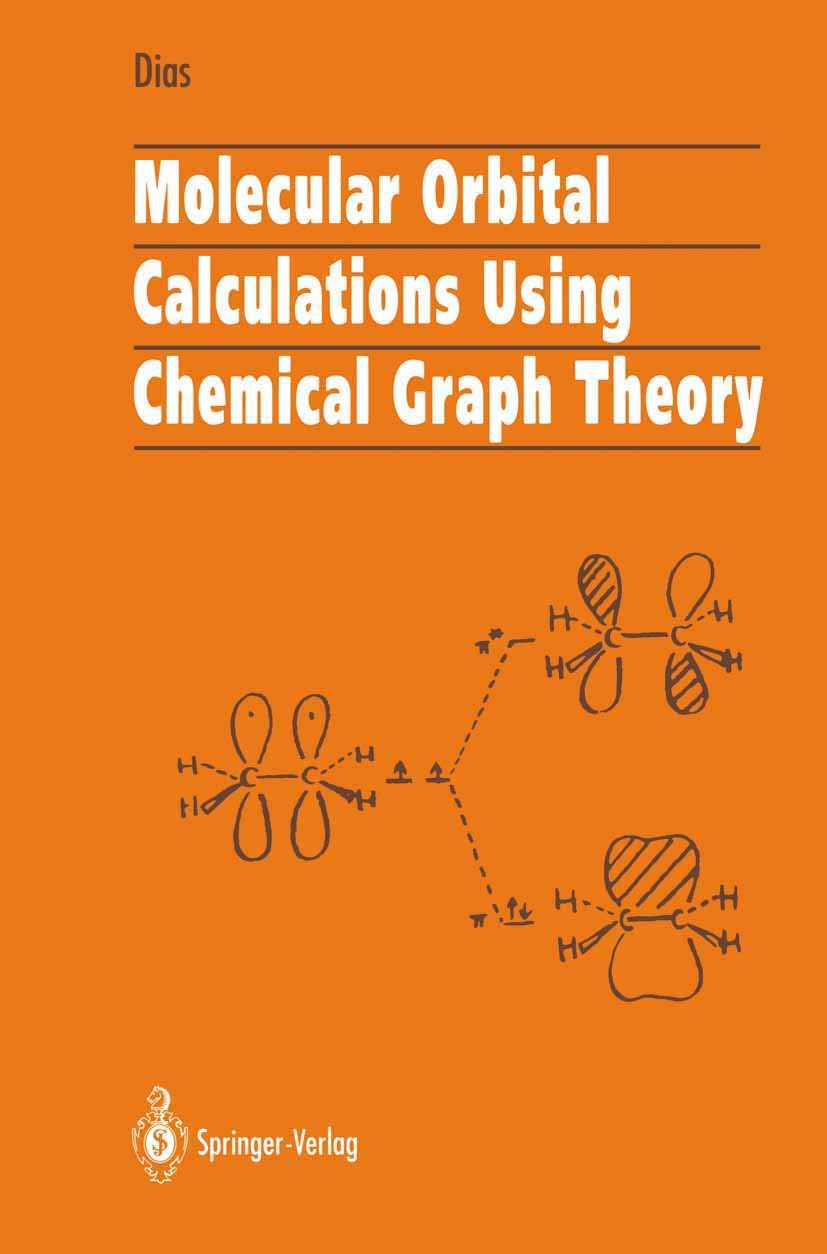
Professor John D. Roberts published a highly readable book on Molecular Orbital Calculations directed toward chemists in 1962. That timely book is the model for this book. The audience this book is directed toward are senior undergraduate and beginning graduate students as well as practicing bench chemists who have a desire to develop conceptual tools for understanding chemical phenomena. Although, ab initio and more advanced semiempirical MO methods are regarded as being more reliable than HMO in an absolute sense, there is good evidence that HMO provides reliable relative answers particularly when comparing related molecular species. Thus, HMO can be used to rationalize electronic structure in 1tsystems, aromaticity, and the shape use HMO to gain insight of simple molecular orbitals. Experimentalists still into subtle electronic interactions for interpretation of UV and photoelectron spectra. Herein, it will be shown that one can use graph theory to streamline their HMO computational efforts and to arrive at answers quickly without the aid of a group theory or a computer program of which the experimentalist has no understanding. The merging of mathematical graph theory with chemical theory is the formalization of what most chemists do in a more or less intuitive mode. Chemists currently use graphical images to embody chemical information in compact form which can be transformed into algebraical sets. Chemical graph theory provides simple descriptive interpretations of complicated quantum mechanical calculations and is, thereby, initselfbyitself an important discipline of study.
⚠️ WARNING (California Proposition 65):
This product may contain chemicals known to the State of California to cause cancer,
birth defects, or other reproductive harm.
For MAP (Minimum Advertised Price) violations and Intellectual Property (IP) or Trademark concerns, please contact:
support@ergodebooks.com
⚠️ California Proposition 65 Warning: Some products sold on this website may expose you to chemicals known to the State of California to cause cancer, birth defects, or other reproductive harm. For more information, visit www.P65Warnings.ca.gov.