If you have any questions, you are always welcome to contact us. We'll get back to you as soon as possible, withing 24 hours on weekdays.
Customer service
All questions about your order, return and delivery must be sent to our customer service team by e-mail at yourstore@yourdomain.com
Sale & Press
If you are interested in selling our products, need more information about our brand or wish to make a collaboration, please contact us at press@yourdomain.com
Help
If you have any questions, you are always welcome to contact us. We'll get back to you as soon as possible, withing 24 hours on weekdays.
Customer service
All questions about your order, return and delivery must be sent to our customer service team by e-mail at yourstore@yourdomain.com
Sale & Press
If you are interested in selling our products, need more information about our brand or wish to make a collaboration, please contact us at press@yourdomain.com
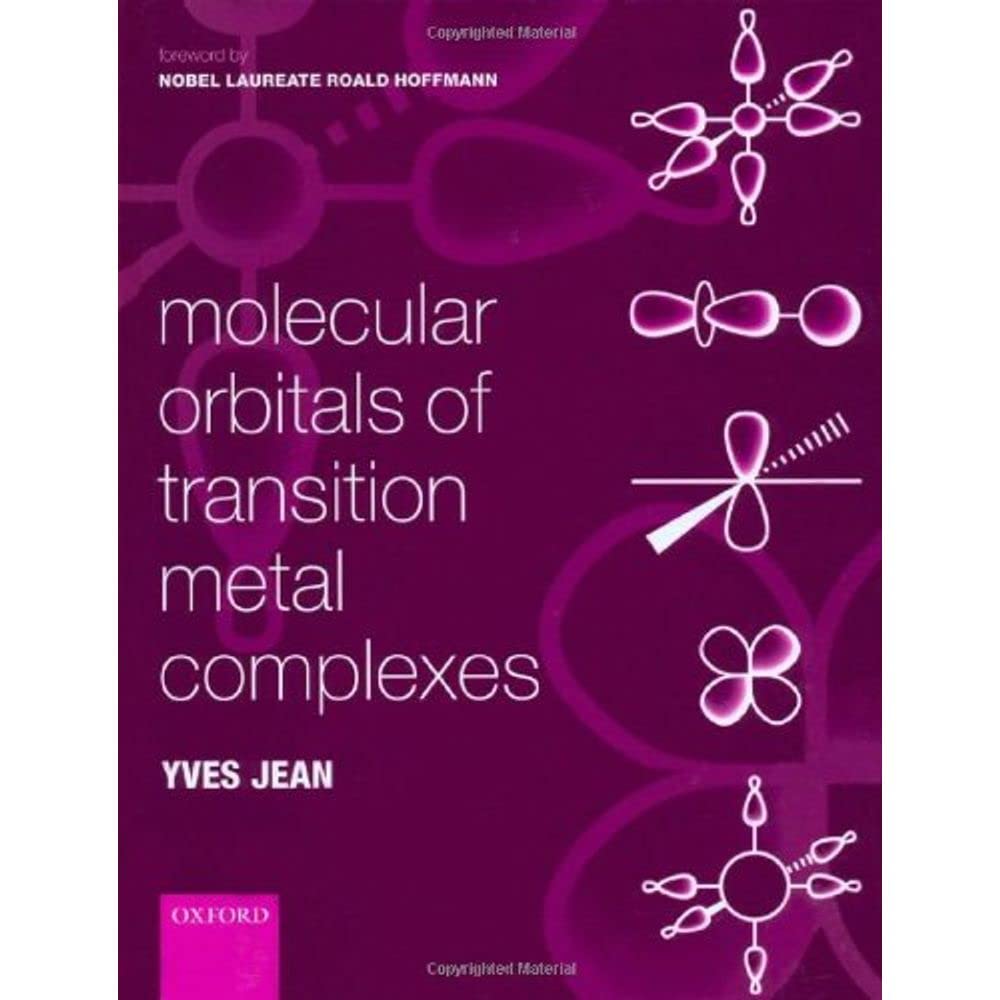
This book starts with the most elementary ideas of molecular orbital theory and leads the reader progressively to an understanding of the electronic structure, geometry and, in some cases, reactivity of transition metal complexes. The qualitative orbital approach, based on simple notions such as symmetry, overlap and electronegativity, is the focus of the presentation and a substantial part of the book is associated with the mechanics of the assembly of molecular orbital diagrams. The first chapter recalls the basis for electron counting in transition metal complexes. The main ligand fields (octahedral, square planar, tetrahedral, etc.) are studied in the second chapter (sigma interactions) and the structure of the 'd block' is used to trace the relationships between the electronic structure and the geometry of the complexes. The third chapter studies the change in analysis when the ligands have pitype interactions with the metal. All these ideas are then used in the fourth chapter to study a series of selected applications of varying complexity (structure, reactivity). The fifth chapter deals with the 'isolobal analogy' which points out the resemblance between the molecular orbitals of inorganic and organic species and provides a bridge between these two subfields of chemistry. The last chapter is devoted to a presentation of basic Group Theory with applications to some of the complexes studied in the earlier chapters.
⚠️ WARNING (California Proposition 65):
This product may contain chemicals known to the State of California to cause cancer,
birth defects, or other reproductive harm.
For MAP (Minimum Advertised Price) violations and Intellectual Property (IP) or Trademark concerns, please contact:
support@ergodebooks.com
⚠️ California Proposition 65 Warning: Some products sold on this website may expose you to chemicals known to the State of California to cause cancer, birth defects, or other reproductive harm. For more information, visit www.P65Warnings.ca.gov.