If you have any questions, you are always welcome to contact us. We'll get back to you as soon as possible, withing 24 hours on weekdays.
Customer service
All questions about your order, return and delivery must be sent to our customer service team by e-mail at yourstore@yourdomain.com
Sale & Press
If you are interested in selling our products, need more information about our brand or wish to make a collaboration, please contact us at press@yourdomain.com
Help
If you have any questions, you are always welcome to contact us. We'll get back to you as soon as possible, withing 24 hours on weekdays.
Customer service
All questions about your order, return and delivery must be sent to our customer service team by e-mail at yourstore@yourdomain.com
Sale & Press
If you are interested in selling our products, need more information about our brand or wish to make a collaboration, please contact us at press@yourdomain.com
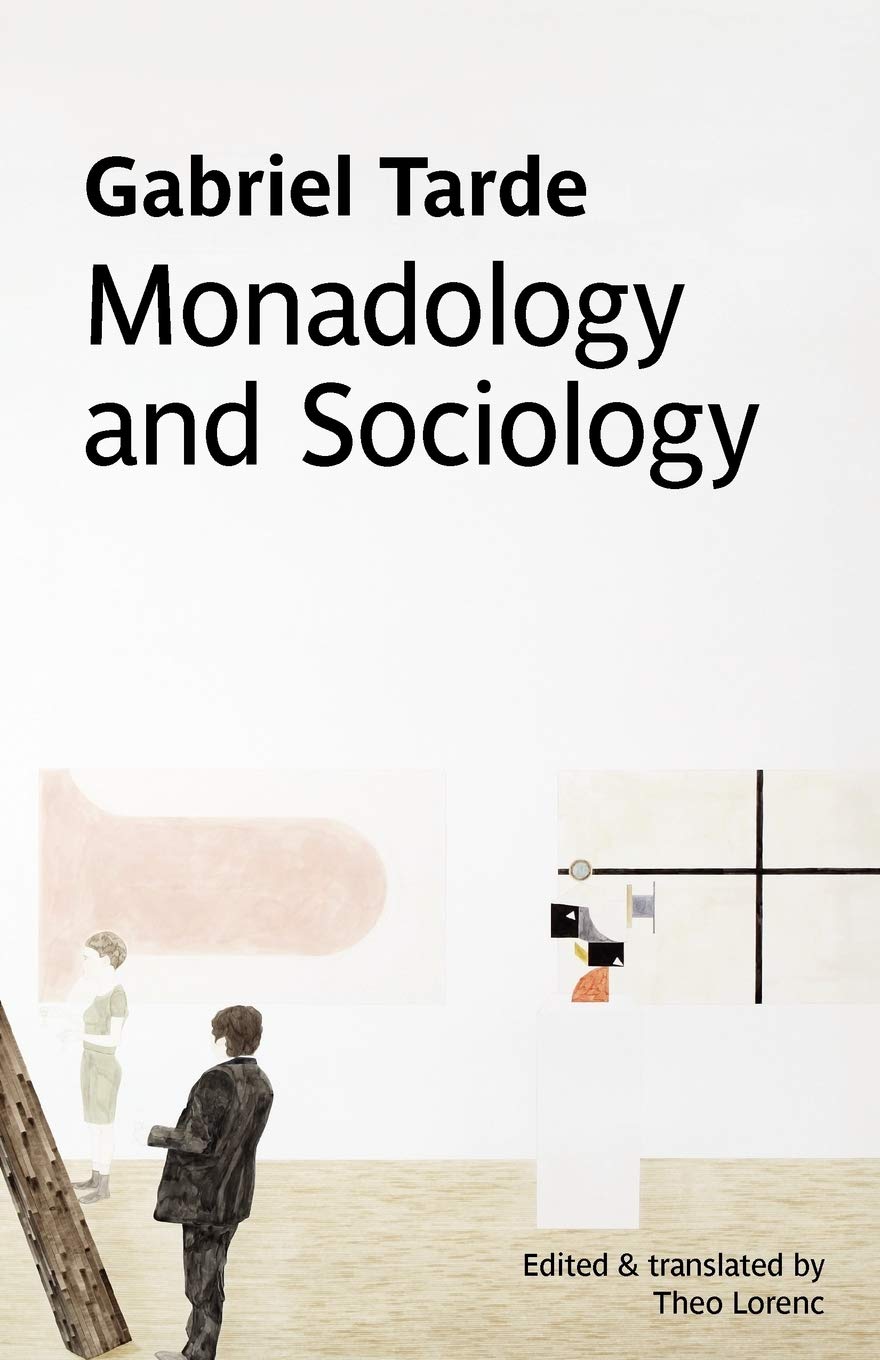
Gabriel Tarde's Monadology and Sociology, originally published in 1893, is a remarkable and unclassifiable book. It sets out a theory of 'universal sociology', which aims to explicate the essentially social nature of all phenomena, including the behaviour of atoms, stars, chemical substances and living beings. He argues that all of nature consists of elements animated by belief and desire, which form social aggregates analogous to those of human societies and institutions. In developing this central insight, Tarde outlines a metaphysical system which builds on both classical rationalist philosophy and the latest scientific theories of the time, in a speculative synthesis of extraordinary range and power. Tarde's work has only recently returned to prominence after a long eclipse. His work was an important influence on later theorists including Deleuze and Latour, and has been widely discussed in the social sciences, but has rarely been a focus of philosophical interest. The translator's afterword provides an explication of the key ideas in the text and situates Tarde's theory within the context of the philosophical tradition, arguing for the importance of the text as a highly original work of systematic ontology, and for its importance for contemporary theoretical debates.
⚠️ WARNING (California Proposition 65):
This product may contain chemicals known to the State of California to cause cancer,
birth defects, or other reproductive harm.
For MAP (Minimum Advertised Price) violations and Intellectual Property (IP) or Trademark concerns, please contact:
support@ergodebooks.com
⚠️ California Proposition 65 Warning: Some products sold on this website may expose you to chemicals known to the State of California to cause cancer, birth defects, or other reproductive harm. For more information, visit www.P65Warnings.ca.gov.