If you have any questions, you are always welcome to contact us. We'll get back to you as soon as possible, withing 24 hours on weekdays.
Customer service
All questions about your order, return and delivery must be sent to our customer service team by e-mail at yourstore@yourdomain.com
Sale & Press
If you are interested in selling our products, need more information about our brand or wish to make a collaboration, please contact us at press@yourdomain.com
Help
If you have any questions, you are always welcome to contact us. We'll get back to you as soon as possible, withing 24 hours on weekdays.
Customer service
All questions about your order, return and delivery must be sent to our customer service team by e-mail at yourstore@yourdomain.com
Sale & Press
If you are interested in selling our products, need more information about our brand or wish to make a collaboration, please contact us at press@yourdomain.com
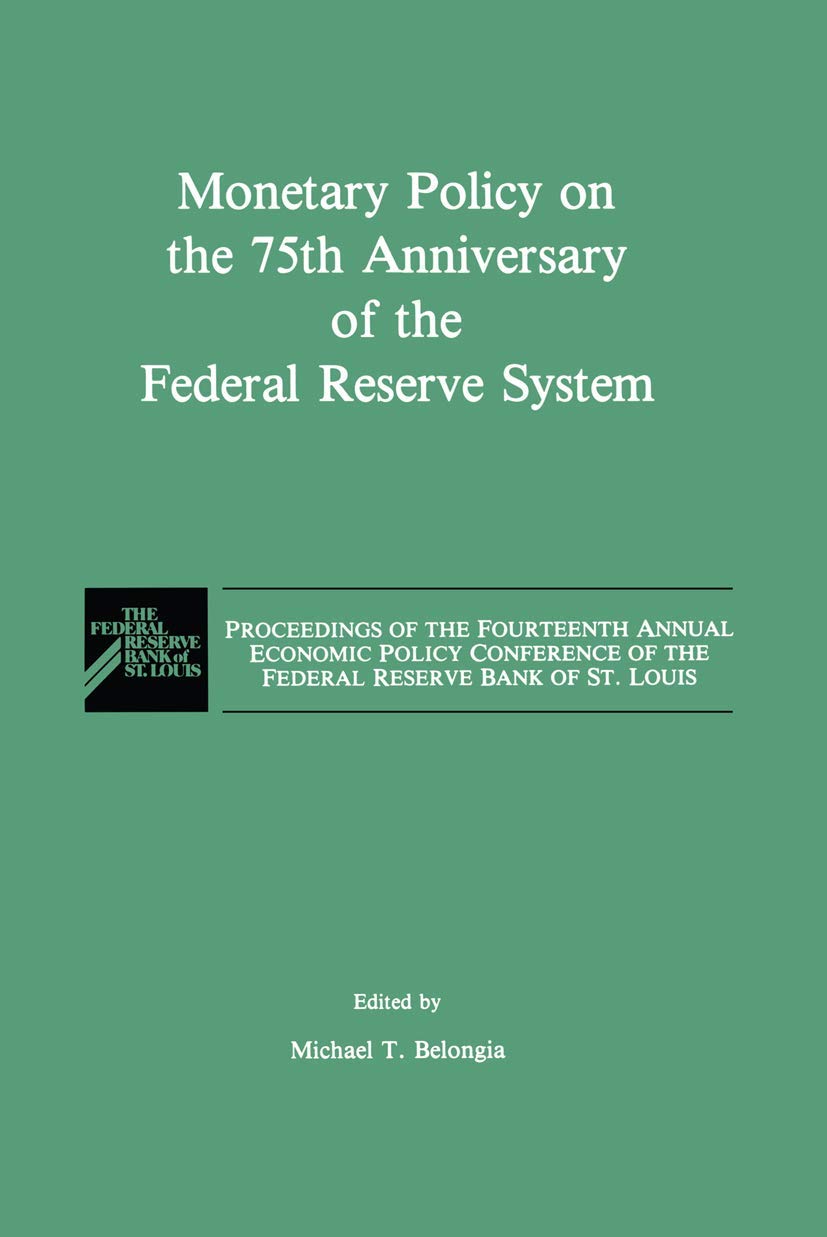
When the 12 District Banks of the Federal Reserve System opened their doors for business on November 16, 1914, few observers could have foreseen the Fed's present role as a major, if not dominant, player in U. S. and world economic policymaking. After all, two previous attempts to create a central bank in this country had ended in failure. Moreover, much of the economic theory and institutional structure that have given rise to monetary policy's influence in recent years were not yet in place. Indeed, it would take the Fed more than 20 years to learn (by accident!) the power of open market operations. Clearly, the modern Federal Reserve System has found itself with powers and responsibilities that were not envisioned by its founders. These proceedings from a conference held at the Federal Reserve Bank of St. Louis on October 1920, 1989, examine U. S. monetary policy from a variety of perspectives: a historical review of how it has affected aggregate economic performance; a positive analysis of why the Federal Reserve has chosen particular policy strategies; a review of normative arguments about what the Fed should pursue as its policy objective; a critique of how the Fed's "output"the flow of monetary services in the U. S. economyis measured; and, finally, a debate over the Fed's ability to influence real economic activity by changing the nominal quantity of money in circulation.
⚠️ WARNING (California Proposition 65):
This product may contain chemicals known to the State of California to cause cancer,
birth defects, or other reproductive harm.
For MAP (Minimum Advertised Price) violations and Intellectual Property (IP) or Trademark concerns, please contact:
support@ergodebooks.com
⚠️ California Proposition 65 Warning: Some products sold on this website may expose you to chemicals known to the State of California to cause cancer, birth defects, or other reproductive harm. For more information, visit www.P65Warnings.ca.gov.