If you have any questions, you are always welcome to contact us. We'll get back to you as soon as possible, withing 24 hours on weekdays.
Customer service
All questions about your order, return and delivery must be sent to our customer service team by e-mail at yourstore@yourdomain.com
Sale & Press
If you are interested in selling our products, need more information about our brand or wish to make a collaboration, please contact us at press@yourdomain.com
Help
If you have any questions, you are always welcome to contact us. We'll get back to you as soon as possible, withing 24 hours on weekdays.
Customer service
All questions about your order, return and delivery must be sent to our customer service team by e-mail at yourstore@yourdomain.com
Sale & Press
If you are interested in selling our products, need more information about our brand or wish to make a collaboration, please contact us at press@yourdomain.com
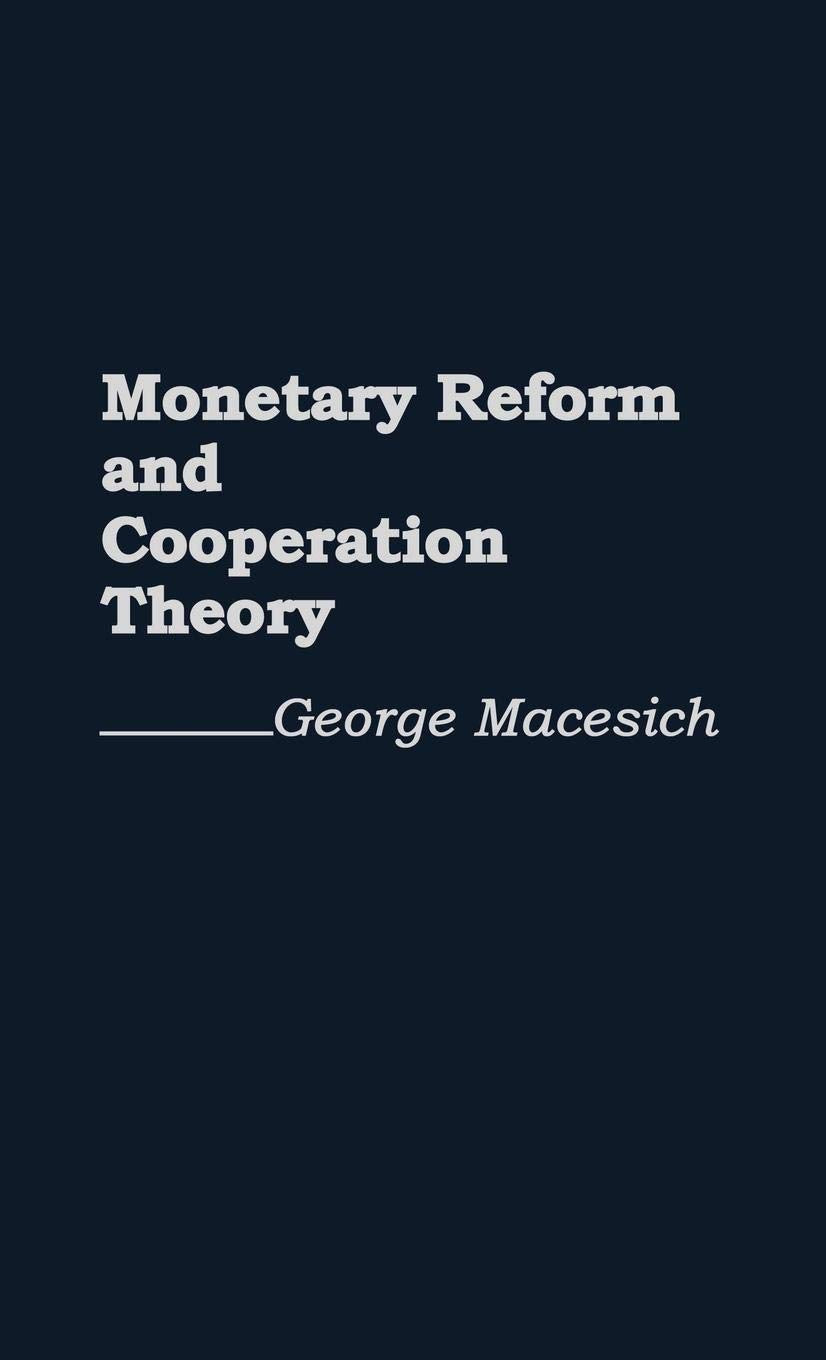
This volume demonstrates how monetary and financial organizations in the United States and abroad can be improved through a new addition to traditional monetary policy. Cooperation theory, a system developed from games theory, is shown to provide an appropriate action/reaction approach that can lead to cooperation without abandoning the free market. Institutional, theoretical, and empirical results of game theory, computer simulation, monetary theory, and policy analysis are woven together so that each reinforces the other. The text clearly stresses that although unilateral, noncooperative action may result in shortterm advantage for an organization, it ultimately leads to longterm losses for all in the economic system.Monetary Reform and Cooperation Theory opens with a discussion of cooperation theory. It goes on to address improving the monetary financial organization. Bureaucracy and philosophy are analyzed, along with reform in the banking industry and banking in other countries. The book concludes with issues of international creditors and debtors. This work is full of useful information for the general economist, political scientist, and layman on the complex issue of monetary reform and the positive role cooperation theory can play in this vital process.
⚠️ WARNING (California Proposition 65):
This product may contain chemicals known to the State of California to cause cancer,
birth defects, or other reproductive harm.
For MAP (Minimum Advertised Price) violations and Intellectual Property (IP) or Trademark concerns, please contact:
support@ergodebooks.com
⚠️ California Proposition 65 Warning: Some products sold on this website may expose you to chemicals known to the State of California to cause cancer, birth defects, or other reproductive harm. For more information, visit www.P65Warnings.ca.gov.