If you have any questions, you are always welcome to contact us. We'll get back to you as soon as possible, withing 24 hours on weekdays.
Customer service
All questions about your order, return and delivery must be sent to our customer service team by e-mail at yourstore@yourdomain.com
Sale & Press
If you are interested in selling our products, need more information about our brand or wish to make a collaboration, please contact us at press@yourdomain.com
Help
If you have any questions, you are always welcome to contact us. We'll get back to you as soon as possible, withing 24 hours on weekdays.
Customer service
All questions about your order, return and delivery must be sent to our customer service team by e-mail at yourstore@yourdomain.com
Sale & Press
If you are interested in selling our products, need more information about our brand or wish to make a collaboration, please contact us at press@yourdomain.com
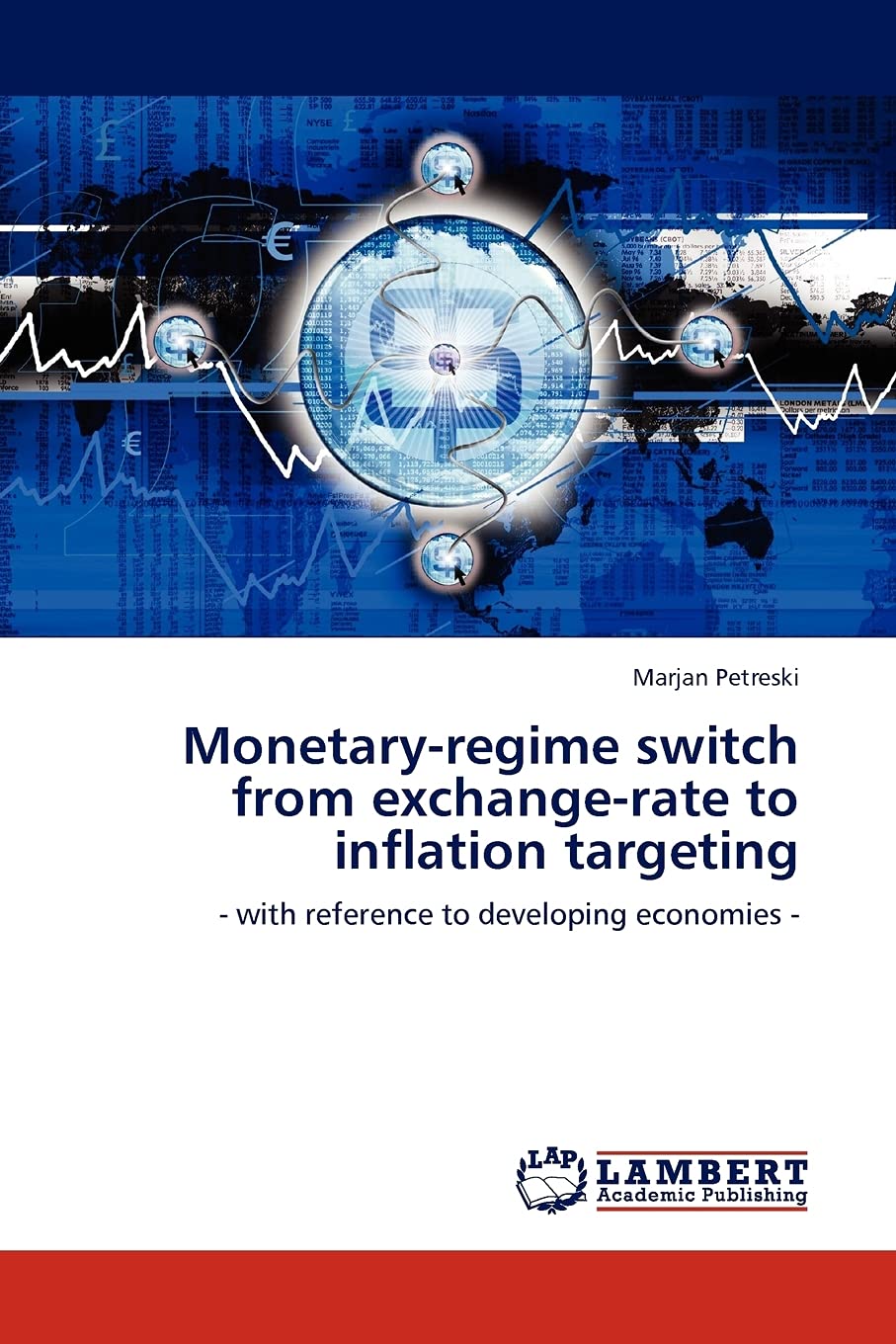
The study investigates whether a switch from exchangerate targeting to inflation targeting will facilitate a more appropriate monetary policy and a more stable macroeconomic environment in developing economies. The research finds that the exchangerate regime is not significant in explaining growth. The empirical evidence on its effect on output volatility suggests that a termsoftrade shock larger than seven percentage points under a fixed exchangerate regime will give higher output volatility compared to a float. Given these findings, the study suggests the exchange rate be made flexible and that the direct targeting of inflation is a rational choice in the aftermath of peg exit. To investigate whether monetarypolicy responses change under such a regime switching, allowing for the possibility of an endogenous switch, the study estimates augmented Taylor rule with two approaches: a panel switching regression; and a Markovswitching VAR. Results from both suggest that inflation targeting represented a real switch in developing economies.
⚠️ WARNING (California Proposition 65):
This product may contain chemicals known to the State of California to cause cancer,
birth defects, or other reproductive harm.
For MAP (Minimum Advertised Price) violations and Intellectual Property (IP) or Trademark concerns, please contact:
support@ergodebooks.com
⚠️ California Proposition 65 Warning: Some products sold on this website may expose you to chemicals known to the State of California to cause cancer, birth defects, or other reproductive harm. For more information, visit www.P65Warnings.ca.gov.