If you have any questions, you are always welcome to contact us. We'll get back to you as soon as possible, withing 24 hours on weekdays.
Customer service
All questions about your order, return and delivery must be sent to our customer service team by e-mail at yourstore@yourdomain.com
Sale & Press
If you are interested in selling our products, need more information about our brand or wish to make a collaboration, please contact us at press@yourdomain.com
Help
If you have any questions, you are always welcome to contact us. We'll get back to you as soon as possible, withing 24 hours on weekdays.
Customer service
All questions about your order, return and delivery must be sent to our customer service team by e-mail at yourstore@yourdomain.com
Sale & Press
If you are interested in selling our products, need more information about our brand or wish to make a collaboration, please contact us at press@yourdomain.com
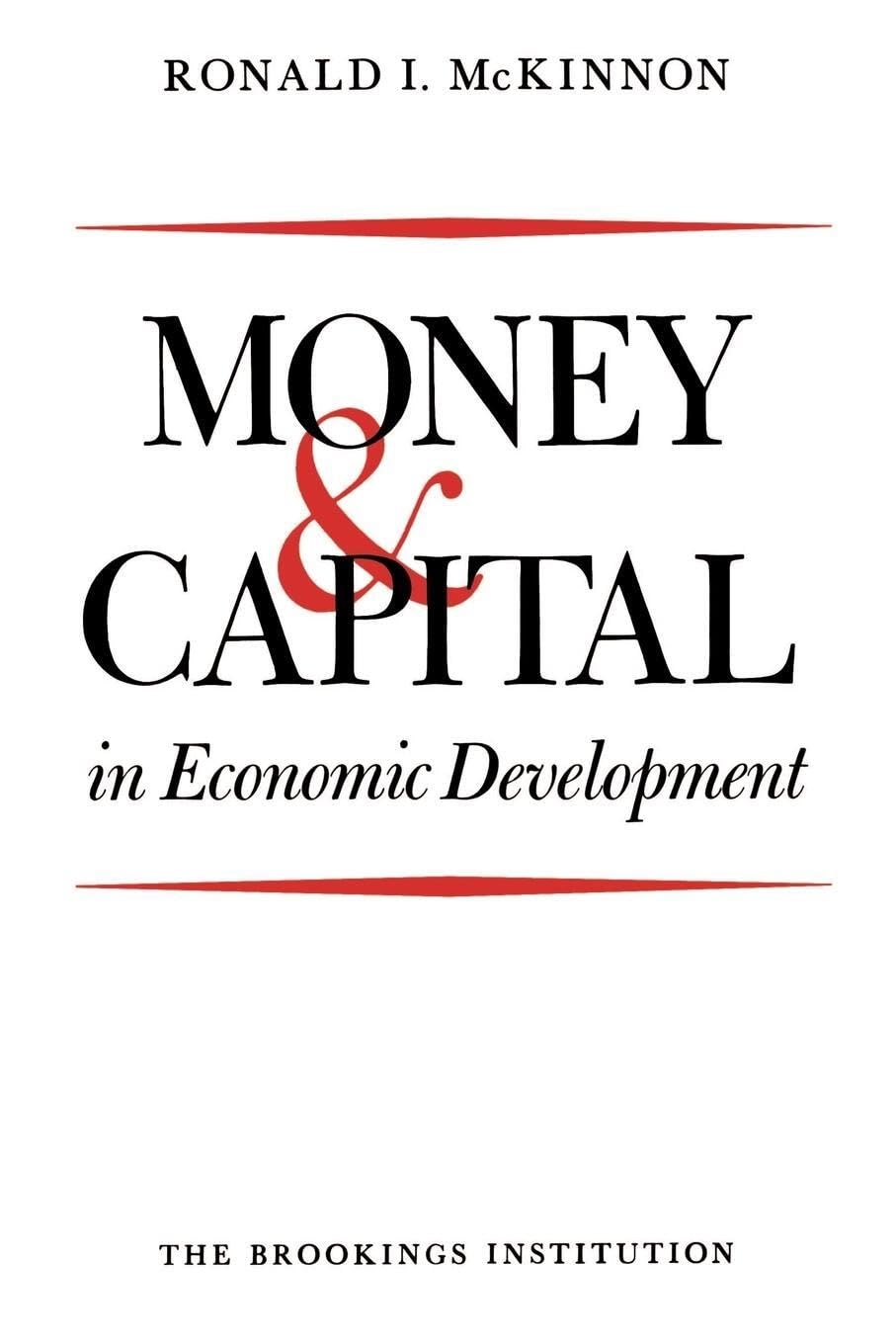
This books presents a theory of economic development very different from the ''stages of growth'' hypothesis or strategies emphasizing foreign aid, trade, or regional association. Leaving these aside, the author breaks new ground by focusing on the use of domestic capital markets to stimulate economic performance. He suggests a ''bootstrap'' approach in which successful development would depend largely on policy choices made by national authorities in the developing countries themselves.Central to his theory is the freeing of domestic financial markets to allow interest rates to reflect the true scarcity of capital in a developing economy. His analysis leads to a critique of prevailing monetary theory and to a new view of the relation between money and physical capitala view with policy implications for governments striving to overcome the vicious circle of inflation and stagnation. Examining the performance of South Korea, Taiwan, Brazil, and other countries, the author suggests that their success or failure has depended primarily on steps taken in the monetary sector. He concludes that monetary reform should take precedence over other development measures, such as tariff and tax reform or the encouragement of foreign capital investment. In addition to challenging much of the conventional wisdom of development, the author's revision of accepted monetary theory may be relevant for mature economies that face monetary problems.'
⚠️ WARNING (California Proposition 65):
This product may contain chemicals known to the State of California to cause cancer,
birth defects, or other reproductive harm.
For MAP (Minimum Advertised Price) violations and Intellectual Property (IP) or Trademark concerns, please contact:
support@ergodebooks.com
⚠️ California Proposition 65 Warning: Some products sold on this website may expose you to chemicals known to the State of California to cause cancer, birth defects, or other reproductive harm. For more information, visit www.P65Warnings.ca.gov.