
Title
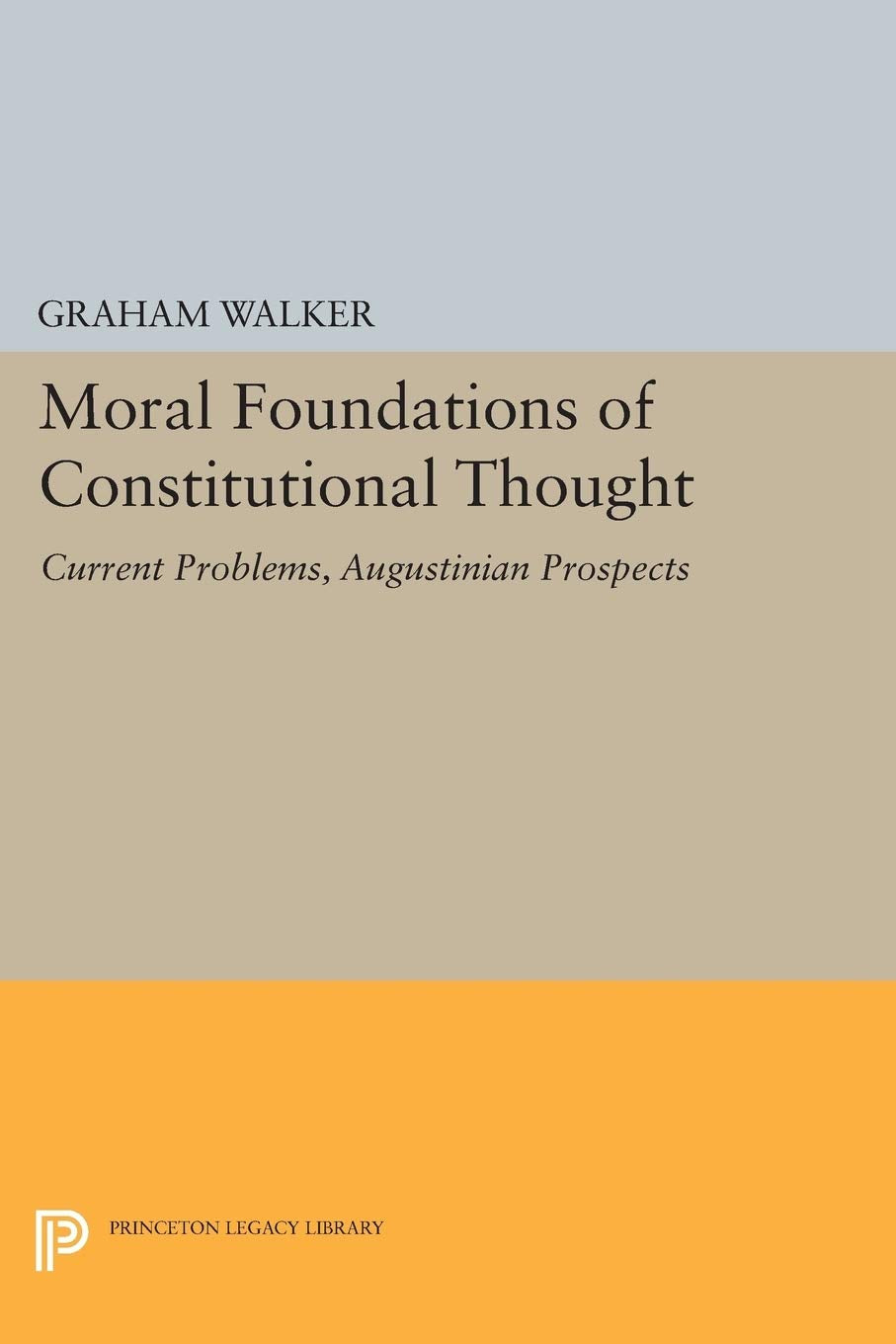
Moral Foundations of Constitutional Thought: Current Problems, Augustinian Prospects (Princeton Legacy Library),Used
Sold by Ergodebooks, an authorized reseller.
Returns accepted within 30 days | support@ergodebooks.com
Shipping Information
- Free Standard Shipping — United States only
- Processing Time: 3–5 business days
- Estimated Delivery: 6–10 business days after dispatch
- Double-boxed, fully insured & discreetly packaged
- Tracking number sent via email once dispatched
Returns & Refund
Returns accepted within 30 days of delivery.
Damaged or Defective Item
Free return shipping + replacement or full refund
Wrong Item Received
Free return shipping + replacement or full refund
Change of Mind
Return shipping at customer's expense · 25% restocking fee applies
Payment Option

Graham Walker boldly recasts the debate over issues like constitutional interpretation and judicial review, and challenges contemporary thinking not only about specifically constitutional questions but also about liberalism, law, justice, and rights. Walker targets the "skeptical" moral nihilism of leading American judges and writers, on both the political left and right, charging that their premises undermine the authority of the Constitution, empty its moral words of any determinate meaning, and make nonsense of ostensibly normative theories. But he is even more worried about those who desire to conduct constitutional government by direct recourse to an authoritative moral truth. Augustine's political ethics, Walker argues, offers a solutiona way to embrace substantive goodness while relativizing its embodiment in politics and law.Walker sees in Augustinian theory an understanding of the rule of law that prevents us from mistaking law for moral truth. Pointing out how the tensions in that theory resonate with the normative ambivalence of America's liberal constitutionalism, he shows that Augustine can provide successful but decidedly nonliberal grounds for the artifices and compromises characteristic of law in a liberal state.Originally published in 1990.The Princeton Legacy Library uses the latest printondemand technology to again make available previously outofprint books from the distinguished backlist of Princeton University Press. These editions preserve the original texts of these important books while presenting them in durable paperback and hardcover editions. The goal of the Princeton Legacy Library is to vastly increase access to the rich scholarly heritage found in the thousands of books published by Princeton University Press since its founding in 1905.
⚠️ WARNING (California Proposition 65):
This product may contain chemicals known to the State of California to cause cancer, birth defects, or other reproductive harm.
For more information, please visit www.P65Warnings.ca.gov.