

Title
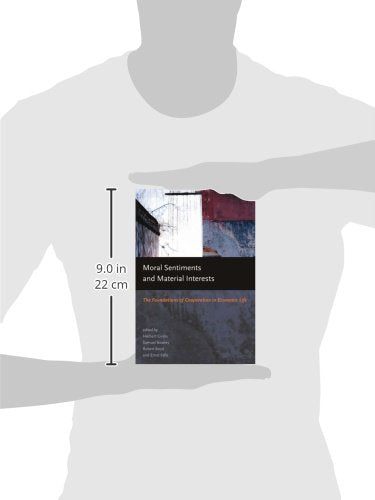
Moral Sentiments And Material Interests: The Foundations Of Cooperation In Economic Life (Economic Learning And Social Evolution,New
Sold by Ergodebooks, an authorized reseller.
Returns accepted within 30 days | support@ergodebooks.com
Shipping Information
- Free Standard Shipping — United States only
- Processing Time: 3–5 business days
- Estimated Delivery: 6–10 business days after dispatch
- Double-boxed, fully insured & discreetly packaged
- Tracking number sent via email once dispatched
Returns & Refund
Returns accepted within 30 days of delivery.
Damaged or Defective Item
Free return shipping + replacement or full refund
Wrong Item Received
Free return shipping + replacement or full refund
Change of Mind
Return shipping at customer's expense · 25% restocking fee applies
Payment Option

Moral Sentiments And Material Interests Presents An Innovative Synthesis Of Research In Different Disciplines To Argue That Cooperation Stems Not From The Stereotypical Selfish Agent Acting Out Of Disguised Selfinterest But From The Presence Of 'Strong Reciprocators' In A Social Group.Presenting An Overview Of Research In Economics, Anthropology, Evolutionary And Human Biology, Social Psychology, And Sociology, The Book Deals With Both The Theoretical Foundations And The Policy Implications Of This Explanation For Cooperation. Chapter Authors In The Remaining Parts Of The Book Discuss The Behavioral Ecology Of Cooperation In Humans And Nonhuman Primates, Modeling And Testing Strong Reciprocity In Economic Scenarios, And Reciprocity And Social Policy. The Evidence For Strong Reciprocity In The Book Includes Experiments Using The Famous Ultimatum Game (In Which Two Players Must Agree On How To Split A Certain Amount Of Money Or They Both Get Nothing).
⚠️ WARNING (California Proposition 65):
This product may contain chemicals known to the State of California to cause cancer, birth defects, or other reproductive harm.
For more information, please visit www.P65Warnings.ca.gov.
- Q: How many pages does this book have? A: This book has four hundred pages. It provides an extensive exploration of cooperation in economic life.
- Q: What is the binding type of this book? A: This book is paperback. The paperback binding makes it lightweight and easy to carry.
- Q: What are the dimensions of this book? A: The dimensions are five point seventy-five inches by zero point seventy-five inches by eight point seventy-five inches. These dimensions make it a convenient size for reading.
- Q: Who is the author of this book? A: The author is Herbert Gintis. He is known for his work in economics and social sciences.
- Q: What is the main topic of this book? A: The main topic of the book is the foundations of cooperation in economic life. It challenges traditional views on self-interest.
- Q: Is this book suitable for academic study? A: Yes, this book is suitable for academic study. It synthesizes research across multiple disciplines, making it valuable for scholars.
- Q: How can I apply the concepts in this book? A: You can apply the concepts by examining cooperation in your own social or economic environments. The book discusses real-world implications and policy.
- Q: Is this book appropriate for beginners in economics? A: Yes, this book is appropriate for beginners. It presents complex ideas in an accessible manner, making it easier to understand.
- Q: What disciplines does this book cover? A: This book covers economics, anthropology, evolutionary biology, social psychology, and sociology. It provides a comprehensive understanding of cooperation.
- Q: How should I store this book? A: Store this book in a cool, dry place. Avoid direct sunlight to preserve the quality of the paperback binding.
- Q: Can I lend this book to someone? A: Yes, you can lend this book to someone. Just make sure to keep it in good condition while they borrow it.
- Q: How do I clean this book if it gets dirty? A: You can gently wipe the cover with a soft, dry cloth. Avoid using liquids that might damage the pages.
- Q: What if I receive a damaged copy of the book? A: If you receive a damaged copy, contact the seller for a replacement. Most sellers have return policies for damaged items.
- Q: What should I do if I have questions about the content? A: If you have questions about the content, consider joining study groups or online forums related to economics and social sciences.
- Q: Is this book part of a series? A: Yes, this book is part of the Economic Learning and Social Evolution Series. It is one of several works exploring economic cooperation.
- Q: What is the publication year of this book? A: The publication year is not specified in the provided details. Check the front matter of the book for this information.