If you have any questions, you are always welcome to contact us. We'll get back to you as soon as possible, withing 24 hours on weekdays.
Customer service
All questions about your order, return and delivery must be sent to our customer service team by e-mail at yourstore@yourdomain.com
Sale & Press
If you are interested in selling our products, need more information about our brand or wish to make a collaboration, please contact us at press@yourdomain.com
Help
If you have any questions, you are always welcome to contact us. We'll get back to you as soon as possible, withing 24 hours on weekdays.
Customer service
All questions about your order, return and delivery must be sent to our customer service team by e-mail at yourstore@yourdomain.com
Sale & Press
If you are interested in selling our products, need more information about our brand or wish to make a collaboration, please contact us at press@yourdomain.com
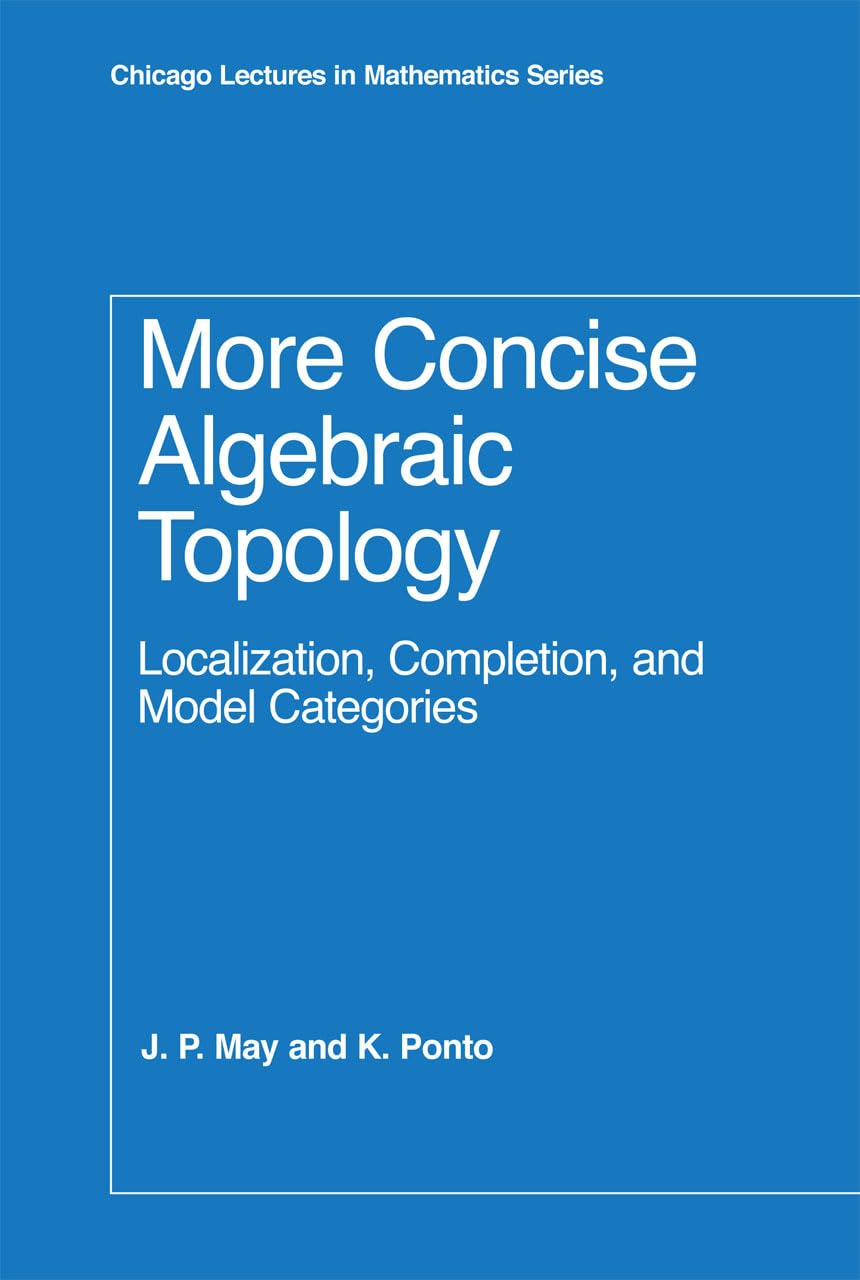
With firm foundations dating only from the 1950s, algebraic topology is a relatively young area of mathematics. There are very few textbooks that treat fundamental topics beyond a first course, and many topics now essential to the field are not treated in any textbook. J. Peter Mays A Concise Course in Algebraic Topology addresses the standard first course material, such as fundamental groups, covering spaces, the basics of homotopy theory, and homology and cohomology. In this sequel, May and his coauthor, Kathleen Ponto, cover topics that are essential for algebraic topologists and others interested in algebraic topology, but that are not treated in standard texts. They focus on the localization and completion of topological spaces, model categories, and Hopf algebras.The first half of the book sets out the basic theory of localization and completion of nilpotent spaces, using the most elementary treatment the authors know of. It makes no use of simplicial techniques or model categories, and it provides full details of other necessary preliminaries. With these topics as motivation, most of the second half of the book sets out the theory of model categories, which is the central organizing framework for homotopical algebra in general. Examples from topology and homological algebra are treated in parallel. A short last part develops the basic theory of bialgebras and Hopf algebras.
⚠️ WARNING (California Proposition 65):
This product may contain chemicals known to the State of California to cause cancer,
birth defects, or other reproductive harm.
For MAP (Minimum Advertised Price) violations and Intellectual Property (IP) or Trademark concerns, please contact:
support@ergodebooks.com
⚠️ California Proposition 65 Warning: Some products sold on this website may expose you to chemicals known to the State of California to cause cancer, birth defects, or other reproductive harm. For more information, visit www.P65Warnings.ca.gov.