If you have any questions, you are always welcome to contact us. We'll get back to you as soon as possible, withing 24 hours on weekdays.
Customer service
All questions about your order, return and delivery must be sent to our customer service team by e-mail at yourstore@yourdomain.com
Sale & Press
If you are interested in selling our products, need more information about our brand or wish to make a collaboration, please contact us at press@yourdomain.com
Help
If you have any questions, you are always welcome to contact us. We'll get back to you as soon as possible, withing 24 hours on weekdays.
Customer service
All questions about your order, return and delivery must be sent to our customer service team by e-mail at yourstore@yourdomain.com
Sale & Press
If you are interested in selling our products, need more information about our brand or wish to make a collaboration, please contact us at press@yourdomain.com
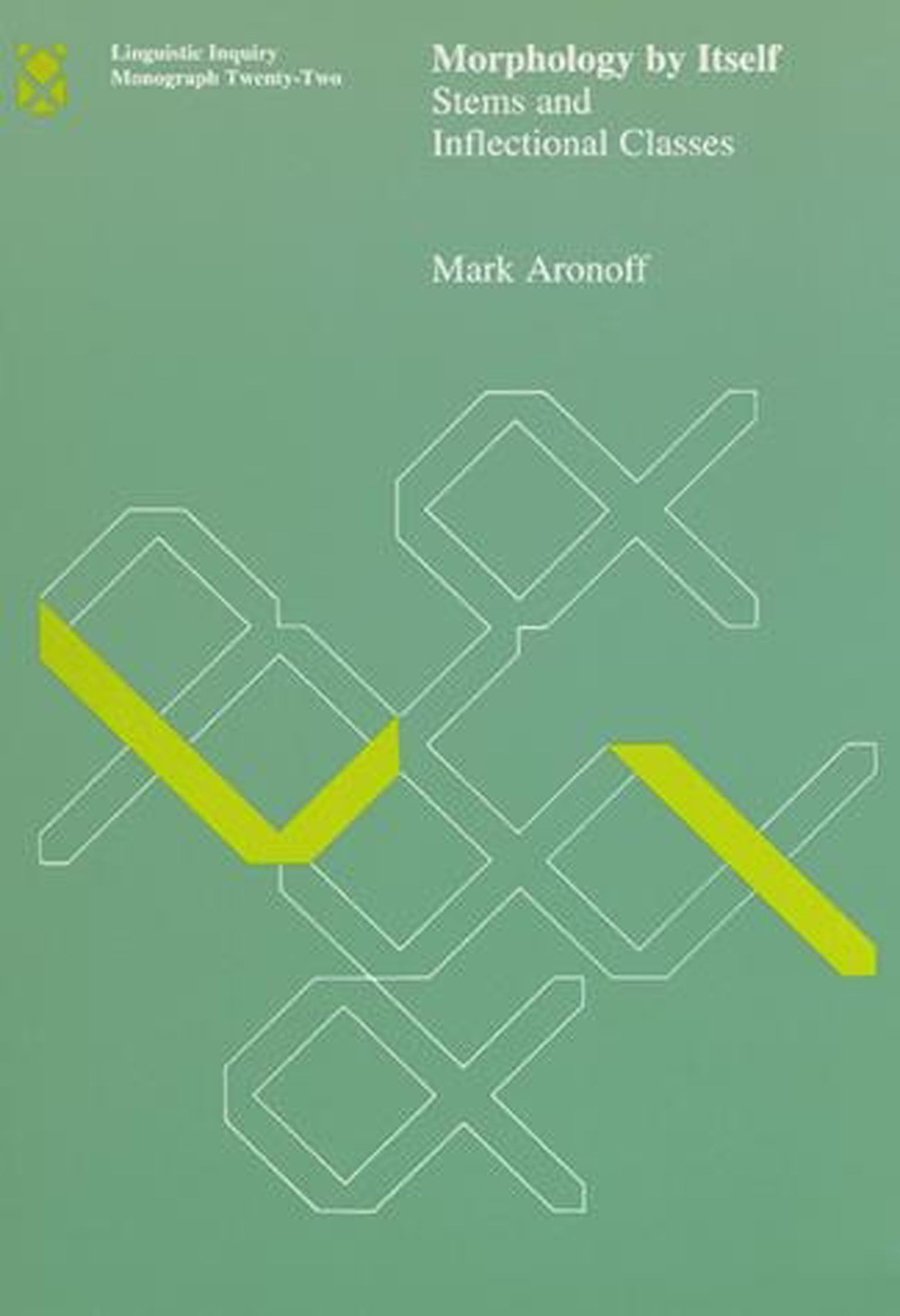
Most recent research in generative morphology has avoided the treatment of purely morphological phenomena and has focused instead on interface questions, such as the relation between morphology and syntax or between morphology and phonology. In this monograph Mark Aronoff argues that linguists must consider morphology by itself, not merely as an appendage of syntax and phonology, and that linguistic theory must allow for a separate and autonomous morphological component. Following a general introductory chapter, Aronoff examines two narrow classes of morphological phenomena to make his case: stems and inflectional classes. Concentrating first on Latin verb morphology, he argues that morphological stems are neither syntactic nor phonological units. Next, using data from a number of languages, he underscores the traditional point that the inflectional class of a word is not reducible to its syntactic gender. He then explores in detail the phonologically motivated nominal inflectional class system of two languages of Papua New Guinea (Arapeshand Yimas) and the precise nature of the relation between this system and the corresponding gender system. Finally, drawing on a number of Semitic languages, Aronoff argues that the verb classes of these languages are purely inflectional although they are partly motivated by derivational and syntactic considerations.
⚠️ WARNING (California Proposition 65):
This product may contain chemicals known to the State of California to cause cancer,
birth defects, or other reproductive harm.
For MAP (Minimum Advertised Price) violations and Intellectual Property (IP) or Trademark concerns, please contact:
support@ergodebooks.com
⚠️ California Proposition 65 Warning: Some products sold on this website may expose you to chemicals known to the State of California to cause cancer, birth defects, or other reproductive harm. For more information, visit www.P65Warnings.ca.gov.