
Title
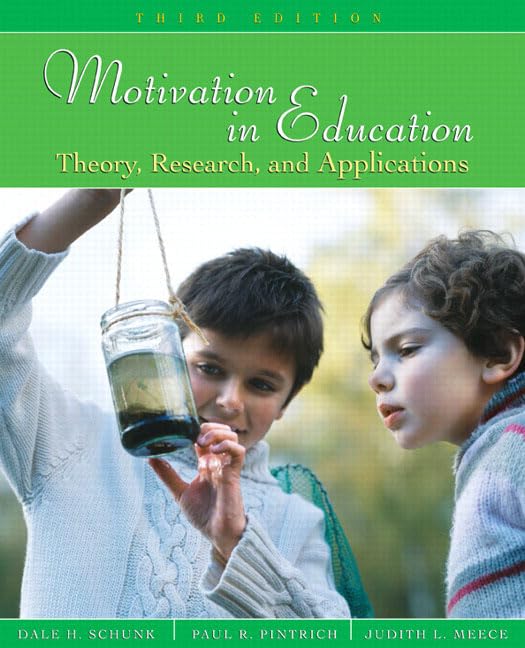
Motivation in Education: Theory, Research, and Applications (3rd Edition),New
Sold by Ergodebooks, an authorized reseller.
Returns accepted within 30 days | support@ergodebooks.com
Shipping Information
- Free Standard Shipping — United States only
- Processing Time: 3–5 business days
- Estimated Delivery: 6–10 business days after dispatch
- Double-boxed, fully insured & discreetly packaged
- Tracking number sent via email once dispatched
Returns & Refund
Returns accepted within 30 days of delivery.
Damaged or Defective Item
Free return shipping + replacement or full refund
Wrong Item Received
Free return shipping + replacement or full refund
Change of Mind
Return shipping at customer's expense · 25% restocking fee applies
Payment Option

The primary objectives of Motivation in Education: Theory, Research, and Application, third edition, are: to present major motivational theories, principles, and research findings in sufficient detail to help students understand the complexity of motivational processes and to provide examples of motivational concepts and principles applied to educational settingsAlthough different perspectives on motivation are presented, the text emphasizes the role of personal cognitions and beliefs during teaching and learning. This focus is consistent with the view that learners are active, constructive participants in the learning process; consequently, the text highlights how motivation is situated, facilitated, and constrained by various classroom and contextual factors.Following an introductory chapter that defines and exemplifies motivation and discusses motivation research, how motivation relates to learning, and historical views of motivation, the next six chapters discuss theoretical and conceptual perspectives that stress the role of personal cognitions, beliefs, affects and values in motivation: expectancyvalue theory, attribution theory, social cognitive theory, goal theory, interest and affect, and intrinsic and extrinsic motivation. The remaining three chapters focus on various contextual factors in promoting motivation: sociocultural influences, teacher influences, and classroom and school influences. By blending theory, research, and applications throughout, the text provides instructors and students with a unified view of the role of motivation in education.
⚠️ WARNING (California Proposition 65):
This product may contain chemicals known to the State of California to cause cancer, birth defects, or other reproductive harm.
For more information, please visit www.P65Warnings.ca.gov.