If you have any questions, you are always welcome to contact us. We'll get back to you as soon as possible, withing 24 hours on weekdays.
Customer service
All questions about your order, return and delivery must be sent to our customer service team by e-mail at yourstore@yourdomain.com
Sale & Press
If you are interested in selling our products, need more information about our brand or wish to make a collaboration, please contact us at press@yourdomain.com
Help
If you have any questions, you are always welcome to contact us. We'll get back to you as soon as possible, withing 24 hours on weekdays.
Customer service
All questions about your order, return and delivery must be sent to our customer service team by e-mail at yourstore@yourdomain.com
Sale & Press
If you are interested in selling our products, need more information about our brand or wish to make a collaboration, please contact us at press@yourdomain.com
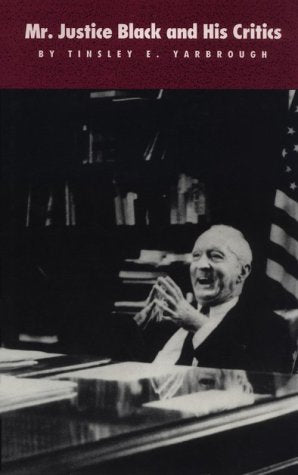
Many jurists give lip service to the idea that judicial interpretation of constitutional provisions should be based on the intent of the framers. Few, if any, have been as faithful to that conception as Hugo Black. As U.S. senator from Alabama, Black was a vigorous critic of the Supreme Court's use of the Constitution as a weapon against the Roosevelt New Deal. Once on the court he played a leading role in overturning those decisions and in attempting to establish for freedom of speech and other guarantees the interpretation he (and others) believe was warranted by the language and intent of the framers.Late in his career, however, Black's commitment to literalism and intent led him to assume apparently conservative positions in civil liberties cases. In an era characterized by growing acceptance of the belief that judges should adapt the Constitution to changing social and ethical perceptions, many came to regard Black's position as unrealistic and irrelevant.Tinsley E. Yarbrough analyzes Black's judicial and constitutional philosophy, as well as his approach to specific cases, through the eyes of Black's critics (such as Justices Frankfurter and Harlan) and through an assessment of scholarly opinion of his jurisprudence. The result is a stimulating and provocative addition to the study of Justice Black and the Supreme Court.
⚠️ WARNING (California Proposition 65):
This product may contain chemicals known to the State of California to cause cancer,
birth defects, or other reproductive harm.
For MAP (Minimum Advertised Price) violations and Intellectual Property (IP) or Trademark concerns, please contact:
support@ergodebooks.com
⚠️ California Proposition 65 Warning: Some products sold on this website may expose you to chemicals known to the State of California to cause cancer, birth defects, or other reproductive harm. For more information, visit www.P65Warnings.ca.gov.