
Title
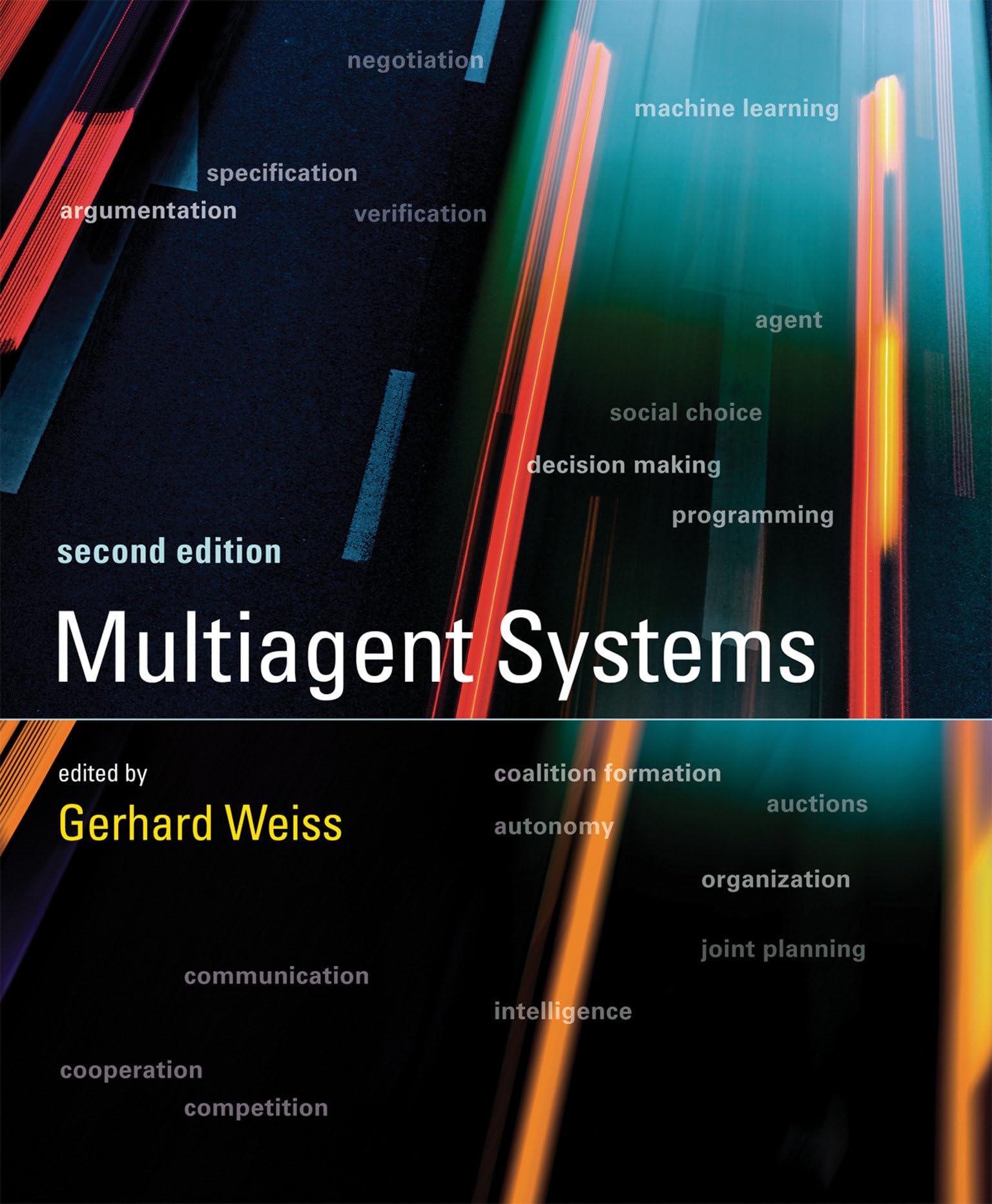
Multiagent Systems, second edition (Intelligent Robotics and Autonomous Agents series),Used
Sold by Ergodebooks, an authorized reseller.
Returns accepted within 30 days | support@ergodebooks.com
Shipping Information
- Free Standard Shipping — United States only
- Processing Time: 3–5 business days
- Estimated Delivery: 6–10 business days after dispatch
- Double-boxed, fully insured & discreetly packaged
- Tracking number sent via email once dispatched
Returns & Refund
Returns accepted within 30 days of delivery.
Damaged or Defective Item
Free return shipping + replacement or full refund
Wrong Item Received
Free return shipping + replacement or full refund
Change of Mind
Return shipping at customer's expense · 25% restocking fee applies
Payment Option

The new edition of an introduction to multiagent systems that captures the state of the art in both theory and practice, suitable as textbook or reference.Multiagent systems are made up of multiple interacting intelligent agentscomputational entities to some degree autonomous and able to cooperate, compete, communicate, act flexibly, and exercise control over their behavior within the frame of their objectives. They are the enabling technology for a wide range of advanced applications relying on distributed and parallel processing of data, information, and knowledge relevant in domains ranging from industrial manufacturing to ecommerce to health care. This book offers a stateoftheart introduction to multiagent systems, covering the field in both breadth and depth, and treating both theory and practice. It is suitable for classroom use or independent study.This second edition has been completely revised, capturing the tremendous developments in multiagent systems since the first edition appeared in 1999. Sixteen of the book's seventeen chapters were written for this edition; all chapters are by leaders in the field, with each author contributing to the broad base of knowledge and experience on which the book rests.The book covers basic concepts of computational agency from the perspective of both individual agents and agent organizations; communication among agents; coordination among agents; distributed cognition; development and engineering of multiagent systems; and background knowledge in logics and game theory. Each chapter includes references, many illustrations and examples, and exercises of varying degrees of difficulty. The chapters and the overall book are designed to be selfcontained and understandable without additional material. Supplemental resources are available on the book's Web site.ContributorsRafael Bordini, Felix Brandt, Amit Chopra, Vincent Conitzer, Virginia Dignum, Jrgen Dix, Ed Durfee, Edith Elkind, Ulle Endriss, Alessandro Farinelli, Shaheen Fatima, Michael Fisher, Nicholas R. Jennings, Kevin LeytonBrown, Evangelos Markakis, Lin Padgham, Julian Padget, Iyad Rahwan, Talal Rahwan, Alex Rogers, Jordi SabaterMir, Yoav Shoham, Munindar P. Singh, Kagan Tumer, Karl Tuyls, Wiebe van der Hoek, Laurent Vercouter, Meritxell Vinyals, Michael Winikoff, Michael Wooldridge, Shlomo Zilberstein
⚠️ WARNING (California Proposition 65):
This product may contain chemicals known to the State of California to cause cancer, birth defects, or other reproductive harm.
For more information, please visit www.P65Warnings.ca.gov.
- Q: What is the page count of the book? A: The book contains nine hundred twenty pages. This extensive page count provides a comprehensive overview of multiagent systems.
- Q: What is the binding type of this book? A: The book is published in paperback binding. This makes it lightweight and easy to handle for reading or studying.
- Q: What are the dimensions of the book? A: The book measures eight point zero seven inches in length, one point three eight inches in width, and ten inches in height. These dimensions make it a standard-sized textbook.
- Q: Who is the author of this book? A: The author of the book is Gerhard Weiss. He is recognized as an authority in the field of multiagent systems.
- Q: What is the main theme of the book? A: The main theme is an introduction to multiagent systems. It covers both theoretical and practical aspects suitable for academic and independent study.
- Q: How do I use this book for study? A: You can use this book as a textbook or reference material. It includes exercises and examples to enhance understanding of multiagent systems.
- Q: Is this book suitable for beginners? A: Yes, this book is suitable for beginners as well as advanced readers. It covers fundamental concepts and progresses to more complex topics.
- Q: Can I use this book for a college course? A: Yes, this book is ideal for college courses on multiagent systems. It has been revised to reflect the latest developments in the field.
- Q: Are there exercises included in the book? A: Yes, the book includes exercises of varying difficulty. These exercises help reinforce the concepts discussed in each chapter.
- Q: How should I care for this book? A: To care for the book, store it in a dry, cool place. Avoid exposing it to direct sunlight to prevent fading or damage.
- Q: Is there a website for supplemental resources? A: Yes, supplemental resources are available on the book's official website. This can enhance your learning experience with additional materials.
- Q: What if the book arrives damaged? A: If the book arrives damaged, you should contact the seller for a return or exchange. Most sellers have policies in place for damaged goods.
- Q: What is the return policy for this book? A: The return policy typically allows for returns within a specified period. Check with the seller for specific details regarding returns.
- Q: How do I properly store this book? A: Store the book upright on a shelf or in a bookcase. Ensure it is not overcrowded to prevent bending or damage to the spine.
- Q: What topics does the book cover? A: The book covers topics such as computational agency, communication among agents, and distributed cognition. It provides a thorough understanding of multiagent systems.
- Q: Is this book part of a series? A: Yes, this book is part of the Intelligent Robotics and Autonomous Agents series. It connects with other works in the field of robotics and AI.