
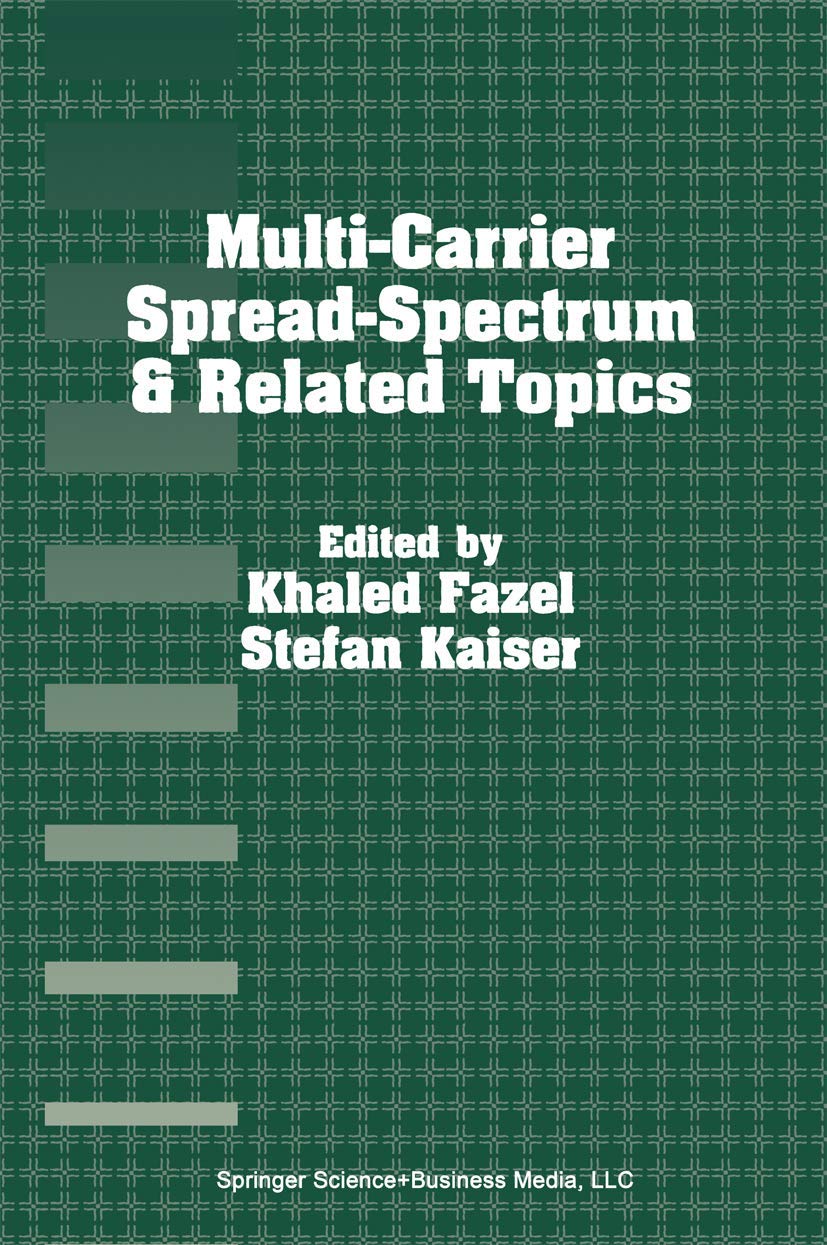
Title
MultiCarrier SpreadSpectrum & Related Topics: Third International Workshop, September 2628, 2001, Oberpfafenhofen, Germany,Used
Sold by Ergodebooks, an authorized reseller.
Returns accepted within 30 days | support@ergodebooks.com
Shipping Information
- Free Standard Shipping — United States only
- Processing Time: 3–5 business days
- Estimated Delivery: 6–10 business days after dispatch
- Double-boxed, fully insured & discreetly packaged
- Tracking number sent via email once dispatched
Returns & Refund
Returns accepted within 30 days of delivery.
Damaged or Defective Item
Free return shipping + replacement or full refund
Wrong Item Received
Free return shipping + replacement or full refund
Change of Mind
Return shipping at customer's expense · 25% restocking fee applies
Payment Option

Stefan Kaiser Khaled Fazel Radio System Design German Aerospace Center (DLR) Marconi Communications lnstitute of Communications and Navigation D71522 Backnang, Germany D82234 Wessling, Germany We are currently observing that frequency spectrum is a limited and valuable resource for wireless mobile communications. A good example can be observed among European network operators for the prices to pay for frequency bands for UMTS/IMT2000. Keeping this in mind, the fIrst goal when designing future wireless communication systems has to be the increase in spectral effIciency by allowing higher flexibility for the system design and deployment. The development in digital communications in the past years has enabled effIcient modulation and coding techniques for robust and spectral effIcient data, speech, audio and video transmission. Here, we should mention two interesting and successful techniques. These are the multicarrier modulation (e. g. OFDM) and the spread spectrum technique (e. g. DSCDMA). During the last decade of this millennium the technique of multicarrier transmission for wireless broadband multimedia applications has received wide interest. Its fIrst great success was in 1990 as it was selected for the European Digital Audio Broadcasting (DAB) standard. Its further prominent success was in 1995 and 1998 as it was selected as modulation scheme for the European Digital Video Broadcasting (DVBT) standard and in three broadband wireless indoor standards, namely European ETSIHIPERLAN/2, American IEEE802. 11a and Japanese MMAC, respectively.
⚠️ WARNING (California Proposition 65):
This product may contain chemicals known to the State of California to cause cancer, birth defects, or other reproductive harm.
For more information, please visit www.P65Warnings.ca.gov.