
Title
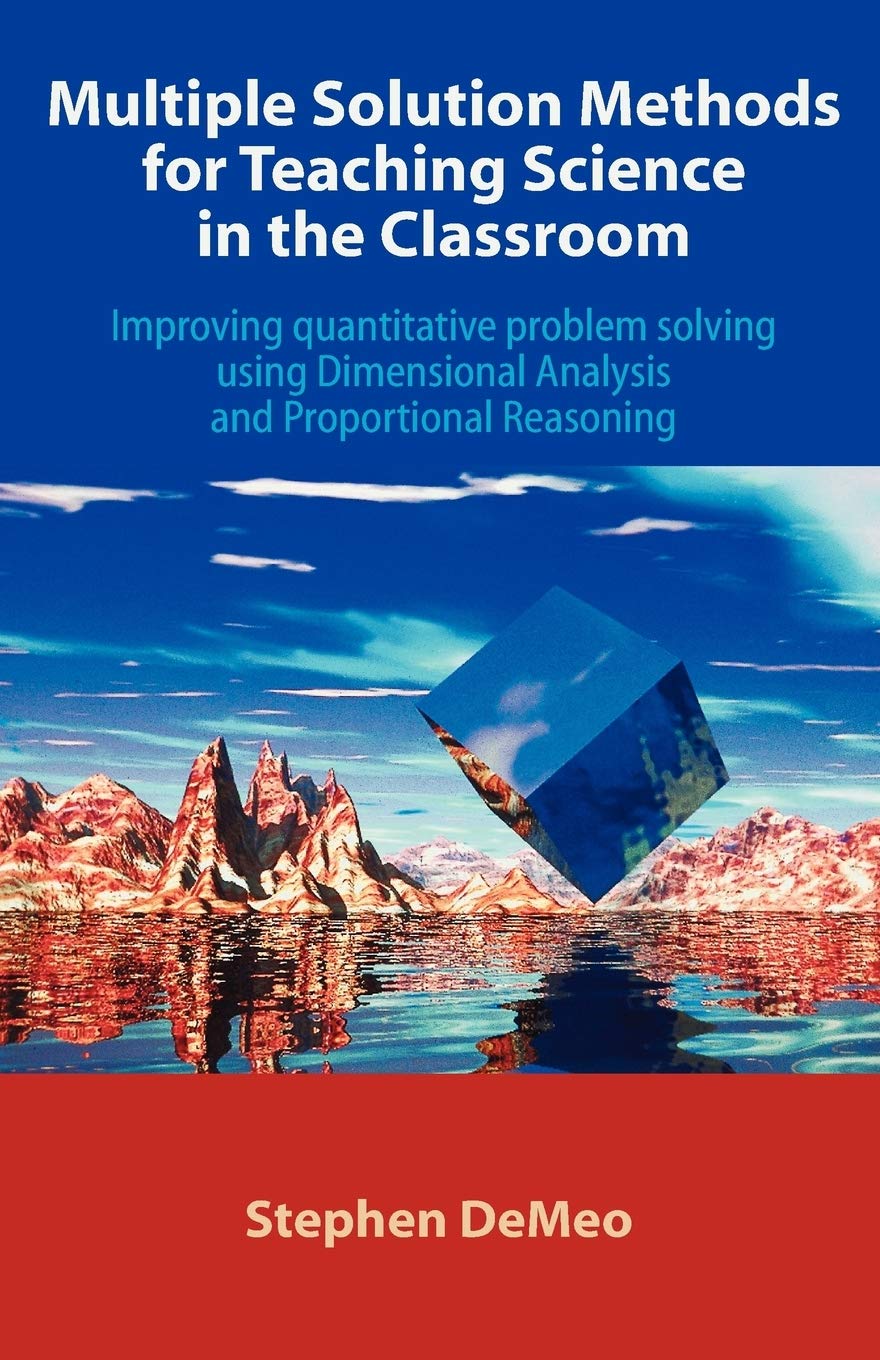
Multiple Solution Methods for Teaching Science in the Classroom: Improving Quantitative Problem Solving Using Dimensional Analys,Used
Sold by Ergodebooks, an authorized reseller.
Returns accepted within 30 days | support@ergodebooks.com
Shipping Information
- Free Standard Shipping — United States only
- Processing Time: 3–5 business days
- Estimated Delivery: 6–10 business days after dispatch
- Double-boxed, fully insured & discreetly packaged
- Tracking number sent via email once dispatched
Returns & Refund
Returns accepted within 30 days of delivery.
Damaged or Defective Item
Free return shipping + replacement or full refund
Wrong Item Received
Free return shipping + replacement or full refund
Change of Mind
Return shipping at customer's expense · 25% restocking fee applies
Payment Option

For the first time in science education, the subject of multiple solution methods is explored in book form. While a multiple method teaching approach is utilized extensively in math education, there are very few journal articles and no texts written on this topic in science. Teaching multiple methods to science students in order to solve quantitative word problems is important for two reasons. First it challenges the practice by teachers that one specific method should be used when solving problems. Secondly, it calls into question the belief that multiple methods would confuse students and retard their learning.Using a case study approach and informed by research conducted by the author, this book claims that providing students with a choice of methods as well as requiring additional methods as a way to validate results can be beneficial to student learning. A close reading of the literature reveals that time spent on elucidating concepts rather than on algorithmic methodologies is a critical issue when trying to have students solve problems with understanding. It is argued that conceptual understanding can be enhanced through the use of multiple methods in an environment where students can compare, evaluate, and verbally discuss competing methodologies through the facilitation of the instructor.This book focuses on two very useful methods: proportional reasoning (PR) and dimensional analysis (DA). These two methods are important because they can be used to solve a large number of problems in all of the four academic sciences (biology, chemistry, physics, and earth science). This book concludes with a plan to integrate DA and PR into the academic science curriculum starting in late elementary school through to the introductory college level. A challenge is presented to teachers as well as to textbook writers who rely on the singlemethod paradigm to consider an alternative way to teach scientific problem solving.
⚠️ WARNING (California Proposition 65):
This product may contain chemicals known to the State of California to cause cancer, birth defects, or other reproductive harm.
For more information, please visit www.P65Warnings.ca.gov.