
Title

Multiplication Made Easy: Fast Learning Memory Booster Workbook One Sheet A Day Practice Worksheets,Used
Sold by Ergodebooks, an authorized reseller.
Returns accepted within 30 days | support@ergodebooks.com
Shipping Information
- Free Standard Shipping — United States only
- Processing Time: 3–5 business days
- Estimated Delivery: 6–10 business days after dispatch
- Double-boxed, fully insured & discreetly packaged
- Tracking number sent via email once dispatched
Returns & Refund
Returns accepted within 30 days of delivery.
Damaged or Defective Item
Free return shipping + replacement or full refund
Wrong Item Received
Free return shipping + replacement or full refund
Change of Mind
Return shipping at customer's expense · 25% restocking fee applies
Payment Option

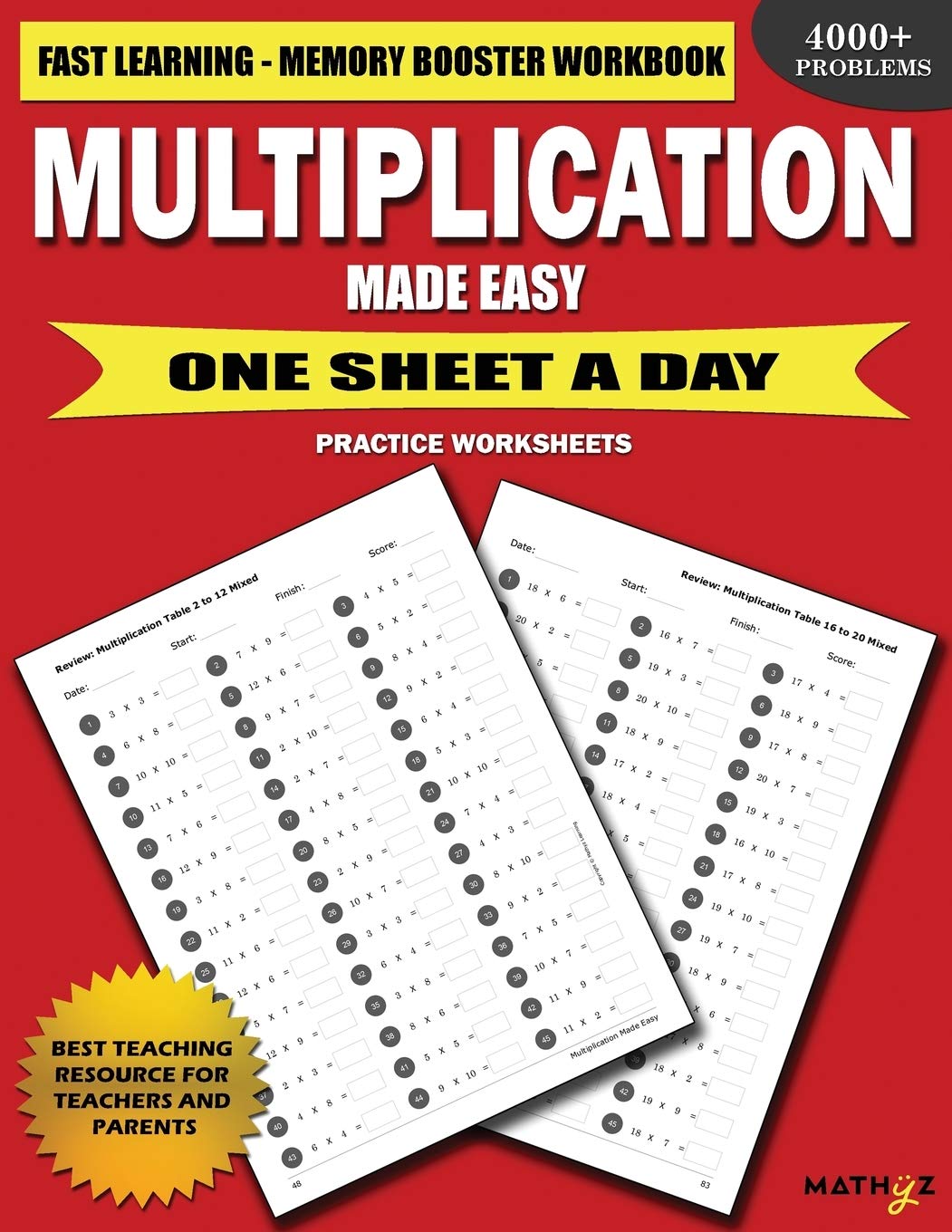
This book has more than 4000 multiplication facts for daily practice by students. Each page has one set consisting of 45 problems. It is recommended for students to attempt 1 set daily for consistent practice. Book starts with times table charts for easy reference followed by some quick multiplication facts. Once students start gaining confidence in individual facts, they can attempt mixed facts. Book can be used to track practice time for each set. Date and time can be recorded at top of each page. Answer to each problem is given at the end of the book.Knowing multiplication facts is helpful not only in academics; we frequently use multiplication in our daily lives too. Just like learning to walk before you can run, learning multiplication and familiarizing yourself with numbers are building blocks for other math topics taught in school such as division, long multiplication, fractions and algebra.Mastering the basic math facts develops automaticity in kids. Automaticity is the ability to do things without occupying the mind with the low level details that are required; this is usually the result of consistent learning, repetition, and practice. For instance, an experienced cyclist does not have to concentrate on turning the pedals, balancing, and holding on to the handlebars. Instead, those processes are automatic and the cyclist can concentrate on watching the road, the traffic, and other surroundings.Until students have developed sufficient sensorycognitive tools supporting access to symbolic memory, they will not be able to image, store or retrieve all of the basic facts with automaticity. Therefore, students need a comprehensive, developmental, and multisensory structured system for developing automaticity with the facts.
⚠️ WARNING (California Proposition 65):
This product may contain chemicals known to the State of California to cause cancer, birth defects, or other reproductive harm.
For more information, please visit www.P65Warnings.ca.gov.