If you have any questions, you are always welcome to contact us. We'll get back to you as soon as possible, withing 24 hours on weekdays.
Customer service
All questions about your order, return and delivery must be sent to our customer service team by e-mail at yourstore@yourdomain.com
Sale & Press
If you are interested in selling our products, need more information about our brand or wish to make a collaboration, please contact us at press@yourdomain.com
Help
If you have any questions, you are always welcome to contact us. We'll get back to you as soon as possible, withing 24 hours on weekdays.
Customer service
All questions about your order, return and delivery must be sent to our customer service team by e-mail at yourstore@yourdomain.com
Sale & Press
If you are interested in selling our products, need more information about our brand or wish to make a collaboration, please contact us at press@yourdomain.com
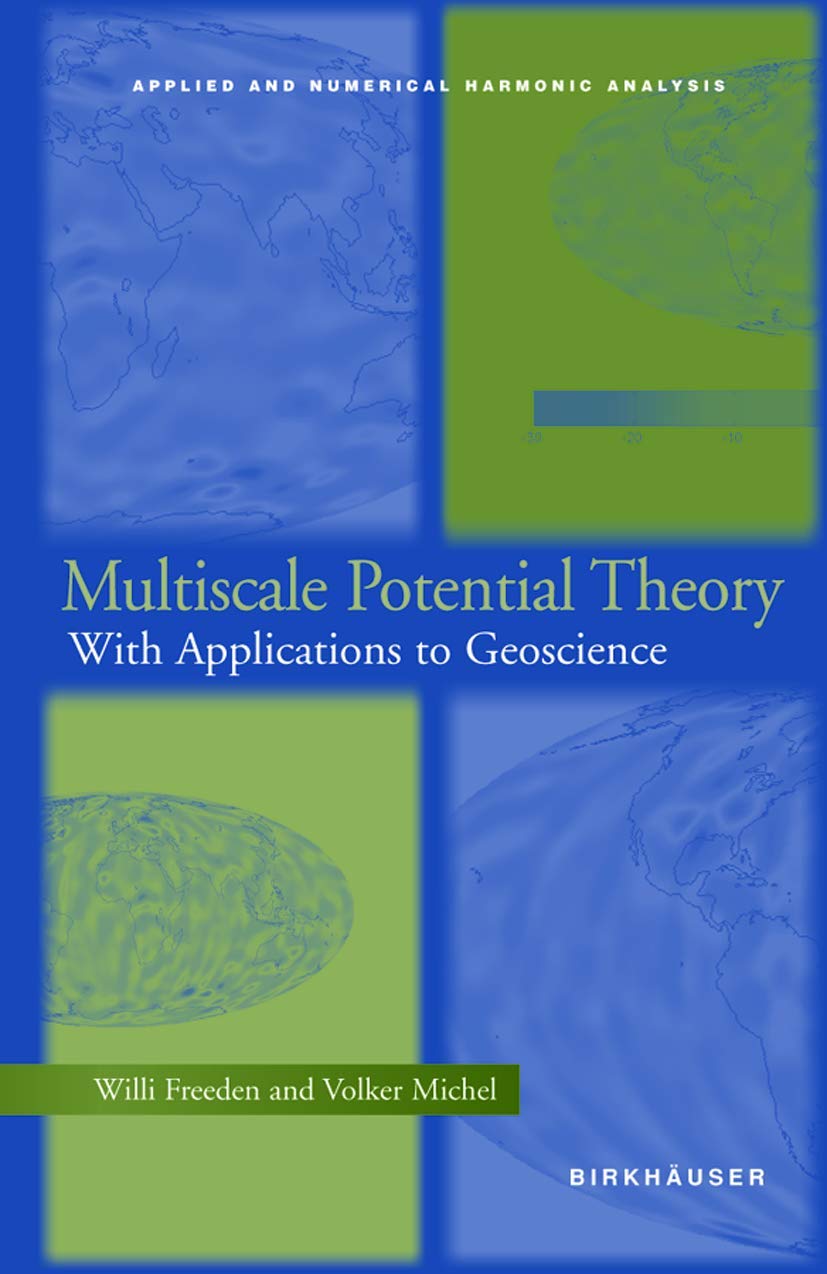
During the last few decades, the subject of potential theory has not been overly popular in the mathematics community. Neglected in favor of more abstract theories, it has been taught primarily where instructors have ac tively engaged in research in this field. This situation has resulted in a scarcity of English language books of standard shape, size, and quality covering potential theory. The current book attempts to fill that gap in the literature. Since the rapid development of highspeed computers, the remarkable progress in highly advanced electronic measurement concepts, and, most of all, the significant impact of satellite technology, the flame of interest in potential theory has burned much brighter. The realization that more and more details of potential functions are adequately visualized by 'zooming in' procedures of modern approximation theory has added powerful fuel to the flame. It seems as if, all of a sudden, harmonic kernel functions such as splines and/or wavelets provide the impetus to offer appropriate means of assimilating and assessing the readily increasing flow of potential data, reducing it to comprehensible form, and providing an objective basis for scientific interpretation, classification, testing of concepts, and solutions of problems involving the Laplace operator.
⚠️ WARNING (California Proposition 65):
This product may contain chemicals known to the State of California to cause cancer,
birth defects, or other reproductive harm.
For MAP (Minimum Advertised Price) violations and Intellectual Property (IP) or Trademark concerns, please contact:
support@ergodebooks.com
⚠️ California Proposition 65 Warning: Some products sold on this website may expose you to chemicals known to the State of California to cause cancer, birth defects, or other reproductive harm. For more information, visit www.P65Warnings.ca.gov.