If you have any questions, you are always welcome to contact us. We'll get back to you as soon as possible, withing 24 hours on weekdays.
Customer service
All questions about your order, return and delivery must be sent to our customer service team by e-mail at yourstore@yourdomain.com
Sale & Press
If you are interested in selling our products, need more information about our brand or wish to make a collaboration, please contact us at press@yourdomain.com
Help
If you have any questions, you are always welcome to contact us. We'll get back to you as soon as possible, withing 24 hours on weekdays.
Customer service
All questions about your order, return and delivery must be sent to our customer service team by e-mail at yourstore@yourdomain.com
Sale & Press
If you are interested in selling our products, need more information about our brand or wish to make a collaboration, please contact us at press@yourdomain.com
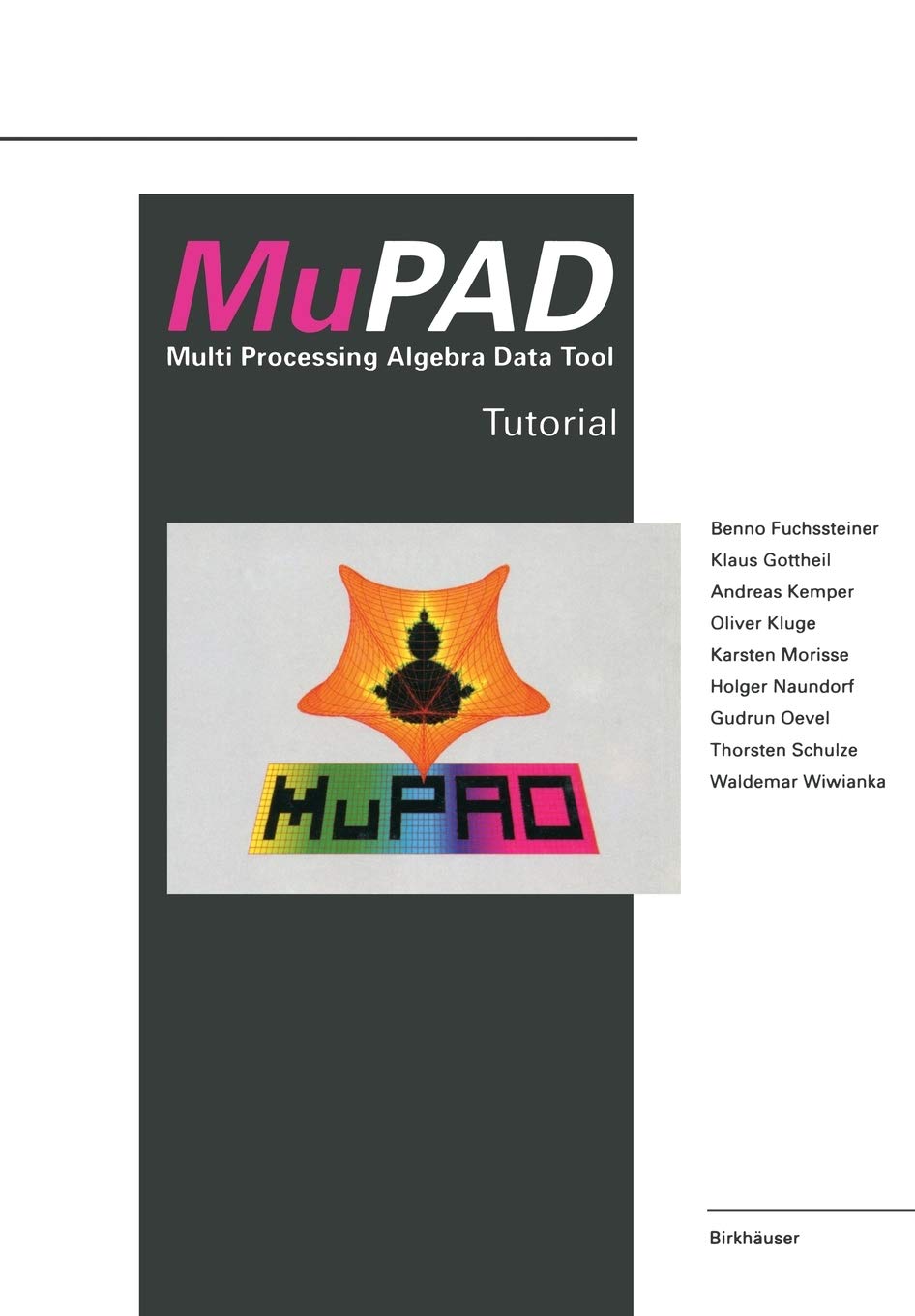
MuPAD is a computer algebra project of the MathPAD group at the University of Paderborn. MuPAD was designed as a parallel system. The design and implemen tation of MuPAD grew out of the desire to efficiently handle large data generated by algorithms used to investigate the group theoretical structure of nonlinear sys tems. Nevertheless, MuPAD outgrew this original goal and was developed as a general purpose system and should be used as such. MuPAD had two major design goals. As already mentioned, firstly we wanted to prmide a tool for fast and efficient handling of large data. This goal was motivated by the special problems which came up in our research on nonlinear systems, where data of several GB are not unusual. As a consequence of this MuPAD is a parallel computer algebra system working on the basis of a shared memor)' machine. Special interfaces, simulating ~hared memory, will be provided for machines with a different architecture. A sequential version of MuPAD is available which, nevertheless, in its highend language provides parallel constructs for programming. In this sequential version parallEl blocks are executed at random, thus allowing for logical tests of parallel programs on sequential machines. The sequential MuPAD version is the topic of this refErence manual. The second major design goal was to make sure that future versions of MuPAD could be the basis for a system capable of learning during interactive use.
⚠️ WARNING (California Proposition 65):
This product may contain chemicals known to the State of California to cause cancer,
birth defects, or other reproductive harm.
For MAP (Minimum Advertised Price) violations and Intellectual Property (IP) or Trademark concerns, please contact:
support@ergodebooks.com
⚠️ California Proposition 65 Warning: Some products sold on this website may expose you to chemicals known to the State of California to cause cancer, birth defects, or other reproductive harm. For more information, visit www.P65Warnings.ca.gov.