
Title
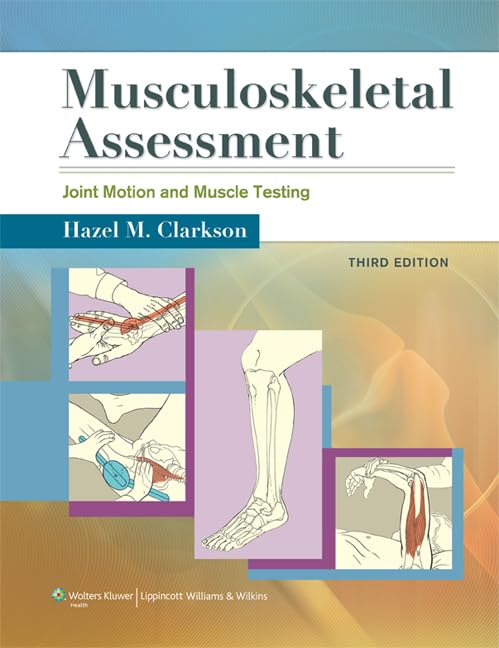
Musculoskeletal Assessment: Joint Motion And Muscle Testing (Musculoskeletal Assesment)
Sold by Ergodebooks, an authorized reseller.
Returns accepted within 30 days | support@ergodebooks.com
Shipping Information
- Free Standard Shipping — United States only
- Processing Time: 3–5 business days
- Estimated Delivery: 6–10 business days after dispatch
- Double-boxed, fully insured & discreetly packaged
- Tracking number sent via email once dispatched
Returns & Refund
Returns accepted within 30 days of delivery.
Damaged or Defective Item
Free return shipping + replacement or full refund
Wrong Item Received
Free return shipping + replacement or full refund
Change of Mind
Return shipping at customer's expense · 25% restocking fee applies
Payment Option

Completely Revised And Updated, The Third Edition Offers A Studentfriendly Approach To Muscle Assessment, Presenting The Principles And Methodology Of Assessing Both Joint Range Of Motion (Rom)/Goniometry And Manual Muscle Strength For The Head, Neck, Trunk, And Extremities. Each Chapter Is Devoted To A Separate Anatomical Region And Provides Knowledge Of Pertinent Surface Anatomy And Deep Anatomy. Excellent Photography And Illustrations Enhance Comprehension Of Techniques And Serve As A Selflearning Tool.
⚠️ WARNING (California Proposition 65):
This product may contain chemicals known to the State of California to cause cancer, birth defects, or other reproductive harm.
For more information, please visit www.P65Warnings.ca.gov.
- Q: What is the page count of Musculoskeletal Assessment: Joint Motion and Muscle Testing? A: The book contains six hundred fifty-six pages. This comprehensive page count allows for in-depth coverage of muscle assessment techniques.
- Q: What are the dimensions of this book? A: The dimensions are nine point zero two inches in length, one inch in width, and eleven inches in height. These measurements make it a manageable size for study and reference.
- Q: What type of binding does this book have? A: The book is spiral bound. This binding style facilitates easy page turning and allows the book to lay flat while in use.
- Q: How do I effectively use this book for muscle assessment? A: You can use this book as a guide for assessing joint range of motion and manual muscle strength. Each chapter is structured to provide specific techniques for different anatomical regions.
- Q: Is this book suitable for beginners in physical therapy? A: Yes, it is suitable for beginners. The student-friendly approach simplifies complex concepts and methodologies for muscle assessment.
- Q: What anatomical regions does this book cover? A: The book covers the head, neck, trunk, and extremities. Each region has dedicated chapters that include relevant surface and deep anatomy.
- Q: How should I care for this book to ensure its longevity? A: Keep the book in a dry environment and avoid exposure to direct sunlight. Cleaning can be done by gently wiping the cover with a soft cloth.
- Q: Is there any specific storage recommendation for this book? A: Store the book upright on a shelf or in a bookcase to maintain its shape. Avoid placing heavy items on top of it.
- Q: Are there any safety concerns with using this book? A: No, there are no safety concerns related to the book. It is designed for educational purposes within physical therapy.
- Q: How does this book compare to other muscle assessment books? A: This book offers a unique spiral binding and a comprehensive student-friendly approach, making it accessible compared to others. It focuses on practical techniques and illustrations.
- Q: Is this book appropriate for advanced physical therapy students? A: Yes, it is appropriate for advanced students. The detailed methodologies and extensive illustrations provide valuable insights for all levels.
- Q: What is the main focus of Musculoskeletal Assessment: Joint Motion and Muscle Testing? A: The main focus is on assessing joint range of motion and manual muscle strength. It provides updated techniques and methodologies for effective muscle assessment.
- Q: Who is the author of this book? A: The book is authored by Clarkson M.A. B.P.T. and Hazel M. Their expertise in physical therapy enhances the book's credibility and instructional quality.
- Q: Are there any illustrations included in the book? A: Yes, the book includes excellent photography and illustrations. These visual aids enhance comprehension and serve as effective self-learning tools.
- Q: Can this book be used as a reference tool in clinical settings? A: Yes, it is an excellent reference tool. Its thorough coverage of muscle assessment techniques makes it useful for clinicians and students alike.