
Title
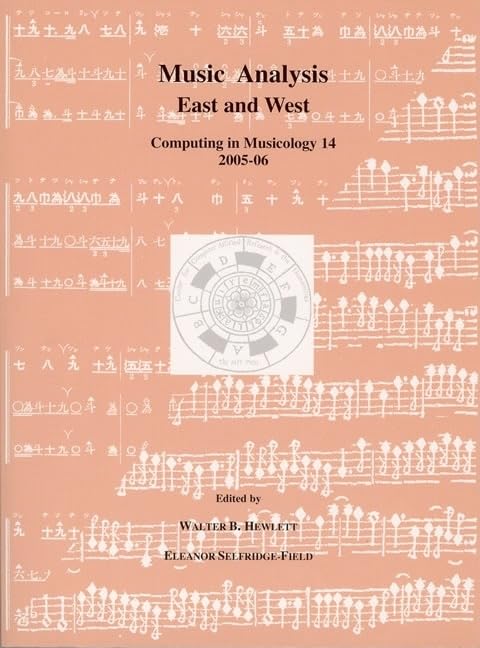
Music Analysis East and West (Computing in Musicology),Used
Sold by Ergodebooks, an authorized reseller.
Returns accepted within 30 days | support@ergodebooks.com
Shipping Information
- Free Standard Shipping — United States only
- Processing Time: 3–5 business days
- Estimated Delivery: 6–10 business days after dispatch
- Double-boxed, fully insured & discreetly packaged
- Tracking number sent via email once dispatched
Returns & Refund
Returns accepted within 30 days of delivery.
Damaged or Defective Item
Free return shipping + replacement or full refund
Wrong Item Received
Free return shipping + replacement or full refund
Change of Mind
Return shipping at customer's expense · 25% restocking fee applies
Payment Option

Computing approaches to the representation, interchange, and analysis of musical repertories that do not use conventional notationin particular, early Western European music and the art music of nonWestern cultures.Early Western music and the art music of the nonWestern world both lack highly specified, standardized systems of notation. A serious impediment to the systematic study of early and nonWestern music arises when a repertory has no extensive notational system, or multiple, nonstandardized ones. In different ways, these conditions pertain to medieval and Renaissance music in the West, and to the art music of Asia, which has traditionally depended on oral tradition rather than notation. Computers hold great potential for the analysis of early music repertories and for the study of music that lies outside the Western tradition. This volume of Computing in Musicology considers approaches to the computer representation, interchange, and analysis of music that predates Western European art music, lies outside the bounds of Western European art music, or both. It describes efforts to provide new tools that may make such work more practical in the future, and it brings fresh insights to the repertories themselves. Initial articles in this issue also treat current work on data interchange involving XML, since interchangeability remains an important ingredient of representational designs for all kinds of music.ContributorsThey come from the fields of musicology and ethnomusicology, audio and software engineering, and mathematics and computer science. They include Parag Chordia, Sachiko Deguchi, Annalisa Doneda, Michael Good, Christine Jeanneret, Arvindh Krishnaswamy, Panayotis Mavromatis, Laurent Pugin, Craig Stuart Sapp, Eleanor SelfridgeField, Katsuhiko Shirai, Iman S. H. Suyoto, Alexandra L. Uitdenbogerd, and Joshua Veltman.
⚠️ WARNING (California Proposition 65):
This product may contain chemicals known to the State of California to cause cancer, birth defects, or other reproductive harm.
For more information, please visit www.P65Warnings.ca.gov.