
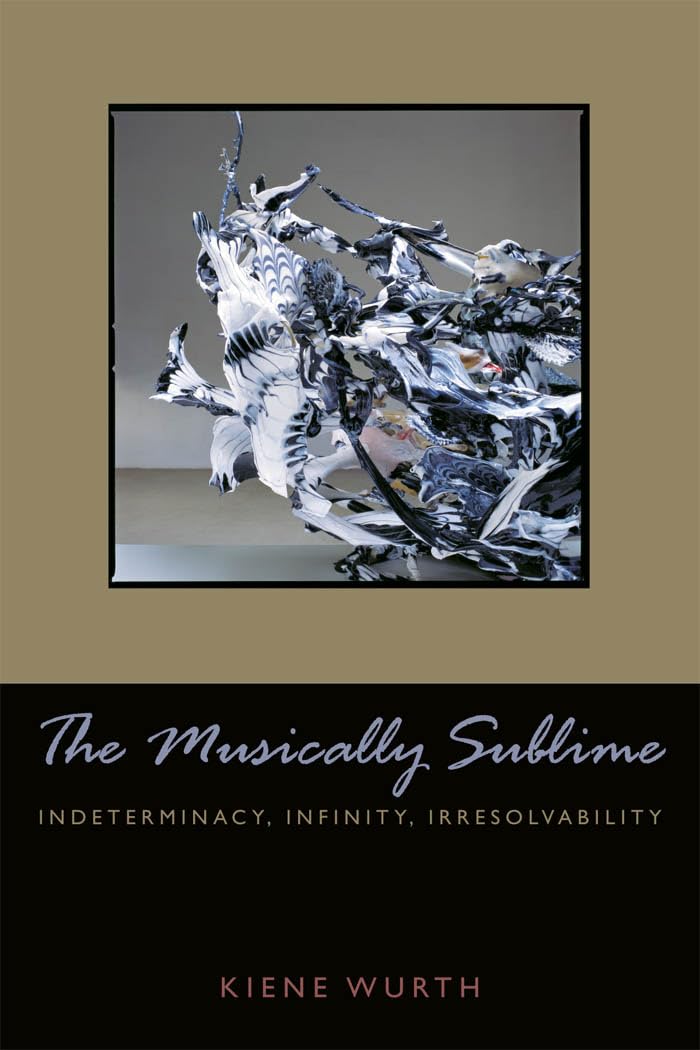
Title
Musically Sublime: Indeterminacy, Infinity, Irresolvability,Used
Sold by Ergodebooks, an authorized reseller.
Returns accepted within 30 days | support@ergodebooks.com
Shipping Information
- Free Standard Shipping — United States only
- Processing Time: 3–5 business days
- Estimated Delivery: 6–10 business days after dispatch
- Double-boxed, fully insured & discreetly packaged
- Tracking number sent via email once dispatched
Returns & Refund
Returns accepted within 30 days of delivery.
Damaged or Defective Item
Free return shipping + replacement or full refund
Wrong Item Received
Free return shipping + replacement or full refund
Change of Mind
Return shipping at customer's expense · 25% restocking fee applies
Payment Option

Musically Sublime rewrites musically the history and philosophy of the sublime. Music enables us to reconsider the traditional course of sublime feeling on a track from pain to pleasure. Resisting the notion that there is a single format for sublime feeling, Wurth shows how, from the mid eighteenth century onward, sublime feeling is, instead, constantly rearticulated in a complex interaction with musicality.Wurth takes as her point of departure Immanuel Kant's Critique of Judgment and JeanFranois Lyotard's aesthetic writings of the 1980s and 1990s. Kant framed the sublime narratively as an epic of selftranscendence. By contrast, Lyotard sought to substitute open immanence for Kantian transcendence, yet he failed to deconstruct the Kantian epic. The book performs this deconstruction by juxtaposing eighteenth and nineteenthcentury conceptions of the infinite, Sehnsucht, the divided self, and unconscious drives with contemporary readings of instrumental music.Critically assessing Edmund Burke, James Usher, E.T.A. Hoffmann, Novalis, Friedrich Hlderlin, Arthur Schopenhauer, Richard Wagner, and Friedrich Nietzsche, this book represents the sublime as a feeling that defers resolution and hangs suspended between pain and pleasure. Musically Sublime rewrites the mathematical sublime as diffrance, while it redresses the dynamical sublime as trauma: unending, undetermined, unresolved.Whereas most musicological studies in this area have focused on traces of the Kantian sublime in Handel, Haydn, and Beethoven, this book calls on the nineteenthcentury theorist Arthur Seidl to analyze the sublime of, rather than in, music. It does so by invoking Seidl's concept of formwidrigkeit ('formcontrariness') in juxtaposition with Romantic piano music, (post)modernist musical minimalisms, and Lyotard's postmodern sublime. It presents a sublime of matter, rather than formperformative rather than representational. In doing so, Musically Sublime shows that the binary distinction Lyotard posits between the postmodern and romantic sublime is finally untenable.
⚠️ WARNING (California Proposition 65):
This product may contain chemicals known to the State of California to cause cancer, birth defects, or other reproductive harm.
For more information, please visit www.P65Warnings.ca.gov.