
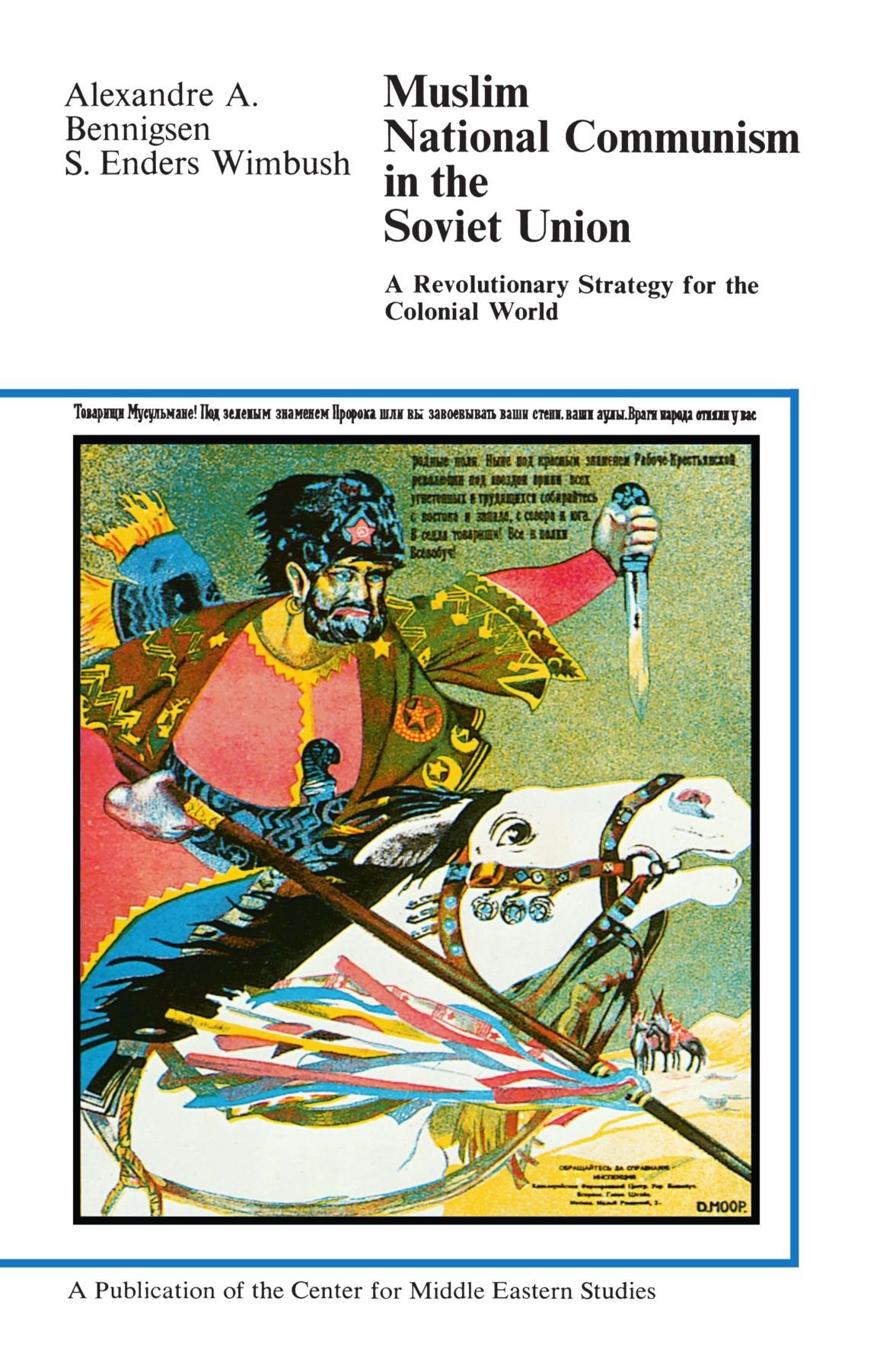
Title

Muslim National Communism in the Soviet Union: A Revolutionary Strategy for the Colonial World (Volume 11) (Publications of the ,Used
Sold by Ergodebooks, an authorized reseller.
Returns accepted within 30 days | support@ergodebooks.com
Shipping Information
- Free Standard Shipping — United States only
- Processing Time: 3–5 business days
- Estimated Delivery: 6–10 business days after dispatch
- Double-boxed, fully insured & discreetly packaged
- Tracking number sent via email once dispatched
Returns & Refund
Returns accepted within 30 days of delivery.
Damaged or Defective Item
Free return shipping + replacement or full refund
Wrong Item Received
Free return shipping + replacement or full refund
Change of Mind
Return shipping at customer's expense · 25% restocking fee applies
Payment Option

In this study, Bennigsen and Wimbush trace the development of the doctrine of national communism in Central Asia and the Caucasus. At the heart of this doctrineas elaborated by the Volga Tatar, MirSaid Sultan Galievwas the concept of "proletarian nations," as opposed to the traditional notion of a working class. With such ideological innovations, Sultan Galiev and his contemporaries were able to reconcile Marxist nationalisms and Islam and devise an "Eastern strategy" whereby the national revolution was to be spread.The authors show that the ideas of Muslim national communism persist in the land of their birth and have spread to such developing societies as China, Algeria, and Indonesia. This doctrine is an important factor in the ideological split and increasing tensions between industrial and nonindustrial nations, East and West, and now North and South, which grip the world communist movement.
⚠️ WARNING (California Proposition 65):
This product may contain chemicals known to the State of California to cause cancer, birth defects, or other reproductive harm.
For more information, please visit www.P65Warnings.ca.gov.
- Q: How many pages does this book have? A: This book has two hundred ninety pages. It's a comprehensive study that delves into the development of national communism.
- Q: What are the dimensions of the book? A: The book measures five point eight seven inches in length, zero point five nine inches in width, and nine point zero two inches in height.
- Q: What type of binding does this book have? A: This book is paperback bound. This makes it lightweight and easy to handle for reading.
- Q: Who is the author of this book? A: The author is Alexandre A. Bennigsen. He co-wrote this work with Wimbush to explore the topic of national communism.
- Q: What is the subject matter of this book? A: This book focuses on the doctrine of national communism in Central Asia and the Caucasus. It includes the ideological innovations of Mir-Said Sultan Galiev.
- Q: What is the reading level for this book? A: This book is suitable for adult readers and scholars. It's designed for those interested in historical and political studies.
- Q: How should I store this book? A: Store the book in a cool, dry place to prevent damage. Avoid direct sunlight to preserve the cover and pages.
- Q: Is this book safe for all ages? A: Yes, this book is appropriate for adult readers. It addresses complex ideological themes that may not be suitable for younger audiences.
- Q: How do I clean this book if it gets dirty? A: To clean the book, gently wipe the cover with a dry cloth. Avoid using liquids that could damage the pages.
- Q: Can I return this book if I change my mind? A: Yes, return policies may apply based on the retailer's terms. Check with the seller for specific return instructions.
- Q: What if my book arrives damaged? A: If the book arrives damaged, contact the seller immediately. They typically have a process for handling returns or exchanges.
- Q: Is this book suitable for someone new to the subject? A: Yes, this book provides a foundational understanding of national communism. It's suitable for those new to the topic.
- Q: How does this book compare to other works on communism? A: This book offers a unique perspective by focusing on Muslim national communism, differing from traditional Marxist literature.
- Q: What is the main argument of the authors? A: The authors argue that Muslim national communism reconciles Marxist nationalisms with Islam. This ideology has influenced various developing nations.
- Q: Are there any illustrations or maps in the book? A: No, this book does not contain illustrations or maps. It focuses primarily on text and analysis.
- Q: What historical period does the book cover? A: The book covers the development of national communism primarily in the early twentieth century. It examines its implications in various regions.