
Title
Mutual Impressions: Writers from the Americas Reading One Another,Used
Sold by Ergodebooks, an authorized reseller.
Returns accepted within 30 days | support@ergodebooks.com
Shipping Information
- Free Standard Shipping — United States only
- Processing Time: 3–5 business days
- Estimated Delivery: 6–10 business days after dispatch
- Double-boxed, fully insured & discreetly packaged
- Tracking number sent via email once dispatched
Returns & Refund
Returns accepted within 30 days of delivery.
Damaged or Defective Item
Free return shipping + replacement or full refund
Wrong Item Received
Free return shipping + replacement or full refund
Change of Mind
Return shipping at customer's expense · 25% restocking fee applies
Payment Option

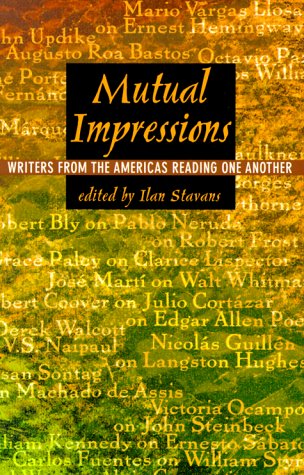
Product Description It is commonly assumed that the United States and Latin America, culturally so different, move artistically to very different rhythms. Also common is the assumption that, with rare exception, the literary figures on one side of the global North/South divide have had little interest in the work of their counterparts. With Mutual Impressions Ilan Stavans dispels these notions by showing how solid the bridges between writers and across borders have been, at least since the early days of this century, and how crucial they are likely to become as we enter the next millennium. Divided into symmetrical halvesSouth reading North and North reading Souththe book presents essays by leading novelists, poets, and other writers that focus on the work of another literary figure from across the divide. Borges, for example, finds in Hawthorne the perfect precursor to his own interest in allegories; Katherine Anne Porter examines Jos Joaqun Fernndez de Lizardi as a rascal whose picaresque views of life in The Itching Parrot served to launch the Latin American novel; Cortzars study of the plots and style of Poe shows an affinity that left an indelible mark on the Argentines short fiction; Susan Sontag views Machado de Assis as the ultimate mirror, a protopostmodernist. With other essays by Thomas Pynchon, William H. Gass, John Updike, Gabriel Garca Mrquez, Alejo Carpentier, John Barth, Robert Coover, Pedro Henrquez Urea, Grace Paley, Juan Carlos Onetti, and Mark Strand, among others, Mutual Impressions offers a remarkable view of the connections that comprise a literary tradition of the Americas. It is a book that will surprise and enliven its readers as it informs and awakens in them a sense of wonder.Contributors. John Barth, Jos Bianco, Robert Bly, Jorge Luis Borges, Alejo Carpentier, Hiber Conteris, Robert Coover, Julio Cortzar, Ezequiel Martnez Estrada, Waldo Frank, Carlos Fuentes, William H. Gass, Nicols Guilln, William Kennedy, Mario Vargas Llosa, Gabriel Garca Mrquez, Jos Mart, Pablo Neruda, Victoria Ocampo, Juan Carlos Onetti, Grace Paley, Octavio Paz, Katherine Anne Porter, Thomas Pynchon, Kenneth Rexroth, Antonio Bentez Rojo, Barbara Probst Solomon, Susan Sontag, Ilan Stavans, Mark Strand, John Updike, Pedro Henrque Urea, Derek Walcott, Paul West From Publishers Weekly This exquisite collection of literary criticism, assembled by Stavans (Growing Up Latino, etc.), offers beautifully rendered pieces by and about the most distinguished writers from the Americas. Perhaps more importantly, Stavans has shrewdlyand originallyarranged these essays as a dialogue between Englishspeaking North and Latin America, so that the book as a whole is greater than the sum of its parts. In the first grouping of 19 essaysall of which are translated from Spanishwe cover ground ranging from Derek Walcott's assessment of V.S. Naipaul ("Victims are now as articulate as their oppressors") to Hiber Conteris's appreciation of Raymond Chandler ("[Philip Marlowe has] a moderate set of virtues and weaknesses that are commonly found in human beings"). In the next 15 essays, North American writers such as John Updike, John Barth and Grace Paley pay respects to their literary "neighbors," including Teresa de la Parra, Pablo Neruda and Ernesto Sabato. The absence of female viewpoints in the first section is not an editorial oversight, but rather an indication of the deep cultural barriers to women's expression in many areas of Latin America. North American readers may be struck by their ignorance about the tradition of Latin American writers: some names are familiar but many are not. Perhaps in anticipation of this fact, many of the North American writers here spend more time educating their readers about their subjects than their South American colleagues do. Overall, the work of Jorge Luis Borges is perhaps the strongest presence across both sets of writers. He appears as both focus and influenti
⚠️ WARNING (California Proposition 65):
This product may contain chemicals known to the State of California to cause cancer, birth defects, or other reproductive harm.
For more information, please visit www.P65Warnings.ca.gov.