
Title
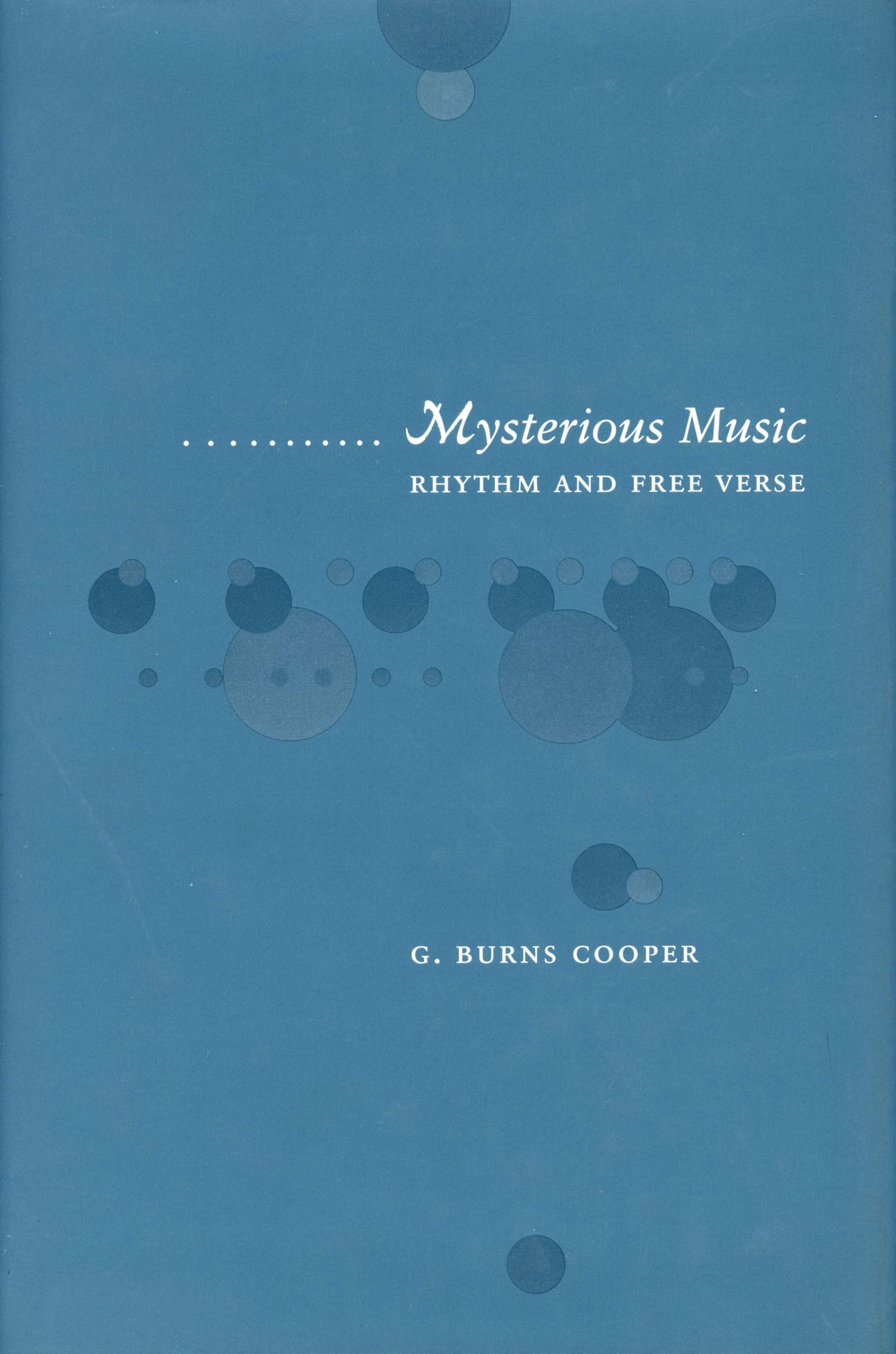
Mysterious Music: Rhythm And Free Verse,Used
Sold by Ergodebooks, an authorized reseller.
Returns accepted within 30 days | support@ergodebooks.com
Shipping Information
- Free Standard Shipping — United States only
- Processing Time: 3–5 business days
- Estimated Delivery: 6–10 business days after dispatch
- Double-boxed, fully insured & discreetly packaged
- Tracking number sent via email once dispatched
Returns & Refund
Returns accepted within 30 days of delivery.
Damaged or Defective Item
Free return shipping + replacement or full refund
Wrong Item Received
Free return shipping + replacement or full refund
Change of Mind
Return shipping at customer's expense · 25% restocking fee applies
Payment Option

Though many recent poets insist on their poetrys musical qualities, few offer linguistically satisfying explanations of that music. This book helps to fill that gap. It is a linguistically based study of rythmic structures, and of the nature of rhythm, in the free verse of T. S. Eliot, Robert Lowell, and James Wright. It was written for accessibility to readers who, although not necessarily specialists in linguistic poetics, have some knowledge of language and poetry.The book begins with an examination of rhythm in language as a whole, and of rhythm as a basic mental structure. This discussion touches on concepts from metrical phonology, acoustic phonetics, Russian Formalist and New Critical ideas of rhythm and meter, and music theory. It then analyzes what the author (borrowing a phrase from Gerard Manley Hopkins) calls rhythmic figures of sound, syntax, line structure, and intonation in the poetry of Eliot, Lowell, and Wright.Although the book focuses on these three writers, other poets are considerednotably Jimmy Santiago Baca, Denise Levertov, and Etheridge Knightin order to illustrate the way different dialects use different intonation patterns for poetic effect. The book also contextualizes contemporary poems with brief comparisons to work from previous centuries.The author argues that in discussions of rhythm and its structures, the oldfashioned way of analyzing types of metrical feet proves less than useful, and that the relatively new field of metrical phonology also has serious limitations. Instead, he advances a new approach based on figures of sound or figures of rhythm, both of which involve the repetition of some key linguistic component: a sound, a sequence of sounds, a method of forming words, a phrase structure, a line structure, or an intonational melody (literally, a tunethe movement of pitch through time).In the simplest language possible, the author explains various linguistic concepts and terms as they occur. He has also provided a glossary of terms that may be unfamiliar to nonlinguists or that may carry different meanings in other disciplines.
⚠️ WARNING (California Proposition 65):
This product may contain chemicals known to the State of California to cause cancer, birth defects, or other reproductive harm.
For more information, please visit www.P65Warnings.ca.gov.