
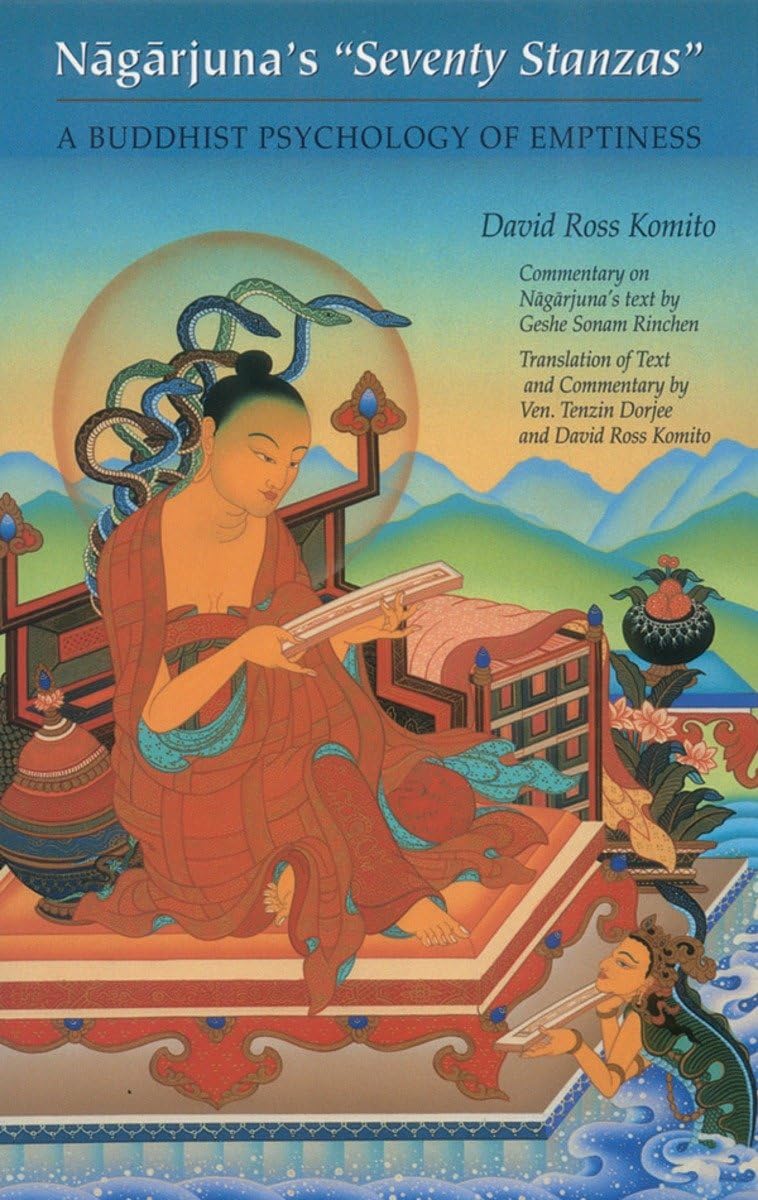
Title
Nagarjuna'S Seventy Stanzas: A Buddhist Psychology Of Emptiness,Used
Sold by Ergodebooks, an authorized reseller.
Returns accepted within 30 days | support@ergodebooks.com
Shipping Information
- Free Standard Shipping — United States only
- Processing Time: 3–5 business days
- Estimated Delivery: 6–10 business days after dispatch
- Double-boxed, fully insured & discreetly packaged
- Tracking number sent via email once dispatched
Returns & Refund
Returns accepted within 30 days of delivery.
Damaged or Defective Item
Free return shipping + replacement or full refund
Wrong Item Received
Free return shipping + replacement or full refund
Change of Mind
Return shipping at customer's expense · 25% restocking fee applies
Payment Option

This Volume Contains A Translation Of Seventy Stanzas, A Fundamental Work Of Nagarjuna On The Madhyamika System Of Buddhist Philosophy, Along With A Commentary On It From The Prasangika Viewpoint By Geshe Sonam Rinchen. David Komito Summarizes Basic Buddhist Doctrines On Perception And The Creation Of Concepts, Which Have Traditionally Served As The Backdrop For Nagarjuna'S Teachings About How People Consistently Misperceive And Misunderstand The Nature Of The Reality In Which They Live And The Means Through Which They Experience It. This Book Will Interest Buddhist Practitioners, Scholars, And Psychologists Who Seek A Deeper Understanding Of Buddhist Psychology And Epistemology.
⚠️ WARNING (California Proposition 65):
This product may contain chemicals known to the State of California to cause cancer, birth defects, or other reproductive harm.
For more information, please visit www.P65Warnings.ca.gov.
- Q: What is the page count of Nagarjuna's Seventy Stanzas? A: This book has two hundred thirty-two pages. It offers a comprehensive exploration of Buddhist philosophy and psychology.
- Q: What are the dimensions of the book? A: The book measures five point five one inches in length, zero point five seven inches in width, and eight point five one inches in height. These dimensions make it easy to handle and read.
- Q: What type of binding does this book have? A: This volume is paperback bound. This allows for flexibility and ease of use while reading.
- Q: Who is the author of this book? A: The author of Nagarjuna's Seventy Stanzas is David Ross Komito. He provides valuable insights into Buddhist teachings and psychology.
- Q: What is the main topic of Nagarjuna's Seventy Stanzas? A: The book focuses on Buddhist psychology and the concept of emptiness. It explores the Madhyamika system of Buddhist philosophy.
- Q: Is this book suitable for beginners in Buddhism? A: Yes, it is suitable for beginners. The text provides foundational insights into Buddhist doctrines and concepts.
- Q: Can I use this book for academic study? A: Yes, this book is suitable for academic study. It offers thorough commentary and analysis of key Buddhist philosophies.
- Q: Is there a glossary or index in the book? A: No, there is no specific mention of a glossary or index. However, the content is structured to aid understanding.
- Q: How should I store this book? A: You should store this book in a cool, dry place. Avoid direct sunlight to prevent fading of the cover and pages.
- Q: How do I clean the book if it gets dirty? A: You can gently wipe the cover with a soft, dry cloth. Avoid using water or cleaning solutions on the pages.
- Q: Can I return the book if I'm not satisfied? A: Yes, you can return the book within the retailer's return policy timeframe. Always check the specific conditions for returns.
- Q: What if the book arrives damaged? A: If the book arrives damaged, contact the retailer for a replacement or refund. Most retailers have policies for such cases.
- Q: Is this book recommended for psychologists? A: Yes, it is recommended for psychologists. It offers insights into Buddhist psychology that can enhance understanding of human perception.
- Q: Does the book include illustrations or diagrams? A: No, the book does not include illustrations or diagrams. It focuses on textual analysis and commentary.
- Q: Is there any specific audience that should avoid this book? A: There are no specific audiences that should avoid this book. It is beneficial for anyone interested in Buddhist philosophy.