
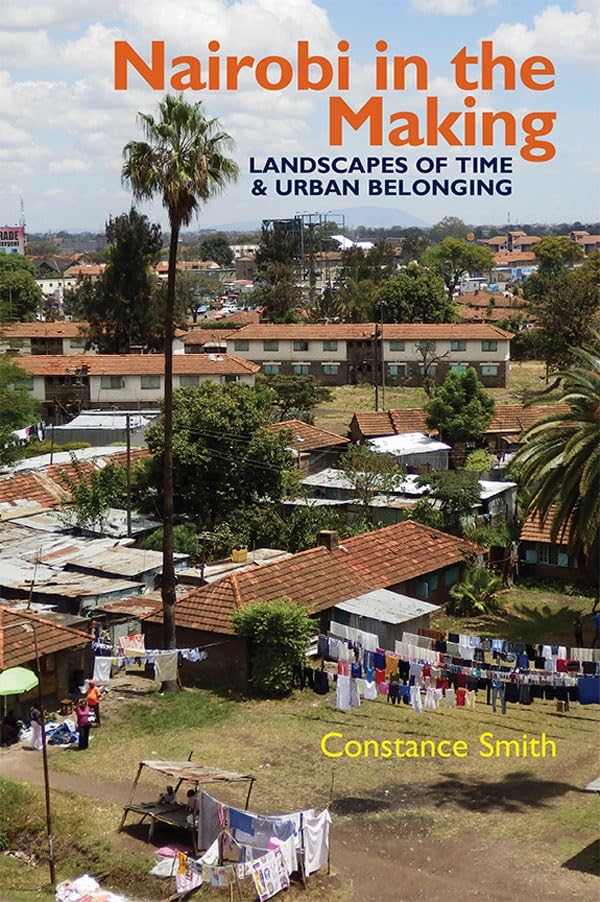
Title
Nairobi in the Making: Landscapes of Time and Urban Belonging (Eastern Africa Series, 46),Used
Sold by Ergodebooks, an authorized reseller.
Returns accepted within 30 days | support@ergodebooks.com
Shipping Information
- Free Standard Shipping — United States only
- Processing Time: 3–5 business days
- Estimated Delivery: 6–10 business days after dispatch
- Double-boxed, fully insured & discreetly packaged
- Tracking number sent via email once dispatched
Returns & Refund
Returns accepted within 30 days of delivery.
Damaged or Defective Item
Free return shipping + replacement or full refund
Wrong Item Received
Free return shipping + replacement or full refund
Change of Mind
Return shipping at customer's expense · 25% restocking fee applies
Payment Option

Examines the making and remaking of Nairobi, one of Africas most fragmented, vibrant cities, contributing to debates on urban anthropology, the politics of the past and postcolonial materialities.What does it mean to make a life in an African city today? How do ordinary Africans, surrounded by collapsing urban infrastructures and amid fantastical promises of hypermodern, globalised futures, try to ensure a place for themselves in the citys future? Exploring the relationship between the remains of empire and the global city, and themes of urban belonging and exclusion, housing and security, Constance Smith examines the making and remaking of one ofAfricas most fragmented, vibrant cities.Nairobi is on the cusp of radical urban change. As in other capital cities across Africa, the Kenyan government has launched "Vision 2030", an urban megaproject that envisions the capital as a "world class metropolis", a spectacular new node in a network of global cities. Yet as a city born of British colonialism, Nairobians also live amongst the dilapidated vestiges of imperial urban planning; spaces designed to regulate urban subjects. Based on extensive ethnographic research in a dilapidated, colonialera public housing project built as a model urban neighbourhood but which is now slated for demolition, Smith explores how projects of selfmaking and citymaking are entwined. She traces how it is through residents everyday lives in the mundane, incremental work of home maintenance, in the accumulation of stories about the past, in ordinary peoples aspirations for the future that urban landscapes are formed, imaginatively, materially and unpredictably, across time. Nairobi emerges as a place of pathways and plans, obstructions and aspirations, residues and endurances, thatinflect the way that ordinary people produce the city, generating practices of historymaking, ideas about urban belonging and attempts to refashion "Vision 2030" into a future more meaningful and inclusive to ordinary city dwellers.Published in association with the British Institute in Eastern Africa.Kenya, Uganda, Tanzania,Rwanda: Twaweza Communications
⚠️ WARNING (California Proposition 65):
This product may contain chemicals known to the State of California to cause cancer, birth defects, or other reproductive harm.
For more information, please visit www.P65Warnings.ca.gov.
- Q: How many pages does this book have? A: This book has two hundred twenty-four pages. It's a comprehensive examination of Nairobi's urban development and cultural identity.
- Q: What is the binding type of this book? A: The binding type of this book is paperback. This makes it lightweight and easy to carry.
- Q: What are the dimensions of this book? A: The dimensions are six point fourteen inches in length, zero point forty-eight inches in width, and nine point twenty-one inches in height. These measurements make it a standard-sized book for easy reading.
- Q: Who is the author of this book? A: The author of this book is Constance Smith. She explores themes of urban anthropology and postcolonial materialities.
- Q: In which series is this book published? A: This book is published in the Eastern Africa Series, number forty-six. It contributes valuable insights into the region's urban dynamics.
- Q: What themes does this book explore? A: This book explores themes of urban belonging, exclusion, and the impacts of colonialism on Nairobi's development. It provides a deep dive into the city's urban landscape.
- Q: How do I use this book for research? A: You can use this book for research by reading its chapters on urban anthropology and urban change in Nairobi. It is suitable for scholars and students alike.
- Q: Is this book suitable for academic study? A: Yes, this book is suitable for academic study. It offers ethnographic research and insights that are valuable for understanding urban environments.
- Q: What is the target audience for this book? A: The target audience includes students, researchers, and anyone interested in urban studies or African studies. It provides critical insights into contemporary urban issues.
- Q: How should I care for this book? A: To care for this book, store it in a cool, dry place away from direct sunlight. Keep it on a bookshelf to prevent damage.
- Q: Is this book safe for young readers? A: Yes, this book is generally safe for young readers interested in social studies. However, it contains complex themes that may require adult guidance.
- Q: Can I return this book if I am not satisfied? A: Yes, you can return this book if you are not satisfied, following the retailer's return policy. Make sure to check their specific terms.
- Q: What if the book arrives damaged? A: If the book arrives damaged, contact the retailer for a replacement or refund. Most retailers have a clear policy for damaged goods.
- Q: Is there a warranty for this book? A: No, there is typically no warranty for books. However, returns for unsatisfied customers are usually accepted.
- Q: Where can I find more books like this? A: You can find more books like this at local bookstores or online retailers specializing in African studies and urban anthropology.