
Title
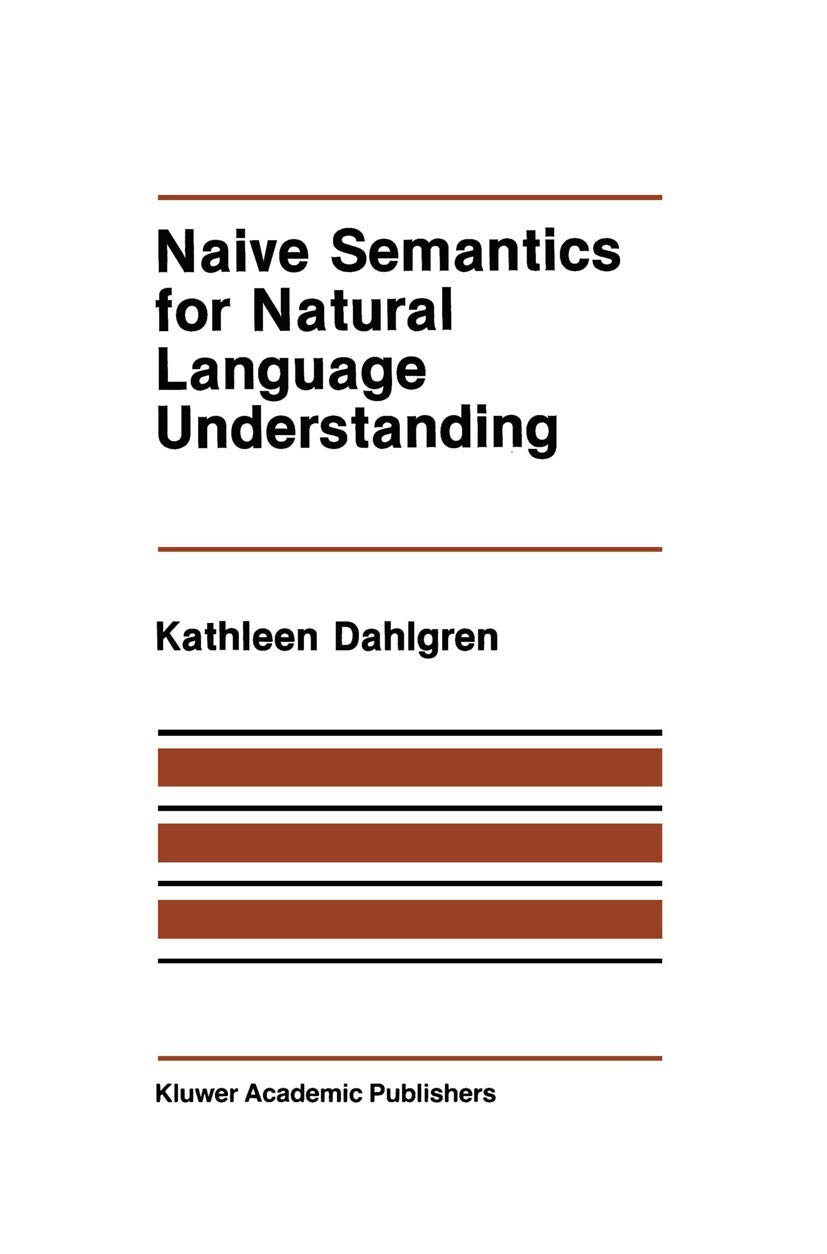
Naive Semantics for Natural Language Understanding (The International Series in Engineering and Computer Science),Used
Sold by Ergodebooks, an authorized reseller.
Returns accepted within 30 days | support@ergodebooks.com
Shipping Information
- Free Standard Shipping — United States only
- Processing Time: 3–5 business days
- Estimated Delivery: 6–10 business days after dispatch
- Double-boxed, fully insured & discreetly packaged
- Tracking number sent via email once dispatched
Returns & Refund
Returns accepted within 30 days of delivery.
Damaged or Defective Item
Free return shipping + replacement or full refund
Wrong Item Received
Free return shipping + replacement or full refund
Change of Mind
Return shipping at customer's expense · 25% restocking fee applies
Payment Option

This book introduces a theory, Naive Semantics (NS), a theory of the knowledge underlying natural language understanding. The basic assumption of NS is that knowing what a word means is not very different from knowing anything else, so that there is no difference in form of cognitive representation between lexical semantics and ency clopedic knowledge. NS represents word meanings as commonsense knowledge, and builds no special representation language (other than elements of firstorder logic). The idea of teaching computers common sense knowledge originated with McCarthy and Hayes (1969), and has been extended by a number of researchers (Hobbs and Moore, 1985, Lenat et aI, 1986). Commonsense knowledge is a set of naive beliefs, at times vague and inaccurate, about the way the world is structured. Traditionally, word meanings have been viewed as criterial, as giving truth conditions for membership in the classes words name. The theory of NS, in identifying word meanings with commonsense knowledge, sees word meanings as typical descriptions of classes of objects, rather than as criterial descriptions. Therefore, reasoning with NS represen tations is probabilistic rather than monotonic. This book is divided into two parts. Part I elaborates the theory of Naive Semantics. Chapter 1 illustrates and justifies the theory. Chapter 2 details the representation of nouns in the theory, and Chapter 4 the verbs, originally published as "Commonsense Reasoning with Verbs" (McDowell and Dahlgren, 1987). Chapter 3 describes kind types, which are naive constraints on noun representations.
⚠️ WARNING (California Proposition 65):
This product may contain chemicals known to the State of California to cause cancer, birth defects, or other reproductive harm.
For more information, please visit www.P65Warnings.ca.gov.