If you have any questions, you are always welcome to contact us. We'll get back to you as soon as possible, withing 24 hours on weekdays.
Customer service
All questions about your order, return and delivery must be sent to our customer service team by e-mail at yourstore@yourdomain.com
Sale & Press
If you are interested in selling our products, need more information about our brand or wish to make a collaboration, please contact us at press@yourdomain.com
Help
If you have any questions, you are always welcome to contact us. We'll get back to you as soon as possible, withing 24 hours on weekdays.
Customer service
All questions about your order, return and delivery must be sent to our customer service team by e-mail at yourstore@yourdomain.com
Sale & Press
If you are interested in selling our products, need more information about our brand or wish to make a collaboration, please contact us at press@yourdomain.com
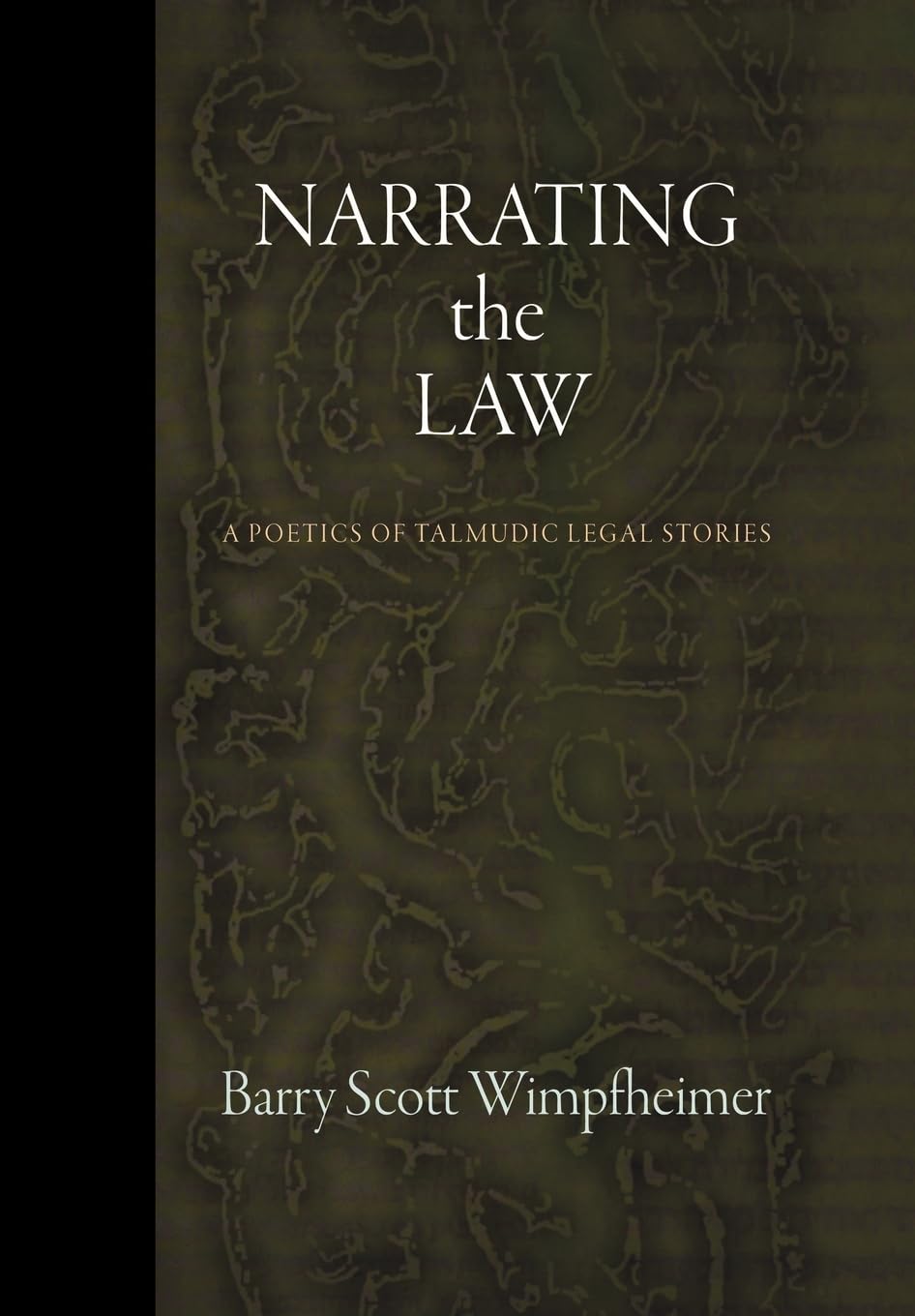
In Narrating the Law Barry Scott Wimpfheimer creates a new theoretical framework for considering the relationship between law and narrative and models a new method for studying talmudic law in particular.Works of law, including the Talmud, are animated by a desire to create clear usable precedent. This animating impulse toward clarity is generally absent in narratives, the form of which is better able to capture the subtleties of lived life. Wimpfheimer proposes to make these different forms compatible by constructing a narrativebased law that considers law as one of several 'languages,' along with politics, ethics, psychology, and others that together compose culture. A narrativebased law is capable of recognizing the limitations of theoretical statutes and the degree to which other cultural languages interact with legal discourse, complicating any attempts to actualize a hypothetical set of rules. This way of considering law strongly resists the divide in traditional Jewish learning between legal literature (Halakhah) and nonlegal literature (Aggadah) by suggesting the possibility of a discourse broad enough to capture both. Narrating the Law activates this mode of reading by looking at the Talmud's legal stories, a set of texts that sits uncomfortably on the divide between Halakhah and Aggadah. After noticing that such stories invite an expansive definition of law that includes other cultural voices, Narrating the Law also mines the stories for the rich descriptions of rabbinic culture that they encapsulate.
⚠️ WARNING (California Proposition 65):
This product may contain chemicals known to the State of California to cause cancer,
birth defects, or other reproductive harm.
For MAP (Minimum Advertised Price) violations and Intellectual Property (IP) or Trademark concerns, please contact:
support@ergodebooks.com
⚠️ California Proposition 65 Warning: Some products sold on this website may expose you to chemicals known to the State of California to cause cancer, birth defects, or other reproductive harm. For more information, visit www.P65Warnings.ca.gov.