
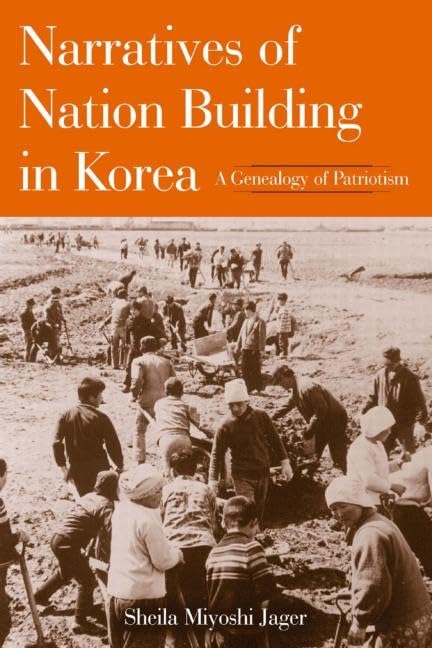
Title
Narratives Of Nationbuilding In Korea
Sold by Ergodebooks, an authorized reseller.
Returns accepted within 30 days | support@ergodebooks.com
Shipping Information
- Free Standard Shipping — United States only
- Processing Time: 3–5 business days
- Estimated Delivery: 6–10 business days after dispatch
- Double-boxed, fully insured & discreetly packaged
- Tracking number sent via email once dispatched
Returns & Refund
Returns accepted within 30 days of delivery.
Damaged or Defective Item
Free return shipping + replacement or full refund
Wrong Item Received
Free return shipping + replacement or full refund
Change of Mind
Return shipping at customer's expense · 25% restocking fee applies
Payment Option

This Book Offers New Insight On How Key Historical Texts And Events In Korea'S History Have Contributed To The Formation Of The Nation'S Collective Consciousness. The Work Is Woven Around The Unifying Premise That Particular Narrative Texts/Events That Extend Back To The Premodern Period Have Remained Important, Albeit Transformed, Over The Modern Period And Into The Contemporary Period. The Author Explores The Relationship Between Gender And Nationalism By Showing How Key Narrative Topics, Such As Tales Of Virtuous Womanhood, Have Been Employed, Transformed, And Redeployed To Make Sense Of Particular National Events. Connecting These Narratives And Historic Events To Contemporary Korean Society, Jager Reveals How These Sites Or Reference Points Were Also Successfully Redeployed In The Context Of The Division Of Korea And The Construction Of Korea'S Modern Consciousness.
⚠️ WARNING (California Proposition 65):
This product may contain chemicals known to the State of California to cause cancer, birth defects, or other reproductive harm.
For more information, please visit www.P65Warnings.ca.gov.
- Q: What is the page count of 'Narratives of Nation-Building in Korea'? A: This book has two hundred twelve pages. It is a comprehensive exploration of Korea's historical narratives and their impact on national identity.
- Q: What is the binding type of the book? A: The book is available in paperback binding. This makes it lightweight and easy to handle for readers.
- Q: What are the dimensions of this book? A: The book measures five point nine eight inches in length, zero point four eight inches in width, and nine point zero two inches in height. These dimensions make it a convenient size for reading and storage.
- Q: Who is the author of this book? A: The author is Sheila Miyoshi Jager. She provides a scholarly perspective on Korea's narratives and their significance.
- Q: What is the main topic of 'Narratives of Nation-Building in Korea'? A: The main topic is the relationship between historical narratives and the formation of Korea's national consciousness. It connects gender, nationalism, and historical events.
- Q: How do I read this book? A: You can read this book at your own pace. It is suitable for anyone interested in Korean history and cultural studies.
- Q: Is this book suitable for academic study? A: Yes, this book is suitable for academic study. It provides in-depth analysis and insights into Korea's historical texts and events.
- Q: What age group is this book appropriate for? A: This book is appropriate for young adults and older. It tackles complex themes related to history and nationalism.
- Q: How should I store this book? A: Store this book in a cool, dry place away from direct sunlight. This will help preserve its condition over time.
- Q: Can I lend this book to others? A: Yes, you can lend this book to others. Just ensure they handle it carefully to maintain its quality.
- Q: What if the book arrives damaged? A: If the book arrives damaged, you should contact the seller for a return or exchange. Most sellers have policies in place for such issues.
- Q: Is there a warranty for this book? A: Typically, there is no warranty for books. However, check with the retailer for their specific return policies.
- Q: How do I care for this book? A: To care for this book, avoid exposing it to moisture and keep it away from excessive heat. Handle it gently to prevent wear.
- Q: Does this book contain illustrations? A: No, this book does not mention illustrations. It focuses on text and scholarly analysis of historical narratives.
- Q: Is this book part of a series? A: No, 'Narratives of Nation-Building in Korea' is not part of a series. It stands alone as a significant work on the topic.
- Q: What genre does this book belong to? A: The book belongs to the genre of historical analysis and cultural studies. It examines narratives that shape national identity in Korea.