
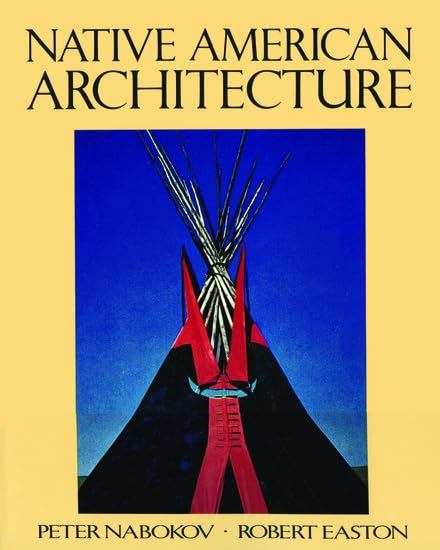
Title
Native American Architecture
Sold by Ergodebooks, an authorized reseller.
Returns accepted within 30 days | support@ergodebooks.com
Shipping Information
- Free Standard Shipping — United States only
- Processing Time: 3–5 business days
- Estimated Delivery: 6–10 business days after dispatch
- Double-boxed, fully insured & discreetly packaged
- Tracking number sent via email once dispatched
Returns & Refund
Returns accepted within 30 days of delivery.
Damaged or Defective Item
Free return shipping + replacement or full refund
Wrong Item Received
Free return shipping + replacement or full refund
Change of Mind
Return shipping at customer's expense · 25% restocking fee applies
Payment Option

For Many People, Native American Architecture Calls To Mind The Wigwam, Tipi, Iglu, And Pueblo. Yet The Richly Diverse Building Traditions Of Native Americans Encompass Much More, Including Specific Structures For Sleeping, Working, Worshipping, Meditating, Playing, Dancing, Lounging, Giving Birth, Decisionmaking, Cleansing, Storing And Preparing Food, Caring For Animals, And Honoring The Dead. In Effect, The Architecture Covers All Facets Of Indian Life.The Collaboration Between An Architect And An Anthropologist, Native American Architecture Presents The First Booklength, Fully Illustrated Exploration Of North American Indian Architecture To Appear In Over A Century. Peter Nabokov And Robert Easton Together Examine The Building Traditions Of The Major Tribes In Nine Regional Areas Of The Continent From The Huge Plankhouse Villages Of The Northwest Coast To The Moundbuilder Towns And Temples Of The Southeast, To The Navajo Hogans And Adobe Pueblos Of The Southwest. Going Beyond A Traditional Survey Of Buildings, The Book Offers A Broad, Clear View Into The Native American World, Revealing A New Perspective On The Interaction Between Their Buildings And Culture. Looking At Native American Architecture As More Than Buildings, Villages, And Camps, Nabokov And Easton Also Focus On Their Use Of Space, Their Environment, Their Social Mores, And Their Religious Beliefs.Each Chapter Concludes With An Account Of Traditional Indian Building Practices Undergoing A Revival Or In Danger Today. The Volume Also Includes A Wealth Of Historical Photographs And Drawings (Including Sixteen Pages Of Color Illustrations), Architectural Renderings, And Specially Prepared Interpretive Diagrams Which Decode The Sacred Cosmology Of The Principal House Types.
⚠️ WARNING (California Proposition 65):
This product may contain chemicals known to the State of California to cause cancer, birth defects, or other reproductive harm.
For more information, please visit www.P65Warnings.ca.gov.
- Q: How many pages does 'Native American Architecture' have? A: This book has four hundred thirty-two pages. It provides a comprehensive exploration of Native American architectural traditions.
- Q: What are the dimensions of 'Native American Architecture'? A: The dimensions are eleven inches in length, eight and a half inches in height, and zero point eight seven inches in width. These sizes make it a manageable book for reading and display.
- Q: What type of binding does 'Native American Architecture' have? A: The book is available in paperback binding. This makes it lightweight and easy to handle.
- Q: Who are the authors of 'Native American Architecture'? A: The authors are Peter Nabokov and Robert Easton. They provide insights into the diverse building traditions of Native Americans.
- Q: What is the main theme of 'Native American Architecture'? A: The main theme is the exploration of the building traditions of Native Americans across various regions. It delves into the cultural significance of these architectural forms.
- Q: Is 'Native American Architecture' suitable for academic study? A: Yes, it is suitable for academic study. The book presents detailed research and illustrations valuable for students and scholars.
- Q: How should I care for my copy of 'Native American Architecture'? A: To care for your copy, store it in a cool, dry place away from direct sunlight. Avoid bending or folding the pages to maintain its condition.
- Q: Is 'Native American Architecture' safe for children? A: Yes, it is generally safe for older children. However, parental guidance is recommended due to complex themes and historical context.
- Q: What kind of illustrations are included in 'Native American Architecture'? A: The book includes historical photographs, drawings, and sixteen pages of color illustrations. These visuals enhance understanding of Native American architecture.
- Q: Can I use 'Native American Architecture' for teaching purposes? A: Yes, it can be used for teaching. The book's in-depth analysis and rich visuals make it an excellent resource for educators.
- Q: What should I do if 'Native American Architecture' arrives damaged? A: If it arrives damaged, contact the retailer for a return or exchange. Most sellers have policies in place for damaged items.
- Q: Does 'Native American Architecture' cover modern building practices? A: Yes, it discusses traditional practices that are undergoing a revival today. This provides a contemporary perspective on Native American architecture.
- Q: Is there a glossary or index in 'Native American Architecture'? A: Yes, the book includes an index which helps in locating specific topics or tribes discussed throughout the text.
- Q: How is 'Native American Architecture' different from other architecture books? A: This book focuses specifically on Native American structures, intertwining cultural context with architectural analysis, unlike general architecture books.
- Q: Can 'Native American Architecture' be used for cultural studies? A: Yes, it is suitable for cultural studies as it explores the relationship between architecture and Native American life and beliefs.
- Q: Are there any reviews available for 'Native American Architecture'? A: Yes, numerous reviews and critiques can be found online. They often highlight the book's thorough research and beautiful illustrations.