If you have any questions, you are always welcome to contact us. We'll get back to you as soon as possible, withing 24 hours on weekdays.
Customer service
All questions about your order, return and delivery must be sent to our customer service team by e-mail at yourstore@yourdomain.com
Sale & Press
If you are interested in selling our products, need more information about our brand or wish to make a collaboration, please contact us at press@yourdomain.com
Help
If you have any questions, you are always welcome to contact us. We'll get back to you as soon as possible, withing 24 hours on weekdays.
Customer service
All questions about your order, return and delivery must be sent to our customer service team by e-mail at yourstore@yourdomain.com
Sale & Press
If you are interested in selling our products, need more information about our brand or wish to make a collaboration, please contact us at press@yourdomain.com
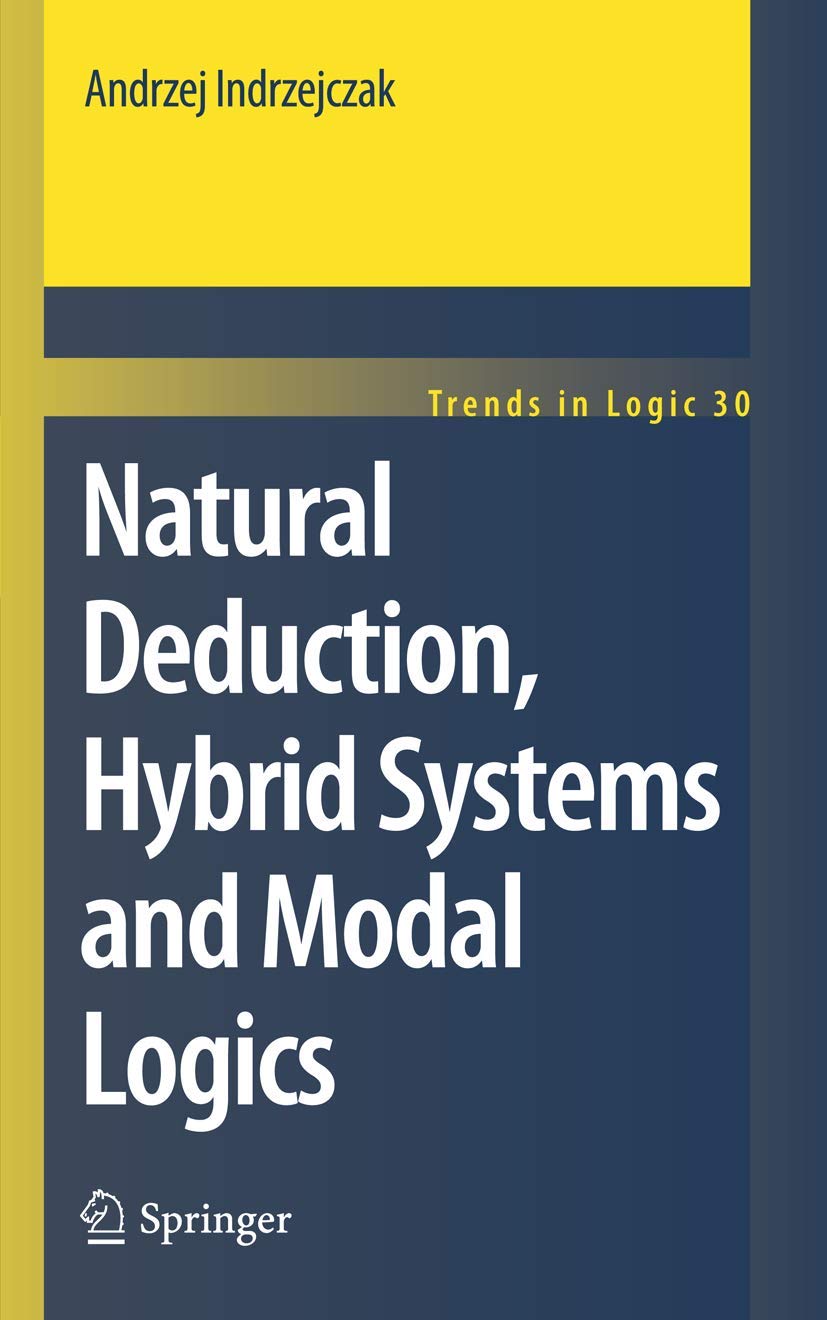
A good title should be informative enough to illuminate a potential reader on the content of a book. We hope that the present title gives at least some hints of what this book is about. The notion of natural deduction or modal logic are rather well known, but the notion of hybrid system certainly needs some explanation. In short, this study may be seen as a kind of search for good deductive systems. We think of systems good in practice which may be applied with easenotonlybywelltrainedlogiciansbutalso, forexample, byphilosophers who need handy deductive tools accompanying their analyses. In parti lar, we are interested in providing systems that may be widely applied in teaching logic. Nowadays one may observe that several courses in critical thinking tend to eliminate courses in practical logic. On the other hand, logic is often taught as a strictly mathematical discipline in very dema ing courses. It is important to ?ll the gap between these extrema, and the crucial ingredient of any course which is supposed to teach how to use logic, is certainly a suitable deductive system. Since we address this work to a wide audience interested in applications of logic, we were trying to make it selfcontained and accessible to a reader with no hard training in logic. The assumed reader should have some ba ground in logic (an elementary course covering classical propositional and ?rstorder logic with basics of set theory is enough) but not necessarily in modal logic.
⚠️ WARNING (California Proposition 65):
This product may contain chemicals known to the State of California to cause cancer,
birth defects, or other reproductive harm.
For MAP (Minimum Advertised Price) violations and Intellectual Property (IP) or Trademark concerns, please contact:
support@ergodebooks.com
⚠️ California Proposition 65 Warning: Some products sold on this website may expose you to chemicals known to the State of California to cause cancer, birth defects, or other reproductive harm. For more information, visit www.P65Warnings.ca.gov.