
Title
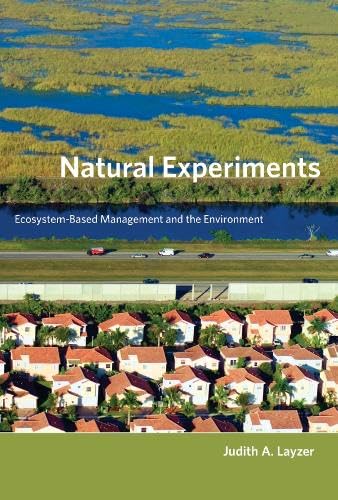
Natural Experiments: EcosystemBased Management and the Environment (American and Comparative Environmental Policy),Used
Sold by Ergodebooks, an authorized reseller.
Returns accepted within 30 days | support@ergodebooks.com
Shipping Information
- Free Standard Shipping — United States only
- Processing Time: 3–5 business days
- Estimated Delivery: 6–10 business days after dispatch
- Double-boxed, fully insured & discreetly packaged
- Tracking number sent via email once dispatched
Returns & Refund
Returns accepted within 30 days of delivery.
Damaged or Defective Item
Free return shipping + replacement or full refund
Wrong Item Received
Free return shipping + replacement or full refund
Change of Mind
Return shipping at customer's expense · 25% restocking fee applies
Payment Option

This systematic assessment of seven prominent initiatives is the first to evaluate the effectiveness of ecosystembased management at protecting the environment.Scholars, scientists, and policymakers have hailed ecosystembased management (EBM) as a remedy for the perceived shortcomings of the centralized, topdown, expertdriven environmental regulatory framework established in the United States in the late 1960s and early 1970s. EBM entails collaborative, landscapescale planning and flexible, adaptive implementation. But although scholars have analyzed aspects of EBM for more than a decade, until now there has been no systematic empirical study of the overall approach. In Natural Experiments, Judith Layzer provides a detailed assessment of whether EBM delivers in practice the environmental benefits it promises in theory. She does this by examining four nationally known EBM initiatives (the Balcones Canyonlands Conservation Program in Austin, Texas, the San Diego Multiple Species Program, the Comprehensive Everglades Restoration Plan, and the California BayDelta Program) and three comparison cases that used more conventional regulatory approaches (Arizona's Sonoran Desert Conservation Plan and efforts to restore Florida's Kissimmee River and California's Mono Basin). Layzer concludes that projects that set goals based on stakeholder collaboration, rather than through conventional politics, are less likely to result in environmental improvement, largely because the pursuit of consensus drives planners to avoid controversy and minimize shortterm costs. Layzer's resolutely practical focus cuts through the ideological and theoretical arguments for and against EBM to identify strategies that hold genuine promise for restoring the ecological resilience of our landscapes.
⚠️ WARNING (California Proposition 65):
This product may contain chemicals known to the State of California to cause cancer, birth defects, or other reproductive harm.
For more information, please visit www.P65Warnings.ca.gov.