
Title
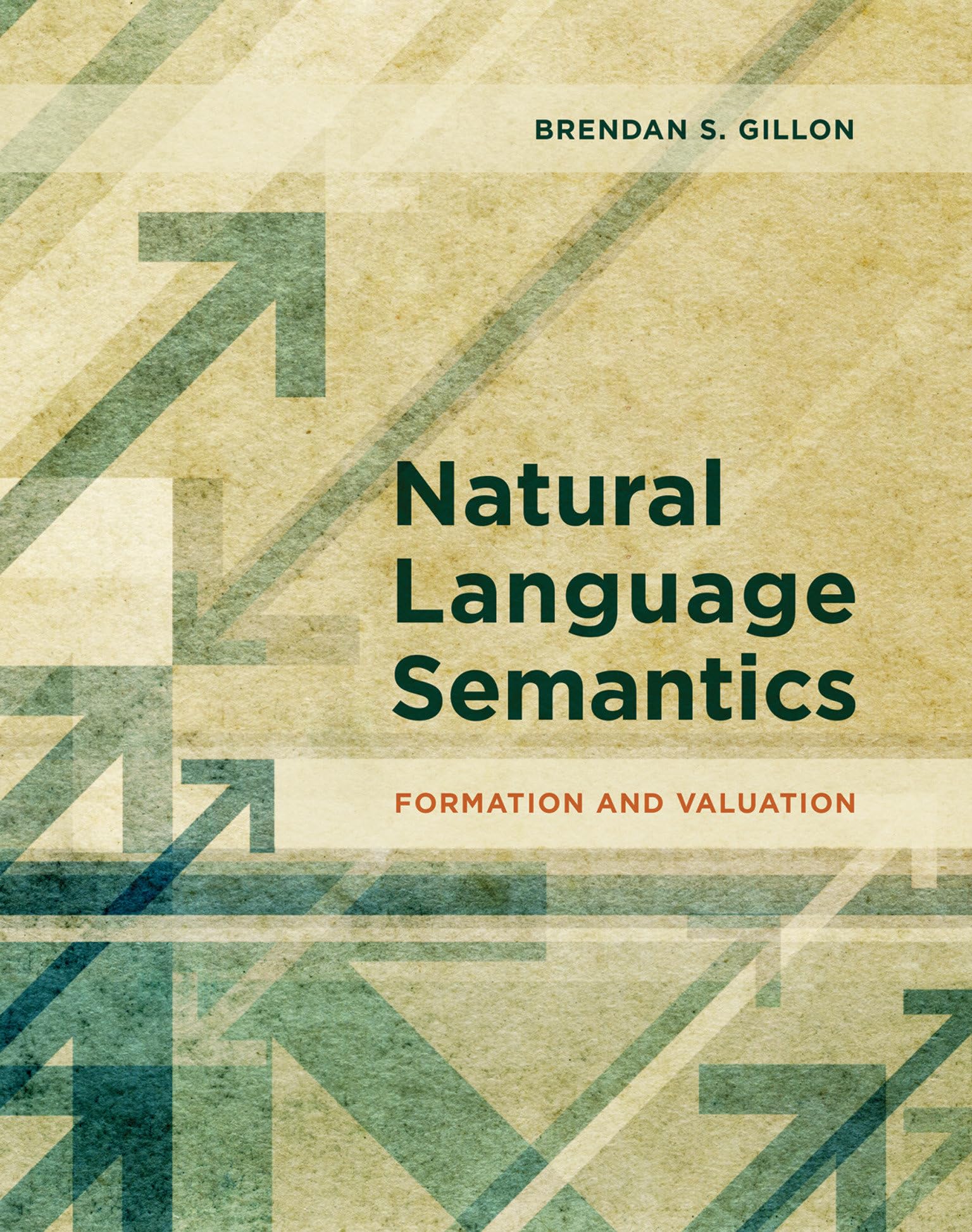
Natural Language Semantics: Formation and Valuation (Mit Press),Used
Sold by Ergodebooks, an authorized reseller.
Returns accepted within 30 days | support@ergodebooks.com
Shipping Information
- Free Standard Shipping — United States only
- Processing Time: 3–5 business days
- Estimated Delivery: 6–10 business days after dispatch
- Double-boxed, fully insured & discreetly packaged
- Tracking number sent via email once dispatched
Returns & Refund
Returns accepted within 30 days of delivery.
Damaged or Defective Item
Free return shipping + replacement or full refund
Wrong Item Received
Free return shipping + replacement or full refund
Change of Mind
Return shipping at customer's expense · 25% restocking fee applies
Payment Option

An introduction to natural language semantics that offers an overview of the empirical domain and an explanation of the mathematical concepts that underpin the discipline.This textbook offers a comprehensive introduction to the fundamentals of those approaches to natural language semantics that use the insights of logic. Many other texts on the subject focus on presenting a particular theory of natural language semantics. This text instead offers an overview of the empirical domain (drawn largely from standard descriptive grammars of English) as well as the mathematical tools that are applied to it. Readers are shown where the concepts of logic apply, where they fail to apply, and where they might apply, if suitably adjusted.The presentation of logic is completely selfcontained, with concepts of logic used in the book presented in all the necessary detail. This includes propositional logic, first order predicate logic, generalized quantifier theory, and the Lambek and Lambda calculi. The chapters on logic are paired with chapters on English grammar. For example, the chapter on propositional logic is paired with a chapter on the grammar of coordination and subordination of English clauses; the chapter on predicate logic is paired with a chapter on the grammar of simple, independent English clauses; and so on.The book includes more than five hundred exercises, not only for the mathematical concepts introduced, but also for their application to the analysis of natural language. The latter exercises include some aimed at helping the reader to understand how to formulate and test hypotheses.
⚠️ WARNING (California Proposition 65):
This product may contain chemicals known to the State of California to cause cancer, birth defects, or other reproductive harm.
For more information, please visit www.P65Warnings.ca.gov.