If you have any questions, you are always welcome to contact us. We'll get back to you as soon as possible, withing 24 hours on weekdays.
Customer service
All questions about your order, return and delivery must be sent to our customer service team by e-mail at yourstore@yourdomain.com
Sale & Press
If you are interested in selling our products, need more information about our brand or wish to make a collaboration, please contact us at press@yourdomain.com
Help
If you have any questions, you are always welcome to contact us. We'll get back to you as soon as possible, withing 24 hours on weekdays.
Customer service
All questions about your order, return and delivery must be sent to our customer service team by e-mail at yourstore@yourdomain.com
Sale & Press
If you are interested in selling our products, need more information about our brand or wish to make a collaboration, please contact us at press@yourdomain.com
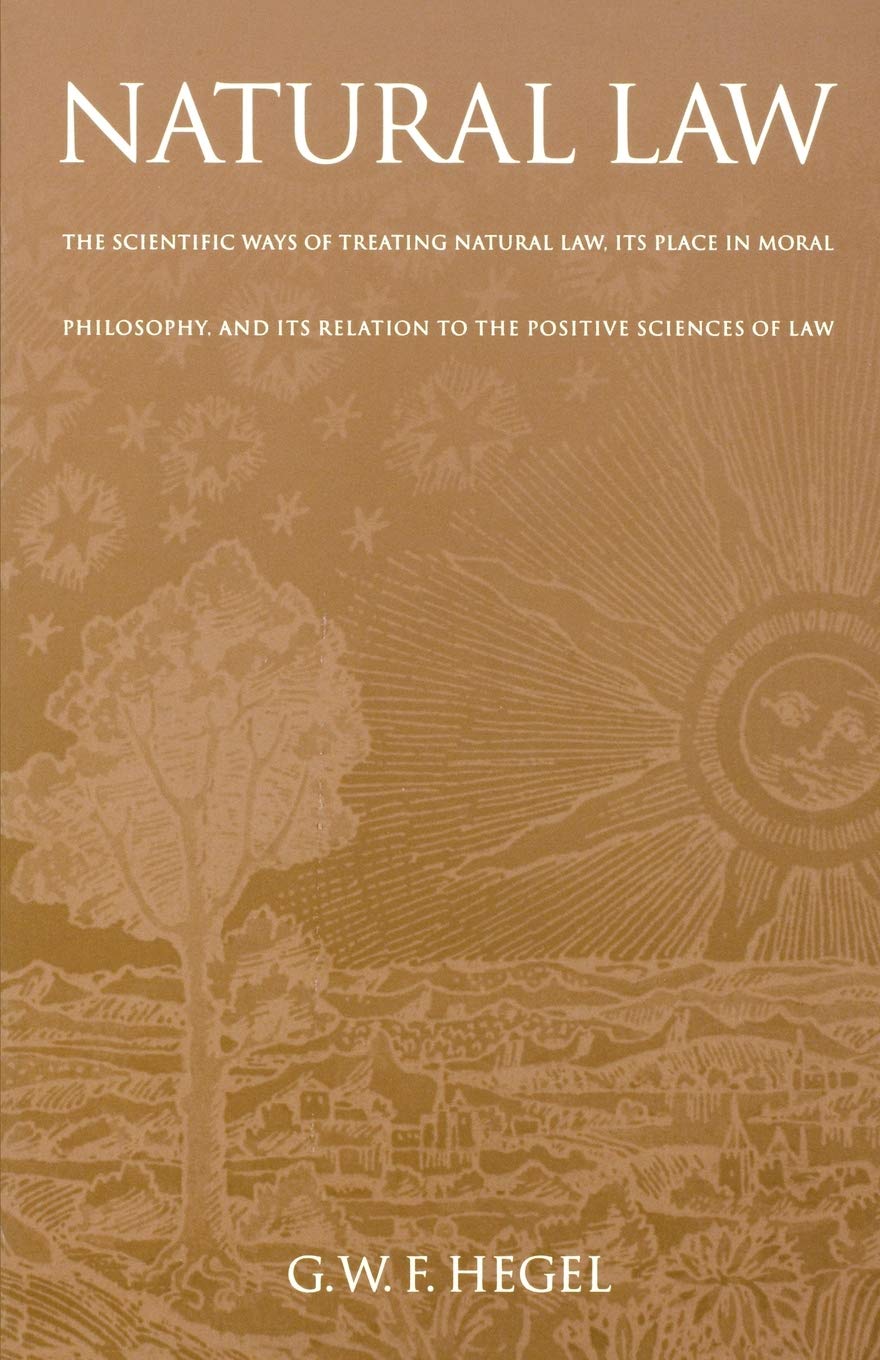
One of the central problems in the history of moral and political philosophy since antiquity has been to explain how human society and its civil institutions came into being. In attempting to solve this problem philosophers developed the idea of natural law, which for many centuries was used to describe the system of fundamental, rational principles presumed universally to govern human behavior in society. By the eighteenth century the doctrine of natural law had engendered the related doctrine of natural rights, which gained reinforcement most famously in the American and French revolutions. According to this view, human society arose through the association of individuals who might have chosen to live alone in scattered isolation and who, in coming together, were regarded as entering into a social contract.In this important early essay, first published in English in this definitive translation in 1975 and now returned to print, Hegel utterly rejects the notion that society is purposely formed by voluntary association. Indeed, he goes further than this, asserting in effect that the laws brought about in various countries in response to force, accident, and deliberation are far more fundamental than any law of nature supposed to be valid always and everywhere. In expounding his view Hegel not only dispenses with the empiricist explanations of Hobbes, Hume, and others but also, at the heart of this work, offers an extended critique of the socalled formalist positions of Kant and Fichte.
⚠️ WARNING (California Proposition 65):
This product may contain chemicals known to the State of California to cause cancer,
birth defects, or other reproductive harm.
For MAP (Minimum Advertised Price) violations and Intellectual Property (IP) or Trademark concerns, please contact:
support@ergodebooks.com
⚠️ California Proposition 65 Warning: Some products sold on this website may expose you to chemicals known to the State of California to cause cancer, birth defects, or other reproductive harm. For more information, visit www.P65Warnings.ca.gov.