
Title
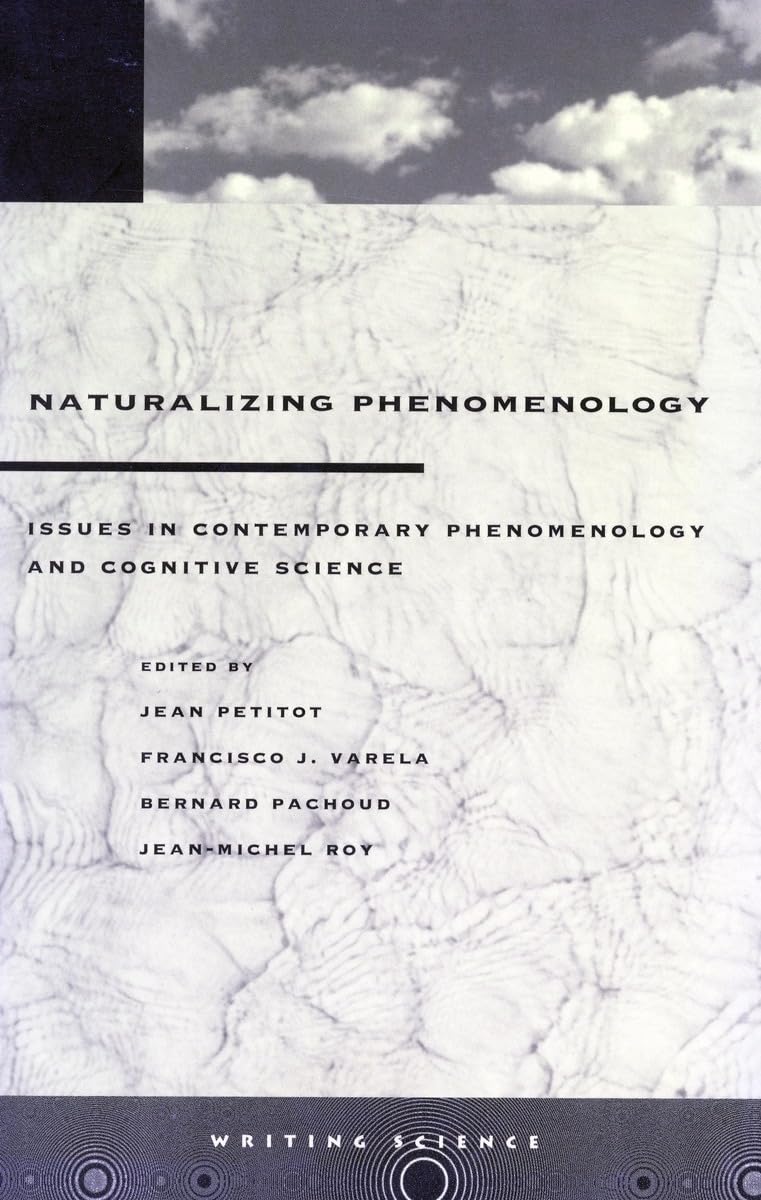
Naturalizing Phenomenology: Issues in Contemporary Phenomenology and Cognitive Science (Writing Science),Used
Sold by Ergodebooks, an authorized reseller.
Returns accepted within 30 days | support@ergodebooks.com
Shipping Information
- Free Standard Shipping — United States only
- Processing Time: 3–5 business days
- Estimated Delivery: 6–10 business days after dispatch
- Double-boxed, fully insured & discreetly packaged
- Tracking number sent via email once dispatched
Returns & Refund
Returns accepted within 30 days of delivery.
Damaged or Defective Item
Free return shipping + replacement or full refund
Wrong Item Received
Free return shipping + replacement or full refund
Change of Mind
Return shipping at customer's expense · 25% restocking fee applies
Payment Option

This ambitious work aims to shed new light on the relations between Husserlian phenomenology and the presentday efforts toward a scientific theory of cognitionwith its complex structure of disciplines, levels of explanation, and conflicting hypotheses.The books primary goal is not to present a new exegesis of Husserls writings, although it does not dismiss the importance of such interpretive and critical work. Rather, the contributors assess the extent to which the kind of phenomenological investigation Husserl initiated favors the construction of a scientific theory of cognition, particularly in contributing to specific contemporary theories either by complementing or by questioning them. What clearly emerges is that Husserlian phenomenology cannot become instrumental in developing cognitive science without undergoing a substantial transformation. Therefore, the central concern of this book is not only the progress of contemporary theories of cognition but also the reorientation of Husserlian phenomenology.Because a single volume could never encompass the numerous facets of this dual aim, the contributors focus on the issue of naturalization. This perspective is farreaching enough to allow for the coverage of a great variety of topics, ranging from general structures of intentionality, to the nature of the founding epistemological and ontological principles of cognitive science, to analyses of temporality and perception and the mathematical modeling of their phenomenological description.This book, then, is a collective reflection on the possibility of utilizing a naturalized Husserlian phenomenology to contribute to a scientific theory of cognition that fills the explanatory gap between the phenomenological mind and brain.
⚠️ WARNING (California Proposition 65):
This product may contain chemicals known to the State of California to cause cancer, birth defects, or other reproductive harm.
For more information, please visit www.P65Warnings.ca.gov.