
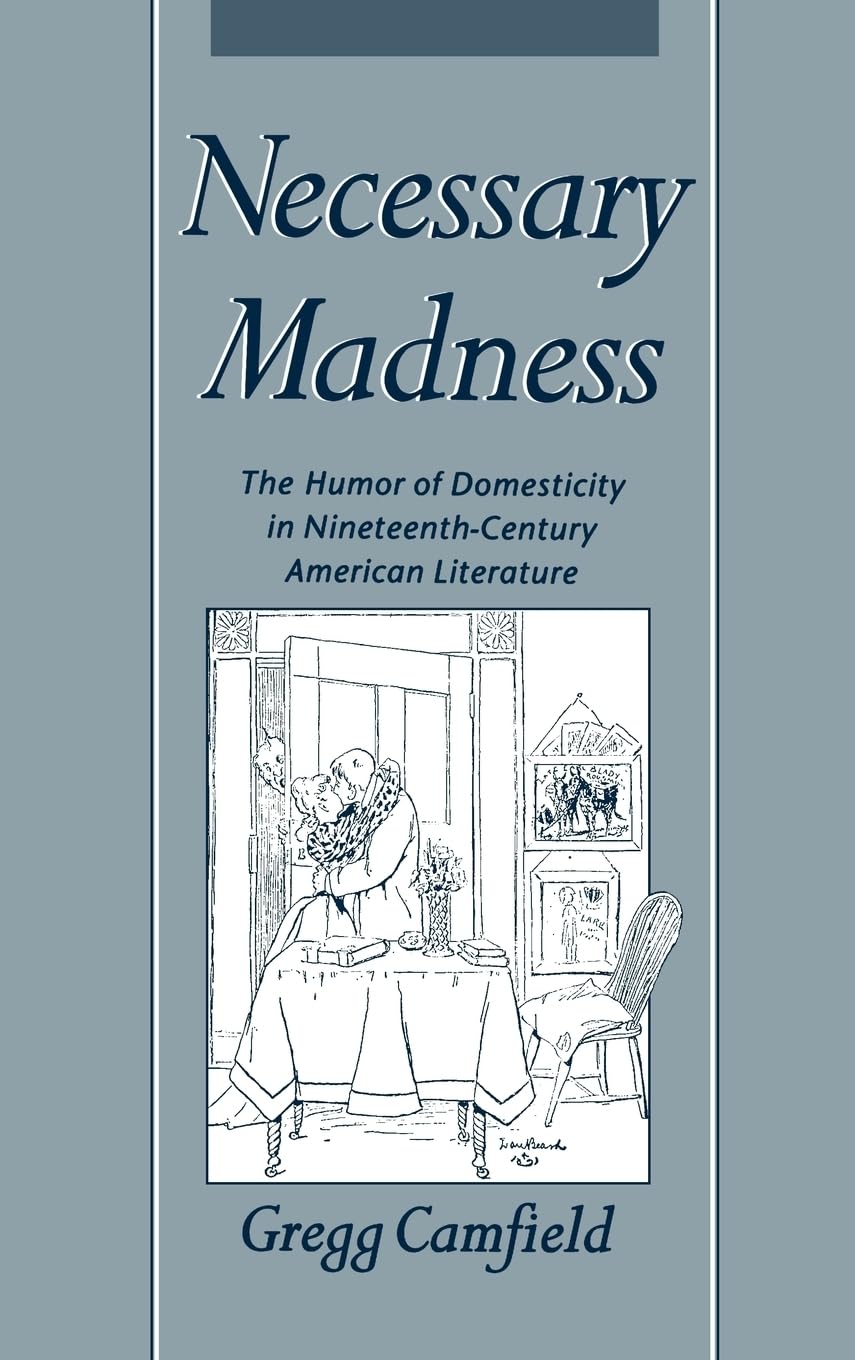
Title
Necessary Madness: The Humor Of Domesticity In Nineteenthcentury American Literature
Sold by Ergodebooks, an authorized reseller.
Returns accepted within 30 days | support@ergodebooks.com
Shipping Information
- Free Standard Shipping — United States only
- Processing Time: 3–5 business days
- Estimated Delivery: 6–10 business days after dispatch
- Double-boxed, fully insured & discreetly packaged
- Tracking number sent via email once dispatched
Returns & Refund
Returns accepted within 30 days of delivery.
Damaged or Defective Item
Free return shipping + replacement or full refund
Wrong Item Received
Free return shipping + replacement or full refund
Change of Mind
Return shipping at customer's expense · 25% restocking fee applies
Payment Option

In this rich, exciting new book, Gregg Camfield explores nineteenthcentury American humor from the perspective of gender and domestic ideology, challenging recent theory asserting a broad gulf between men's and women's humor during the period and contributing vital new insights to the study of humor in general.Capturing in part I a vision of humor unique to the era, Camfield examines the period's faith in what was called 'amiable humor,' a genial and supple comic mode whose non aggression makes it resist easy assimilation to theories stressing humor's basis in hostility, negation, rage, and other combative or displaced energies. Seeking to illuminate this distinct comedy, Camfield probes a related, central cultural strandthe domesticity idealthat so often is a subject of this humor, carefully tracking contact between the two discourses and identifying their common social and intellectual roots. Turning next to four literary casestudies powerfully revealing of this contact, Camfield in part II pairs male and female humoristsWashington Irving and Fanny Fern; Harriet Beecher Stowe and Herman Melville; Mark Twain and Marietta Holley; and George Washington Harris and Mary Wilkins Freemannot only to demonstrate the way these influential writers approach domesticity with genial humor, but also to support his claim that gender difference does not always correlate to differences in viewpoint and practice within this common style. Where many argue nineteenth century women's humor constitutes a genre unto itself, Camfield finds that like women, men filtered reaction to the constraints and opportunities of home life through genial comedy, and that women, like their male counterparts, wrote humor marked by extravagance, expansion, caricature, fantasy, and posturing. Broadening out to an intriguing consideration of humor theory in part III, Camfield draws on recent work in psychology, culture studies, neopragmatist philosophy, and neuroscience to model a compelling alternative view of humor capable of negotiating both the complexities of nineteenthcentury American humor and the comic art of periods before and since. Students and scholars of humor, nineteenthcentury American literature and culture, and women's writing, will find Necessary Madness to be a provocative, essential achievement.
⚠️ WARNING (California Proposition 65):
This product may contain chemicals known to the State of California to cause cancer, birth defects, or other reproductive harm.
For more information, please visit www.P65Warnings.ca.gov.